
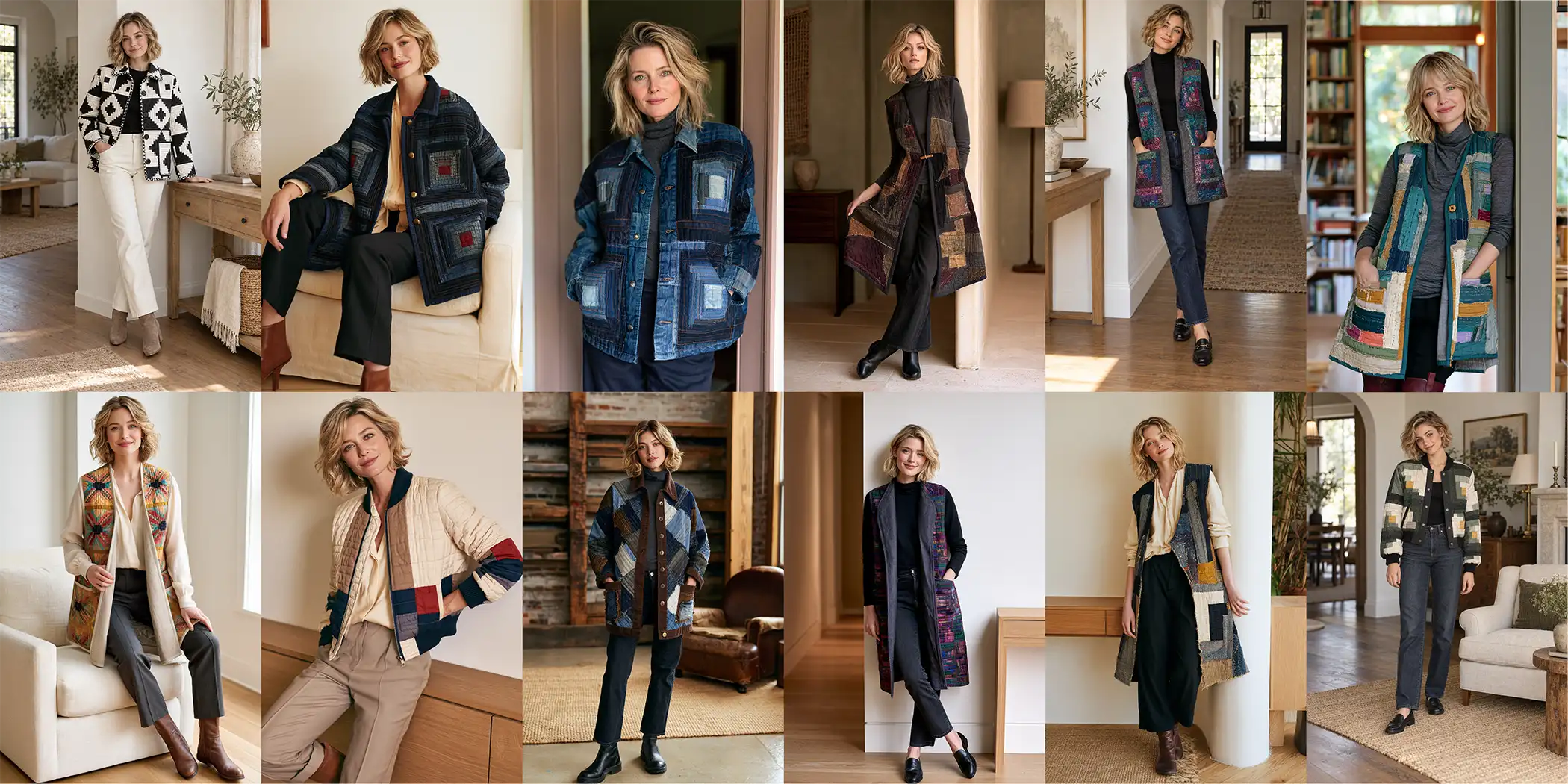
Log Cabin Quilt Jacket, Coat, and Vest Ideas: From Cropped Bombers to Longline Coats
A Log Cabin Quilt Jacket, Coat, and Vest starts with one of the most recognizable construction sequences in quilting — strips of fabric added outward from a central square in successive rounds — and brings it into the garment world, where the block’s geometry interacts with shoulders, lapels, hemlines, and silhouette in ways that a flat quilt never has to consider.
What gives Log Cabin patchwork its particular power in a garment context is that the secondary patterns it produces — the large diamonds of a Barn Raising arrangement, the diagonal bands of Straight Furrows, the tiered horizontal lines of Courthouse Steps — are scale-dependent in a way that changes entirely between a longline coat and a cropped bomber. The same block construction looks completely different at different sizes and in different settings, which is what makes the twelve pieces here visually distinct even though they share the same underlying technique.
Log Cabin Quilt Jacket, Coat, and Vest
Readers will find a genuinely broad range of interpretations across these designs, from precise and tailored to deliberately loose and improvisational. A tailored black-and-white Courthouse Steps blazer with micro-pieced blocks sits at one end; a wonky swing vest with asymmetric blocks, raw edges, and visible mending sits at the other.
Between them are denim chore jackets with mixed-wash indigo strips, plaid flannel shackets, belted trench coats where the Straight Furrows layout runs across wide lapels and structured panels, reversible vests with scrappy patchwork on one face and quiet solid linen on the other, and hooded cocoon coats with oversized geometric blocks scaled to match the generosity of the silhouette. Some pieces are built for cold weather, others are light enough for transitional seasons; some use reclaimed denim and vintage fabric, others use new cotton chosen for color and contrast.
See also: Jelly Roll Quilted Jackets and Vests – Farmhouse Quilt Jackets & Vests – Sashiko Quilt Jackets and Vests – Fall Quilted Jacket and Vest – Nakshi Kantha Jackets and Vests
Why Make This Type of Garment
Strip piecing is one of the most efficient quilting techniques — adding fabric in rounds around a center is fast, uses narrow pieces that might otherwise have no home, and is infinitely adjustable in strip width and block scale. A jacket or coat benefits from all of that directly: it requires less total fabric than a bed quilt, smaller pieces contribute meaningfully, and you can adjust the block size to suit the garment’s proportions without changing the method.
For quilters who have already made Log Cabin quilts and understand how the light-dark arrangement creates secondary patterns, adapting that understanding to a garment mostly comes down to planning block placement relative to the pattern pieces before cutting. The strip-piecing skills are the same; what changes is the need to consider where seam lines will fall and how the visual layout behaves across a three-dimensional shape rather than a flat surface.
What Makes These Designs Different
Log Cabin construction is defined by its additive structure: fabric strips are sewn around a central square in successive rounds, and the visual character of the finished block is produced by the contrast between the values — the lights and darks — assigned to different strip positions. That contrast creates secondary geometric patterns when multiple blocks are arranged together, and those patterns change completely depending on the arrangement: a Barn Raising setting produces large concentric diamonds, Straight Furrows produces diagonal bands, and Courthouse Steps — a related variation where strips are added in parallel pairs on opposite sides rather than in a rotating sequence — produces a more architectural, horizontal-and-vertical character.
What distinguishes Log Cabin garments from general patchwork outerwear is that these secondary patterns need to be planned in relation to the garment itself, not just the block grid. A Barn Raising diamond centered on a flat quilt can be lost or split by a front opening; a Straight Furrows layout that runs coherently across a coat back may need adjustment at the side seams. The design work lies in reconciling the block geometry with the garment pattern, a different challenge from flat quilting or conventional garment construction alone.
Tips for Choosing Fabrics
The most important fabric decision in a Log Cabin garment is consistency within each value group. The secondary patterns that make Log Cabin construction visually effective depend on light strips reading as clearly lighter than dark strips, and in a garment that consistency needs to hold across every block in every panel — not just in the fabric samples on a table. Mixed denim in different washes, for example, can drift in value from piece to piece, softening the contrast and muddying the Barn Raising or Straight Furrows layout. Where that’s intentional, as in the denim chore jacket, it’s a design choice; where it’s accidental, it undermines the whole effect.
For fabric weight, mid-weight quilting cotton is the most reliable base material for accurate strip piecing, but it can feel stiff in a garment if the batting is also substantial. For flowing silhouettes — kimono jackets, longline dusters, swing vests — consider using chambray, cotton-lawn, or lightweight linen for some or all strips, which drapes better on the body than crisp quilting cotton. Flannel, used in the shacket designs, shrinks noticeably more than cotton, so prewash it twice before cutting. Whatever the fabric, keep the middle layer low-loft: high-loft batting creates bulk at every seam intersection, and Log Cabin construction has considerably more seam intersections than a simple patchwork grid.
Color and Fabric Planning
Color planning needs change significantly depending on the Log Cabin layout the garment uses, and treating them all the same produces predictable results. For Barn Raising, the light-dark split needs to be high-contrast and consistent — the whole point is the large diamond that emerges from the arrangement, and softer value differences will read as a diffused, directionless surface rather than a clear geometric. Straight Furrows is slightly more forgiving of tonal variation because the directional bands give the eye somewhere to move even when individual strips don’t contrast sharply.
Courthouse Steps, particularly at small scale, benefits from very controlled palettes — the black-and-white micro-pieced blazer in this collection works precisely because there are only two values and no ambiguity about which is which. At the other end of the range, the scrappy reversible vest and the wonky swing vest deliberately loosen the value logic — scrappy works because repeated accent colors connect disparate prints, and wonky works because the construction itself signals that precision isn’t the goal. Planning color by layout type rather than by personal preference produces more consistent results.
Common Mistakes to Avoid When Sewing
The most common mistake in Log Cabin garment construction is not accounting for how much seam bulk accumulates as you add strips in rounds. Each additional round adds two seam allowances to the panel, and where the strips from one round meet the strips from another, the intersection creates a multi-layer stack. In a flat quilt, this is managed by pressing; in a garment, those stacks land at specific points on the body — shoulders, underarms, front openings — and can create uncomfortable ridges if not addressed. Grade the seam allowances at intersections in stressed areas, and position pattern pieces on the panel so the thickest intersections fall away from shoulders and armholes rather than directly over them.
A second mistake specific to Log Cabin garments is losing the secondary geometric pattern when cutting garment pieces from the panel. A Barn Raising diamond that reads clearly across a flat panel may be split asymmetrically by the front opening, or the center of a Straight Furrows layout may land in an unexpected place once the pattern is placed.
Plan the relationship between the block layout and the garment pattern pieces before cutting anything — mock up the pattern on the panel with tailor’s chalk or pins to check where the major design lines will fall. Finally, don’t assume wonky or improvisational designs need less planning than precise ones. Raw edges, visible mending, and asymmetric blocks all need deliberate placement and secure fastening; the difference between a considered wonky design and a genuinely messy one comes down to how intentional the placement decisions are.
Branded and Trademarked Fabrics, Logos, and Graphics
The designs throughout this article use generic fabric descriptions — quilting cotton, denim, chambray, flannel, linen — rather than pieces from specific manufacturers, designers, or licensed fabric ranges. When the article references old clothing as source material, it refers to general garment categories rather than specific brands or labels. Readers using their own reclaimed pieces should use their judgment about any branded or trademarked content on those fabrics if they plan to sell or publish the finished garments.
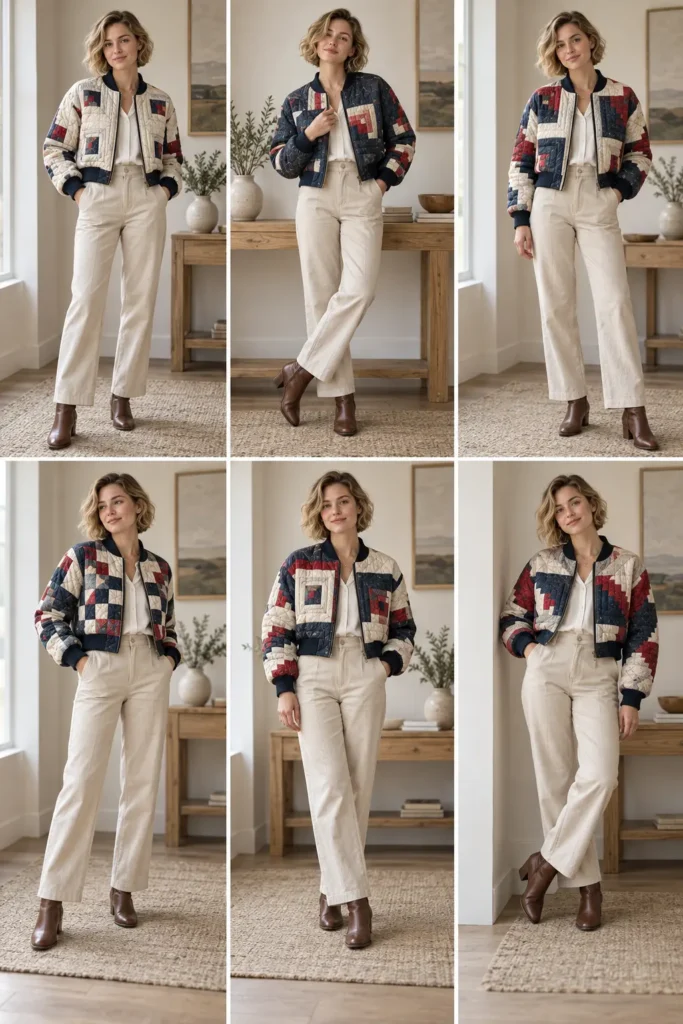
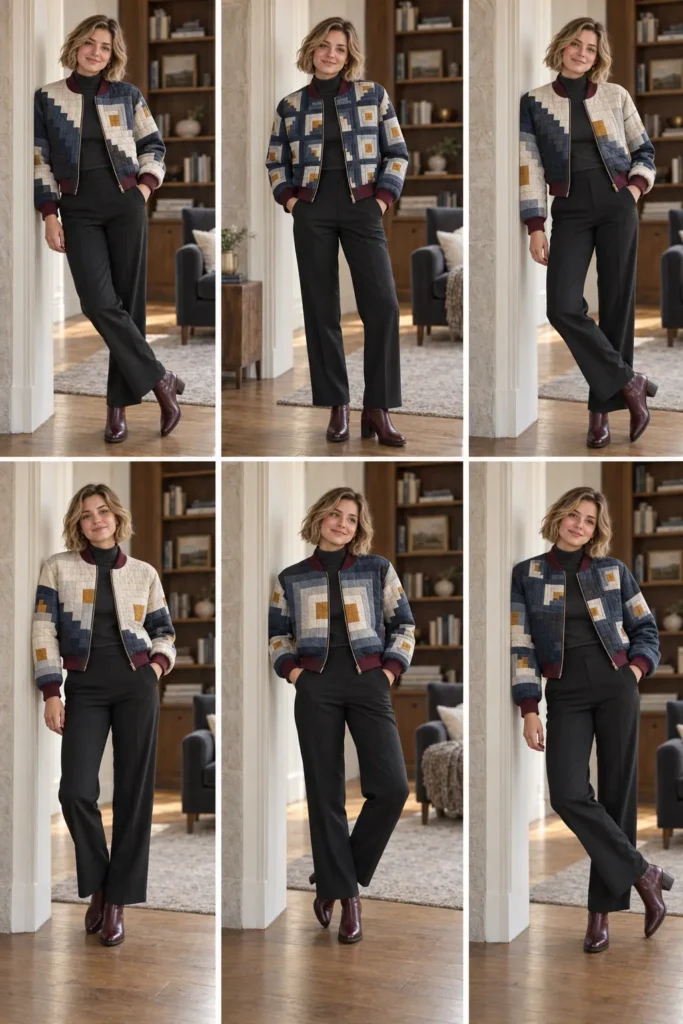
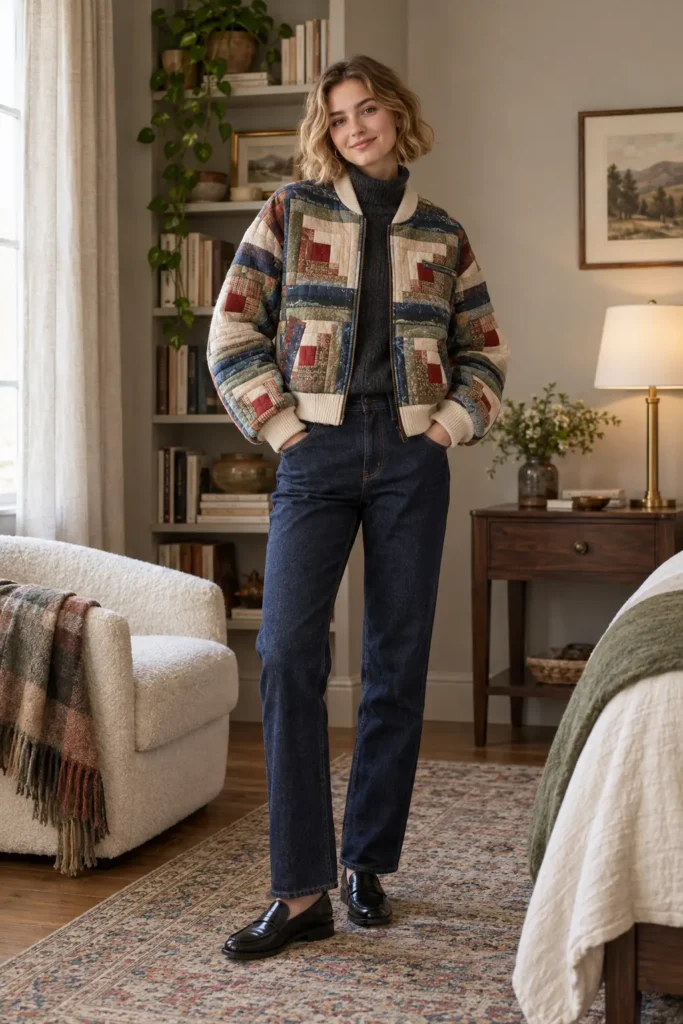
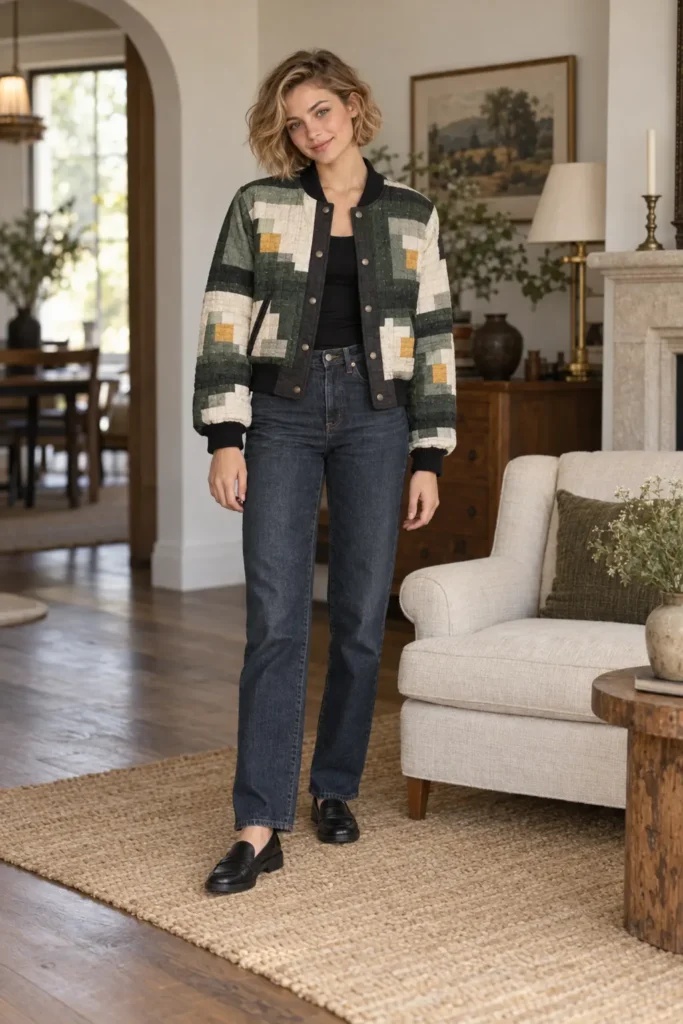
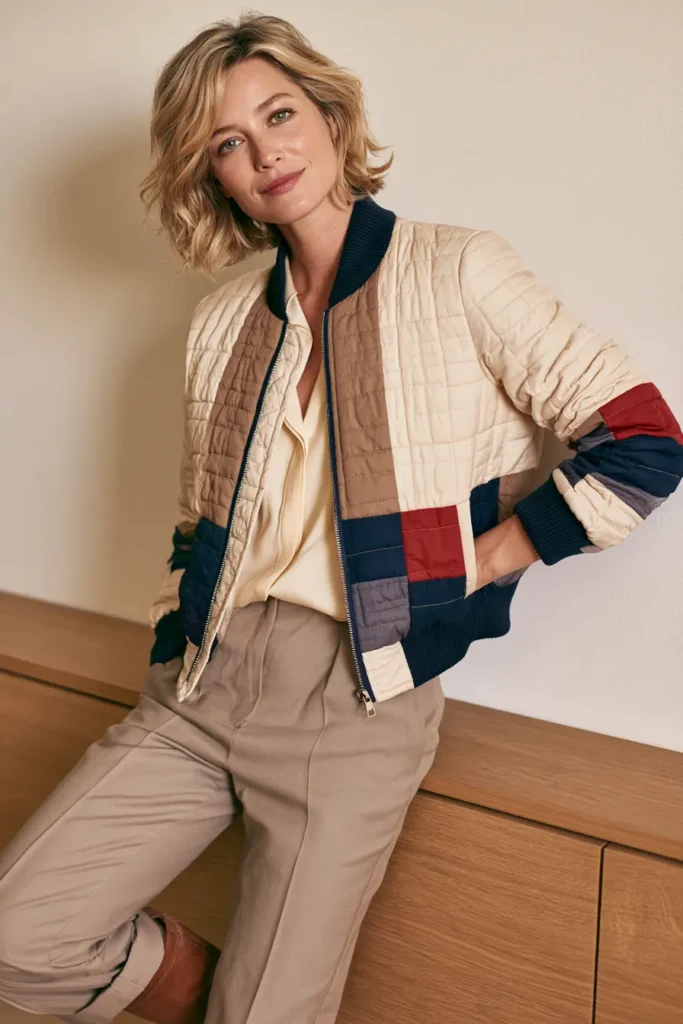
1. Cropped Log Cabin Quilted Bomber Jacket with Classic Light-Dark Blocks and Contrasting Ribbed Edges
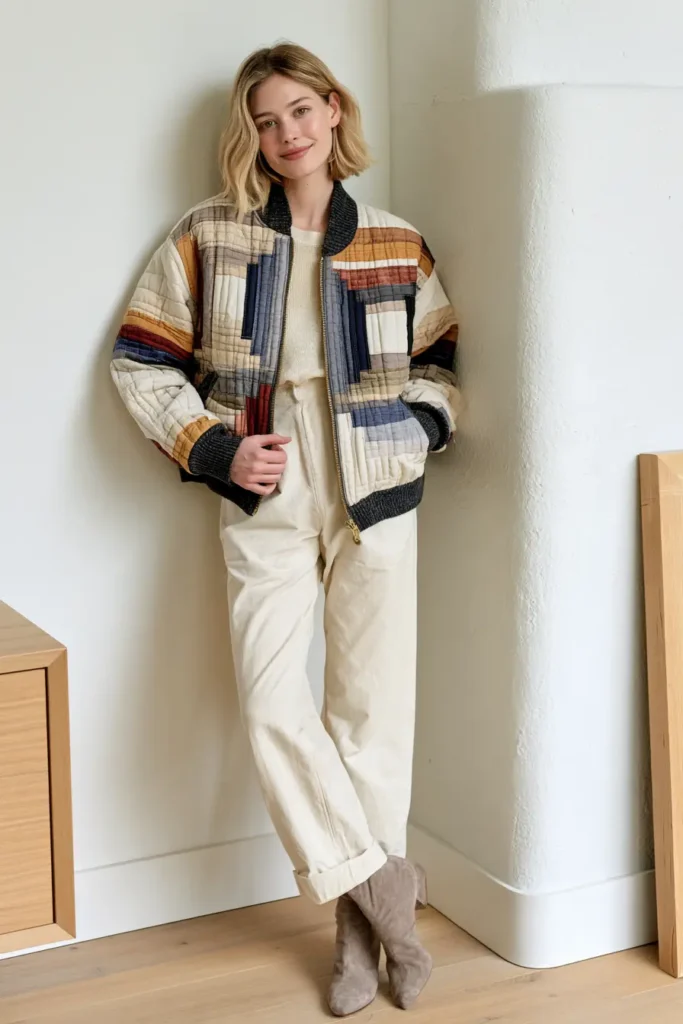
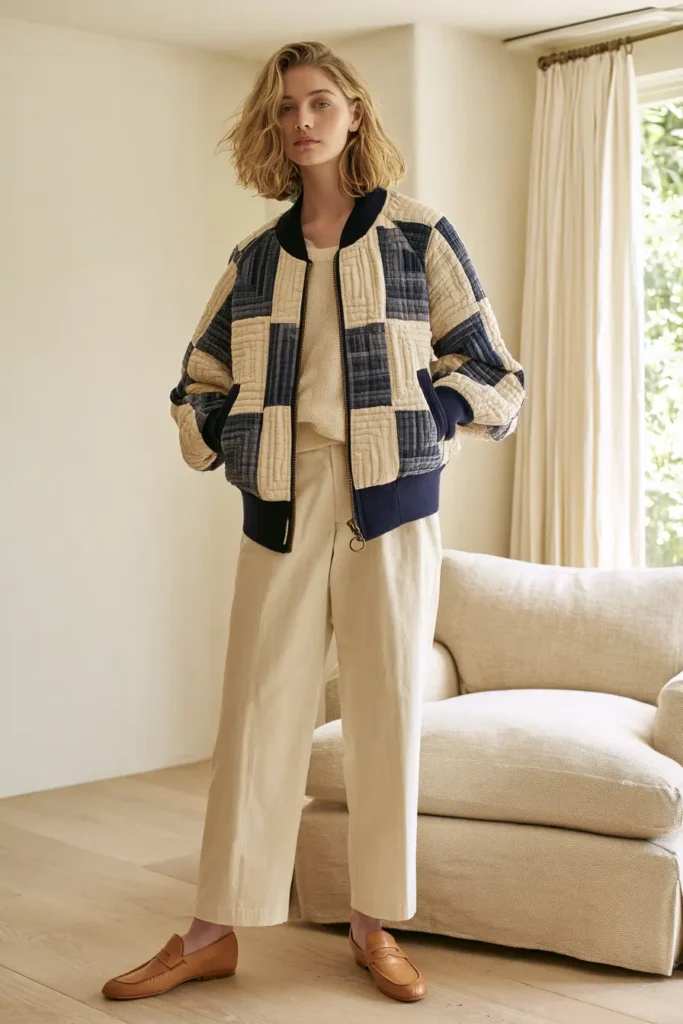
A cropped Log Cabin quilted bomber jacket brings traditional patchwork geometry into a sporty, contemporary silhouette. Its defining feature is the arrangement of light and dark Log Cabin blocks, each constructed from fabric strips surrounding a central square. When the blocks are positioned thoughtfully, contrasting values create rhythmic geometric patterns across the jacket’s front, back, and sleeves. Unlike oversized patchwork coats, this design concentrates its visual detail in a compact, waist-length shape, letting the quilt blocks stay prominent without overwhelming the garment.
The bomber’s contrasting ribbed collar, cuffs, and waistband provide a particularly appealing counterpoint to the structured patchwork. These knitted edges create a clean outline while adding flexibility where movement is needed. A slightly relaxed body, full-length sleeves, and practical front zipper preserve the recognizable bomber silhouette. The mix of traditional strip piecing and athletic-inspired finishing gives this jacket a distinctive character that suits both casual autumn outfits and everyday transitional layering.
Design Inspirations – Digitally Modified Images. Texture and color may vary from the actual product.
Choosing Fabrics and Building Light-Dark Contrast
Strong value contrast is essential to the classic Log Cabin appearance. Consider warm ivory, oatmeal, natural beige, and pale wheat for the light strips, paired with espresso brown, walnut, charcoal, and muted cinnamon for the dark sections. Small rust-red center squares can provide a traditional-inspired accent without dominating the palette.
Stable quilting cotton is particularly suitable because it supports accurate strip piecing and presses cleanly. Subtle woven textures, tiny checks, and understated prints can add variation while preserving each block’s clarity. Avoid combining too many large-scale prints, which may obscure the geometric arrangement.
Block Placement, Quilting, and Ribbed Finishes
Medium-scale Log Cabin blocks work particularly well on a cropped bomber because they remain recognizable across relatively short garment panels. Arrange the blocks so their light-dark divisions form a balanced pattern across the jacket front. Use smaller or repositioned blocks in sleeve panels to accommodate their narrower shape without adding excessive seam intersections.
Lightweight, low-loft batting helps create a softly padded surface without making the jacket unnecessarily stiff. Straight-line or restrained echo quilting can highlight the Log Cabin strips while keeping the jacket flexible.
For the ribbed finishes, deep chocolate, charcoal, or muted burgundy can provide attractive contrast. A rib-knit waistband should sit near the natural waist, complemented by matching cuffs and a short ribbed collar. A central zipper and discreet side-entry pockets complete the bomber’s practical character.
Common Mistakes to Avoid
One common mistake is using fabrics with insufficient light-dark contrast, which can make individual Log Cabin blocks blend together. Another is choosing blocks too large for the cropped silhouette, which can interrupt key geometric details with armholes, seams, or the zipper opening.
Excessive thickness also deserves attention. Multiple patchwork seams, batting, and rib-knit attachments can create bulky areas around cuffs, shoulders, and the waistband. Choose compatible fabric weights, place seams thoughtfully, and avoid overly dense quilting that restricts movement.
Helpful Note: Before committing to the patchwork layout, photograph the arranged blocks in grayscale. This makes it easier to evaluate value contrast independently of color and identify areas where the classic light-dark pattern may lose definition.
Other Design Inspirations – Digitally Modified Images. Texture and color may vary from the actual product.
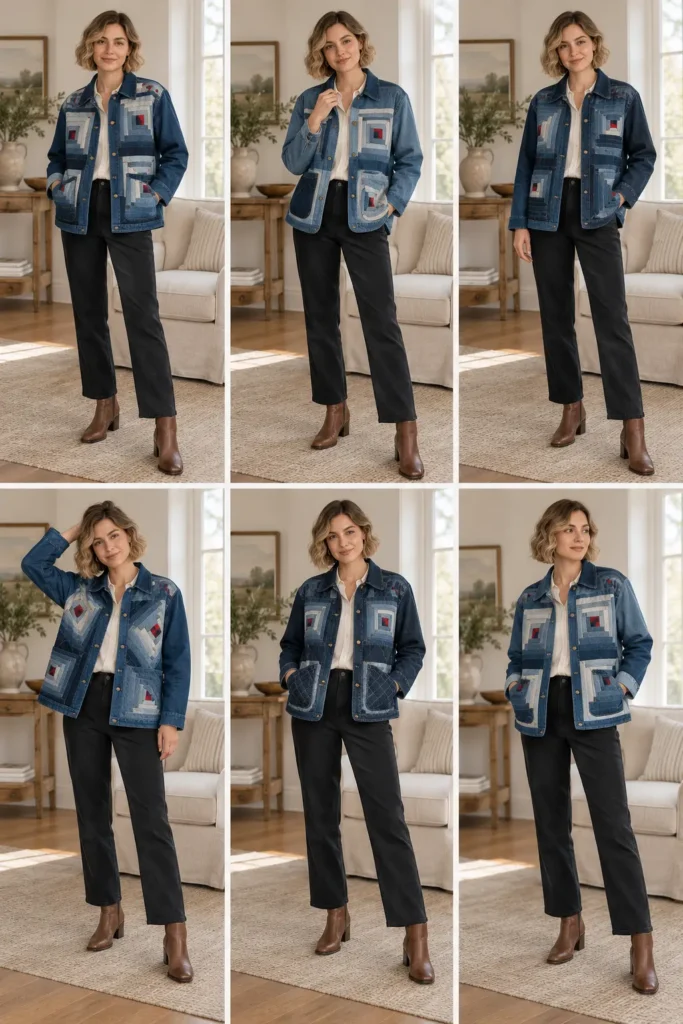
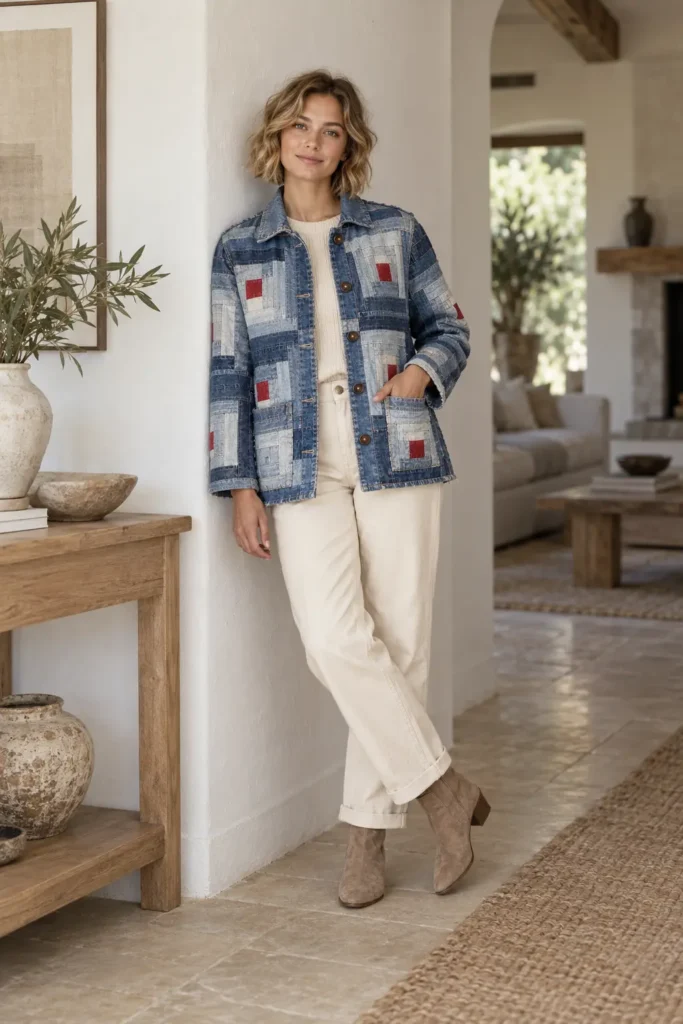
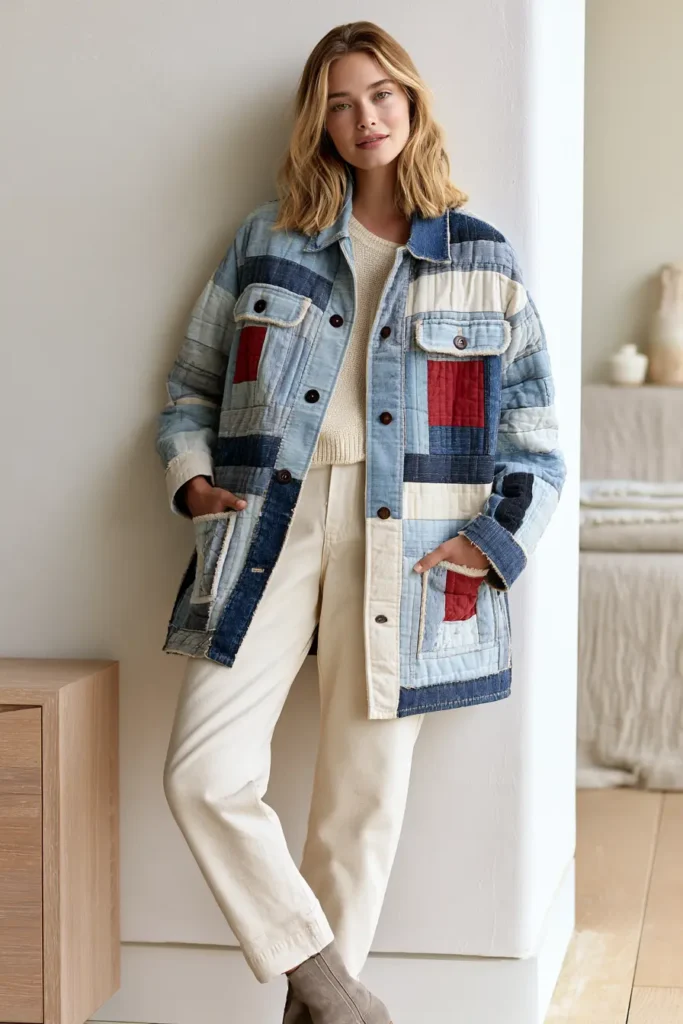
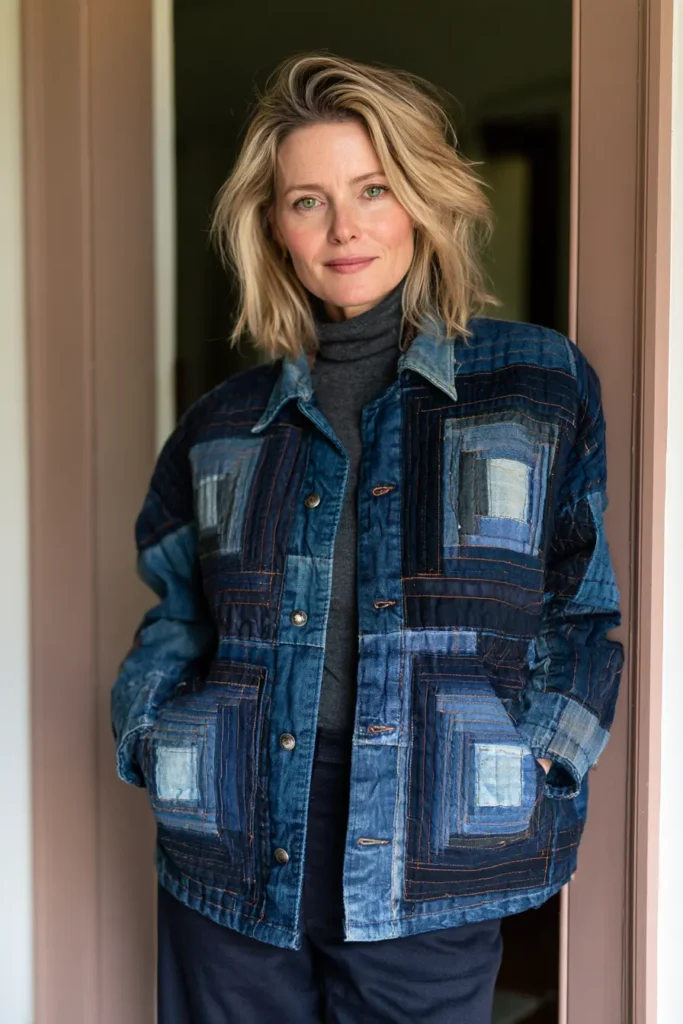
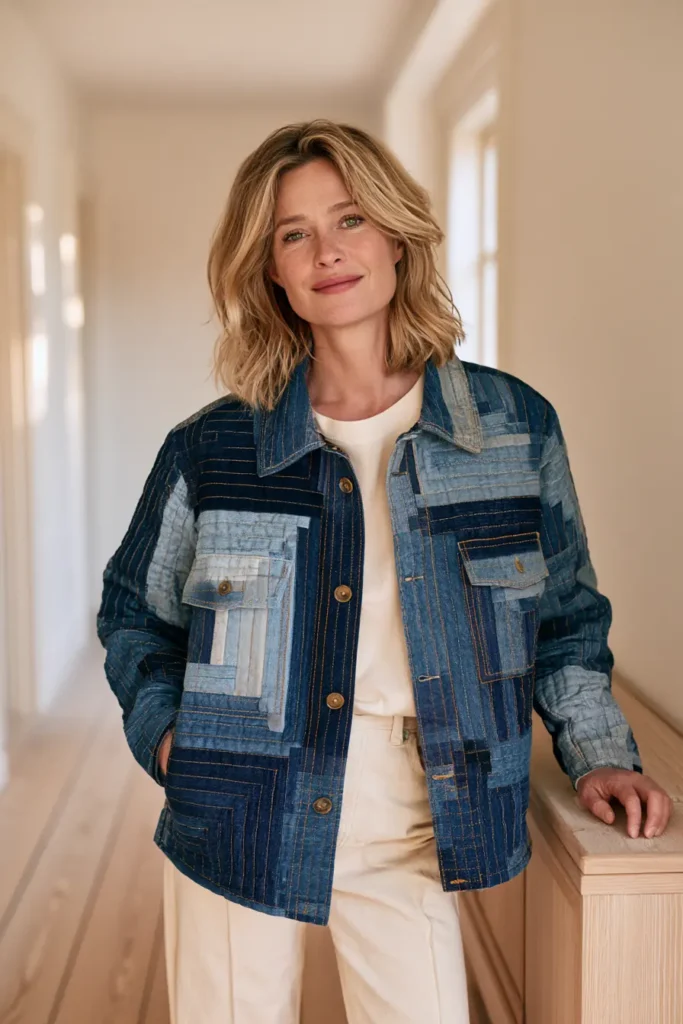
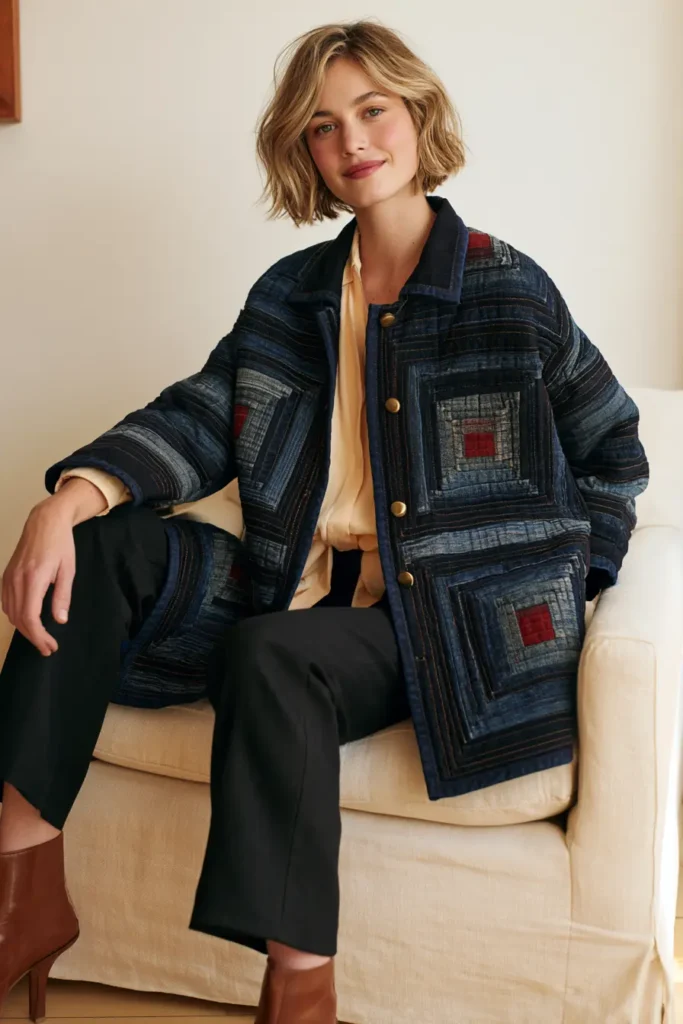
2. Upcycled Denim Log Cabin Quilted Chore Jacket with Mixed-Wash Indigo Strips and Utility Pockets
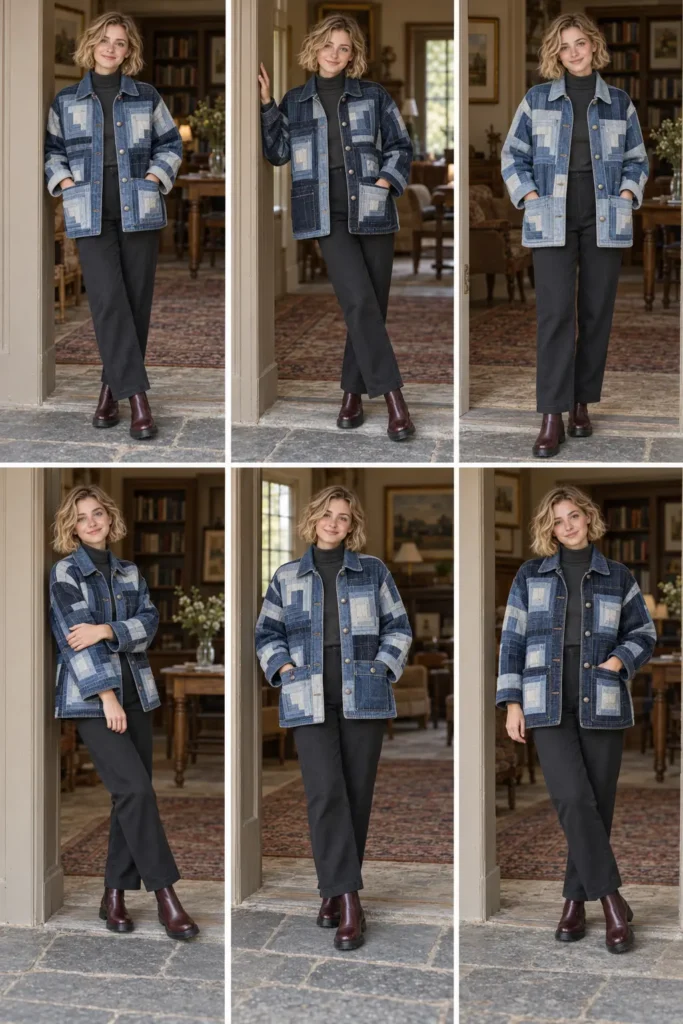
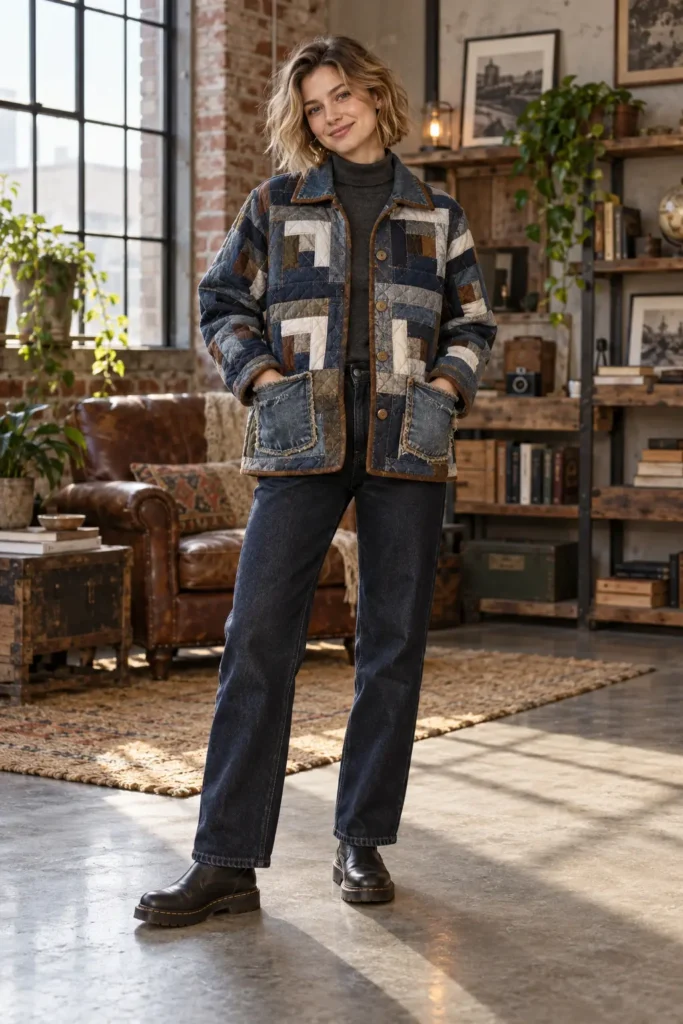
An upcycled denim Log Cabin quilted chore jacket combines the rugged character of traditional workwear with the structured geometry of classic Log Cabin patchwork. Instead of relying on ordinary denim panels, the jacket features individual strips of reclaimed fabric arranged around central squares to form recognizable geometric blocks. Deep indigo, faded navy, washed blue, and pale chambray create a rich, layered appearance, while subtle variations in wear and texture give the patchwork a naturally weathered character.
The relaxed, hip-length silhouette preserves the practical appeal of a traditional chore jacket, with a pointed collar, button-front opening, comfortable sleeves, and generously sized utility pockets. Unlike a decorative denim patchwork jacket assembled from random fabric pieces, this design uses the repeating structure of Log Cabin blocks to organize the different denim washes. Contrasting strips create movement across the garment, while sturdy topstitching and functional pockets reinforce its workwear-inspired identity.
Design Inspirations – Digitally Modified Images. Texture and color may vary from the actual product.
Choosing Reclaimed Denim and Building Indigo Contrast
A successful mixed-wash design depends on combining denim shades with enough contrast to reveal the Log Cabin structure. Consider deep midnight indigo and charcoal-blue for the darkest strips, medium vintage blue and weathered cobalt for transitional tones, and pale stonewashed denim or lightweight chambray for highlights. Alternating these values around selected central squares helps individual blocks remain recognizable.
Choose softened lightweight or medium-weight denim rather than excessively heavy jeans fabric. Reclaimed shirts, suitable denim offcuts, and gently worn jeans can add different textures, but avoid weakened knees, thinning fabric, and unstable areas. Prewash compatible materials and check stretch and thickness differences before combining them.
Arranging Log Cabin Blocks Around Utility Pockets
Medium-scale Log Cabin blocks are particularly effective on the jacket’s broad front and back panels. Their rectangular strips create an orderly geometric pattern without losing the relaxed character of the garment. You can incorporate smaller coordinating blocks into the sleeves, where narrower pattern pieces may interrupt larger arrangements.
Two generous lower-front patch pockets and a smaller chest pocket strengthen the chore-jacket appearance. Consider coordinating their denim washes with the surrounding blocks rather than introducing unrelated colors. Pocket placement should also preserve visibility of key Log Cabin centers and avoid adding unnecessary bulk at major seam intersections.
Quilting Texture, Topstitching, and Common Mistakes
Subtle straight-line or echo quilting can emphasize the rectangular strip arrangements while adding dimension to the denim surface. Lightweight, low-loft batting helps maintain flexibility, while muted copper, tobacco, or faded cream thread can highlight the workwear character through visible topstitching.
The main construction challenge is excessive bulk. Multiple denim strips, seam allowances, batting, and reinforced pockets can make shoulders, armholes, and front closures unnecessarily stiff. Avoid placing thick seam intersections directly beneath pocket corners or collars, and consider carefully graded seams where appropriate.
Helpful Note: When selecting reclaimed denim, reserve softer, thinner pieces for densely pieced Log Cabin blocks and use sturdier fabric for pockets and other high-wear areas. This helps balance flexibility with durability.
Other Design Inspirations – Digitally Modified Images. Texture and color may vary from the actual product.
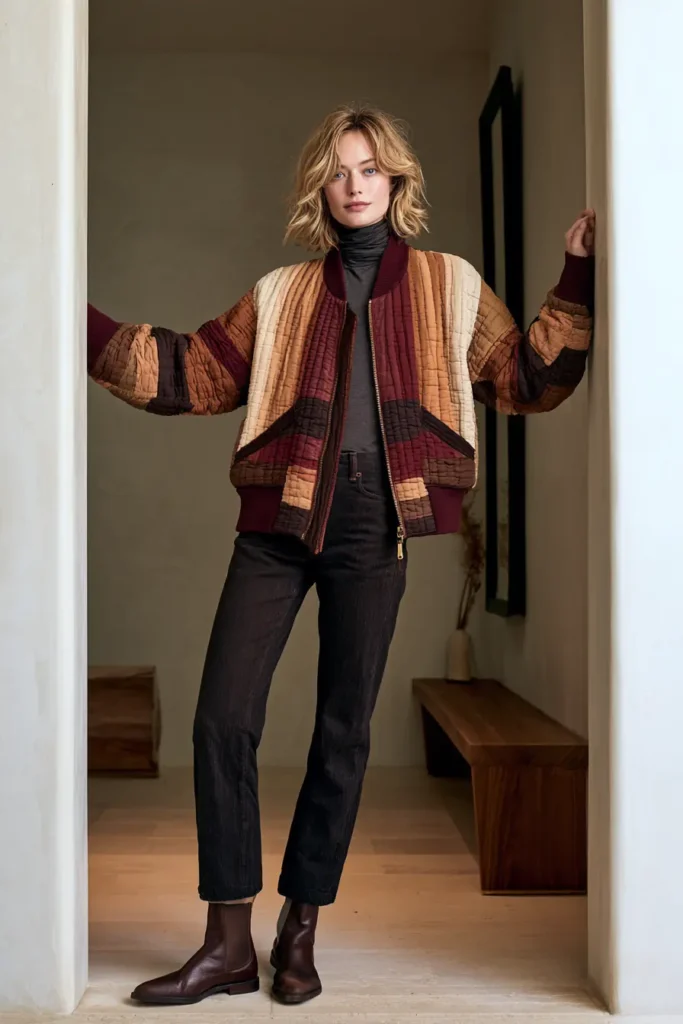
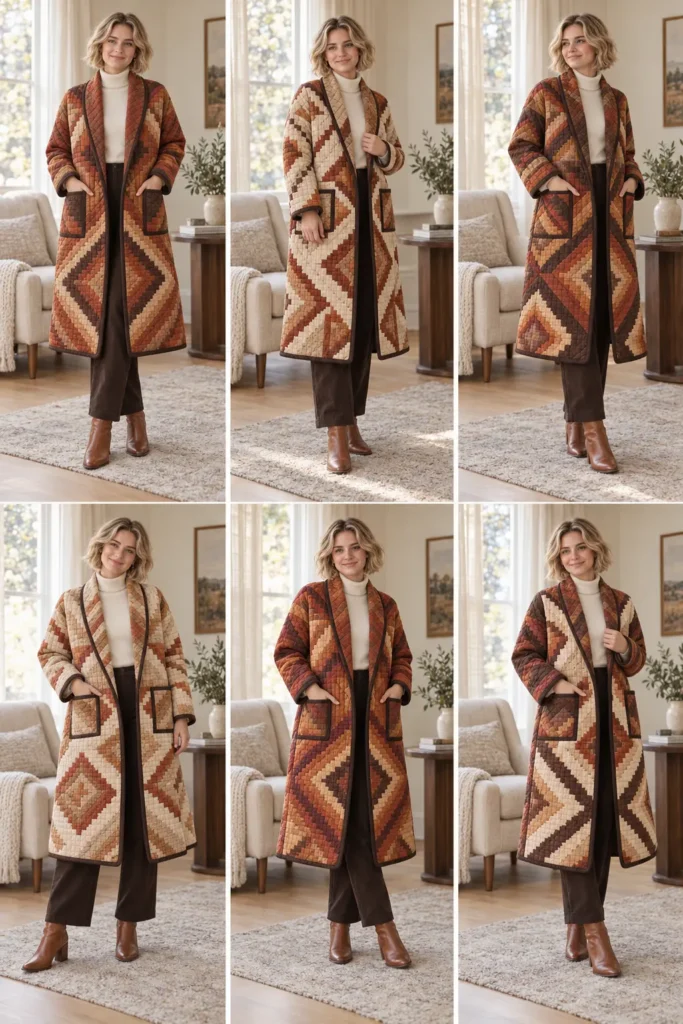
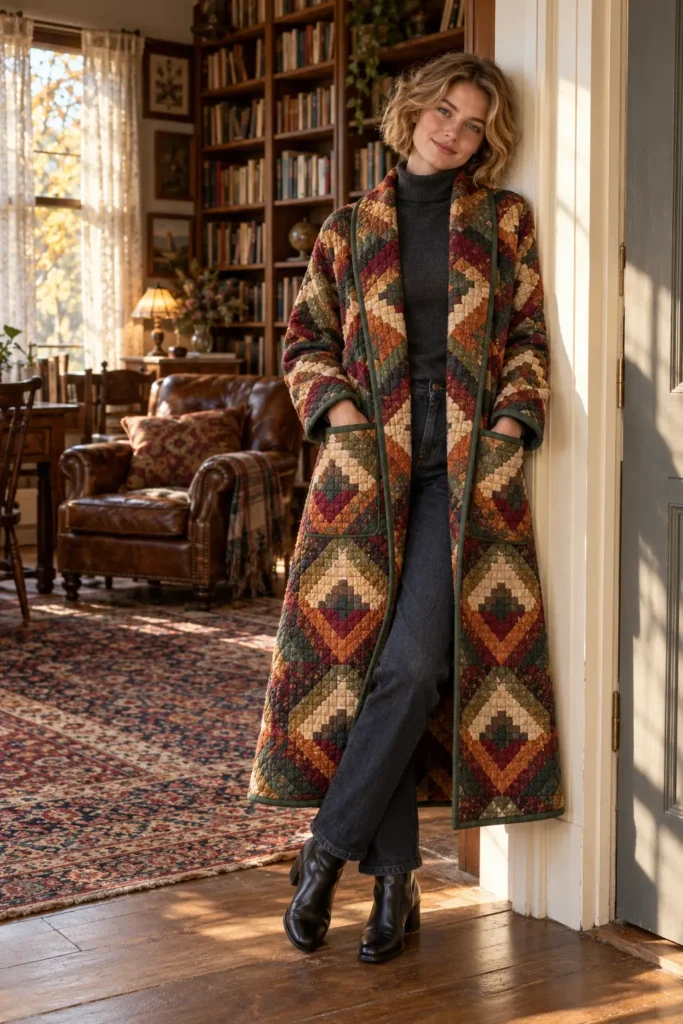
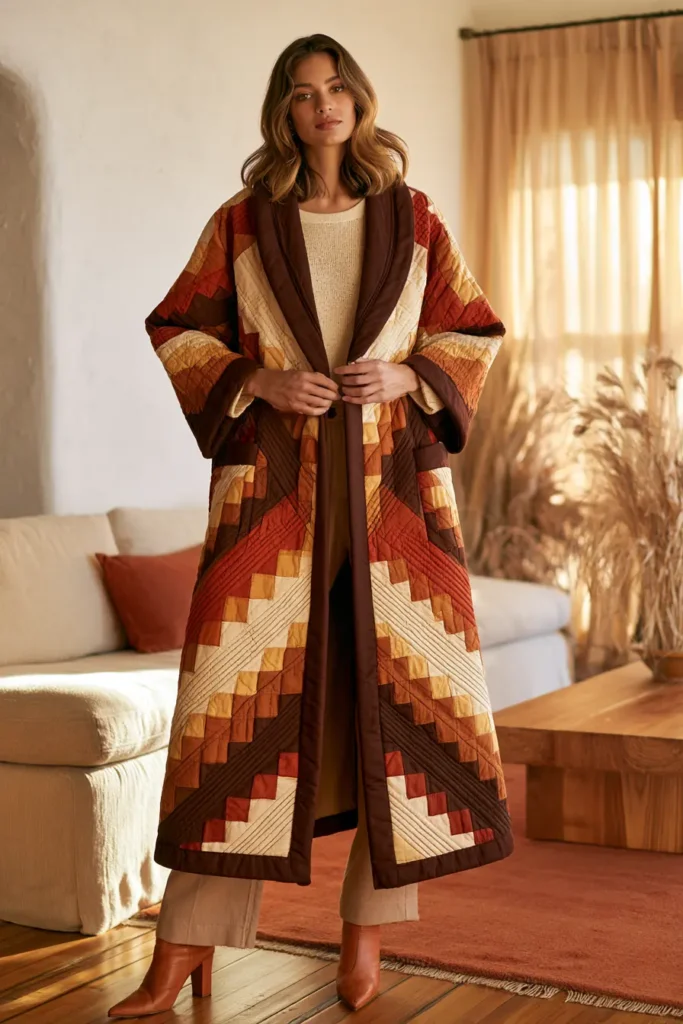
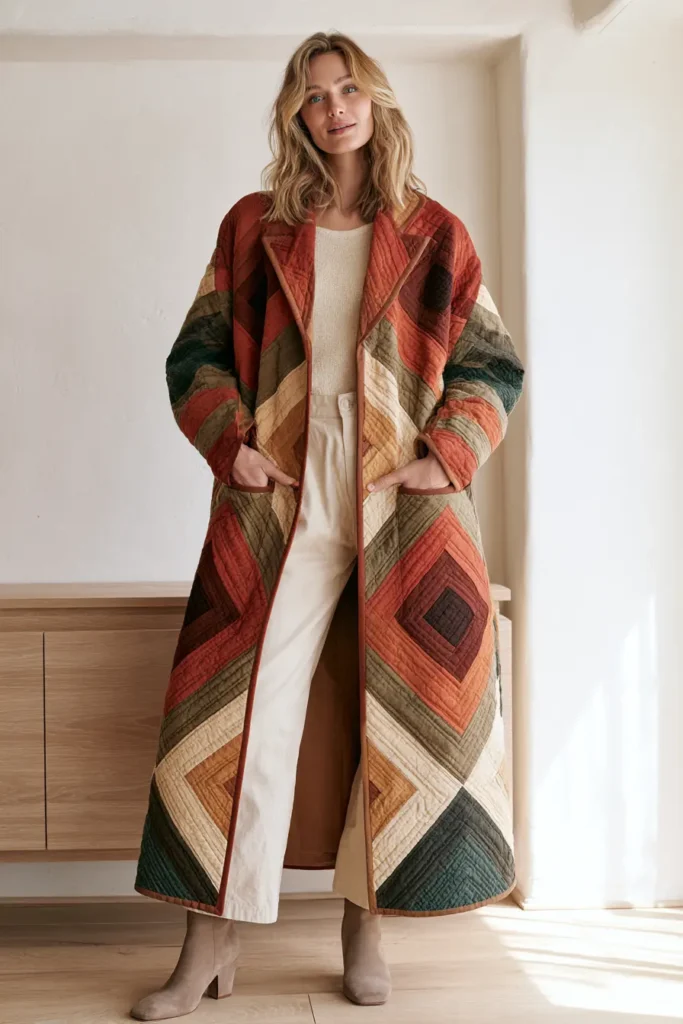
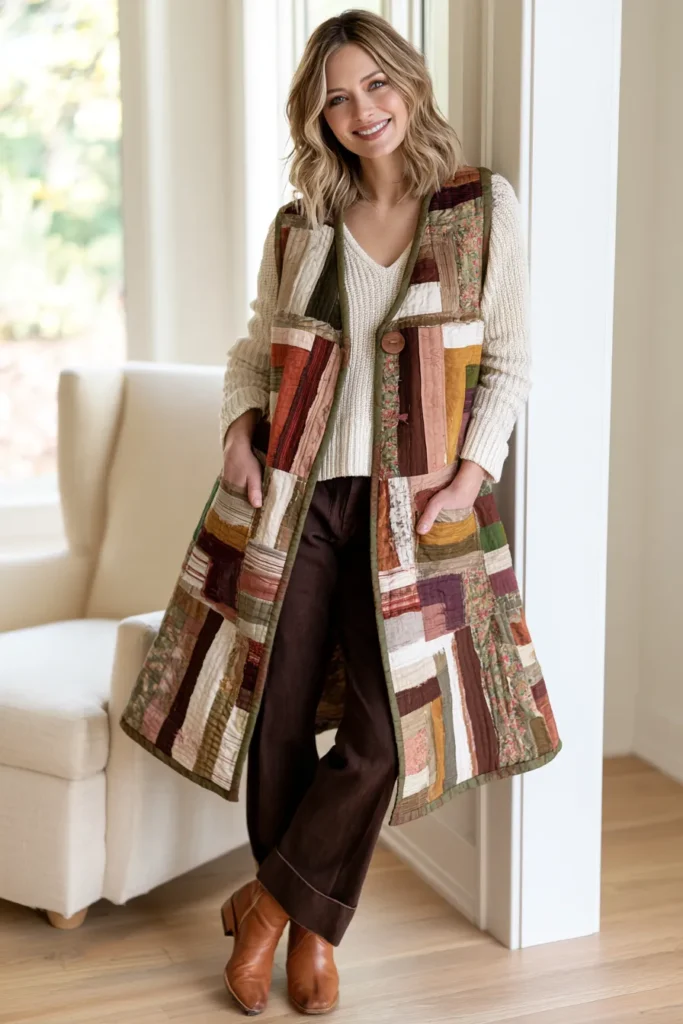
3. Longline Log Cabin Quilted Duster Coat with Barn Raising Diamond Layout in Warm Earth Tones
A longline Log Cabin quilted duster coat transforms traditional patchwork geometry into an elegant, flowing garment with a distinctly autumnal character. Its defining feature is the Barn Raising layout, where carefully oriented Log Cabin blocks create large, nested diamond arrangements through contrasting light and dark fabric strips. Warm terracotta, burnt sienna, copper, ochre, and chocolate brown add depth, while oatmeal and cream accents keep the geometric pattern clearly visible.
Unlike a shorter quilted jacket, the duster’s generous length allows for more dramatic block arrangements. A relaxed, mid-calf silhouette, softly structured shoulders, straight sleeves, and an open front allow the patchwork to remain the main attraction. The mix of traditional Barn Raising geometry and an understated contemporary coat shape creates a distinctive piece that feels both heritage-inspired and suited to modern autumn layering.
Design Inspirations – Digitally Modified Images. Texture and color may vary from the actual product.
Planning the Barn Raising Diamond Layout
This design’s success depends on how individual Log Cabin blocks are arranged. Each traditional block is constructed from rectangular strips surrounding a central square, often with lighter fabrics concentrated on one diagonal half and darker fabrics on the other. Rotating and joining these blocks in a Barn Raising setting creates larger diamond formations that extend beyond the boundaries of individual squares.
For a longline coat, make the back panel the main location for an uninterrupted nested diamond arrangement. Coordinating sections on the front panels can continue the visual rhythm without requiring a complete diamond to remain visible across an open front. Avoid positioning important diamond centers directly beneath closures, pockets, or major garment seams.
Choosing Warm Earth Tones and Suitable Fabrics
Quilting cotton is a practical foundation for accurately pieced Log Cabin blocks. Subtle cotton-linen textures, narrow tonal stripes, and small-scale prints can introduce variation without distracting from the diamonds.
Combine lighter sandstone, wheat, ivory, and caramel strips with darker walnut, tobacco brown, rust, and espresso fabrics. Muted olive or antique gold can provide restrained accents. Maintaining a clear difference between light and dark values matters more than using many colors.
Lightweight, low-loft batting is particularly suitable for preserving the duster’s relaxed movement. Fine straight-line or echo quilting can emphasize the pieced strips without making the coat overly rigid.
Maintaining a Flowing Silhouette
The greatest challenge is balancing substantial patchwork detail with comfortable drape. Multiple seam intersections, heavy batting, and densely spaced quilting can stiffen the coat, especially around the shoulders and lower panels.
Choose compatible fabric weights, plan seam placement carefully, and avoid bulky intersections around armholes and pockets. Narrow cotton binding can finish the front opening, cuffs, and hem without introducing unnecessary visual weight.
Helpful Note: Arrange the Log Cabin blocks over a full-size garment pattern before cutting the quilted panels. This helps identify where the Barn Raising diamonds may be interrupted by the front opening, side seams, or armholes.
Other Design Inspirations – Digitally Modified Images. Texture and color may vary from the actual product.
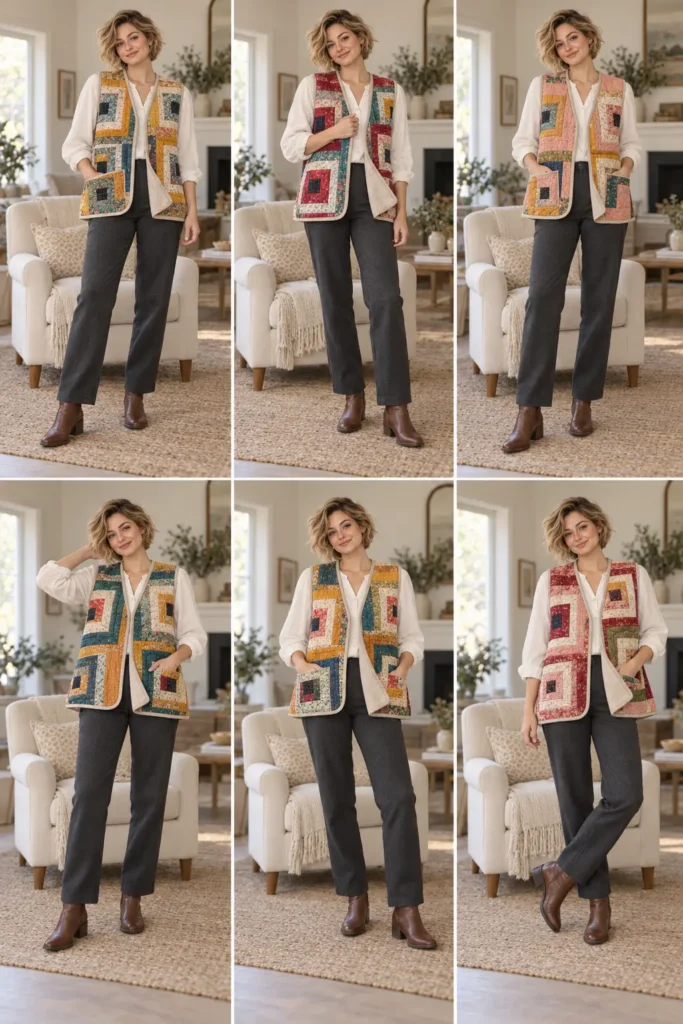
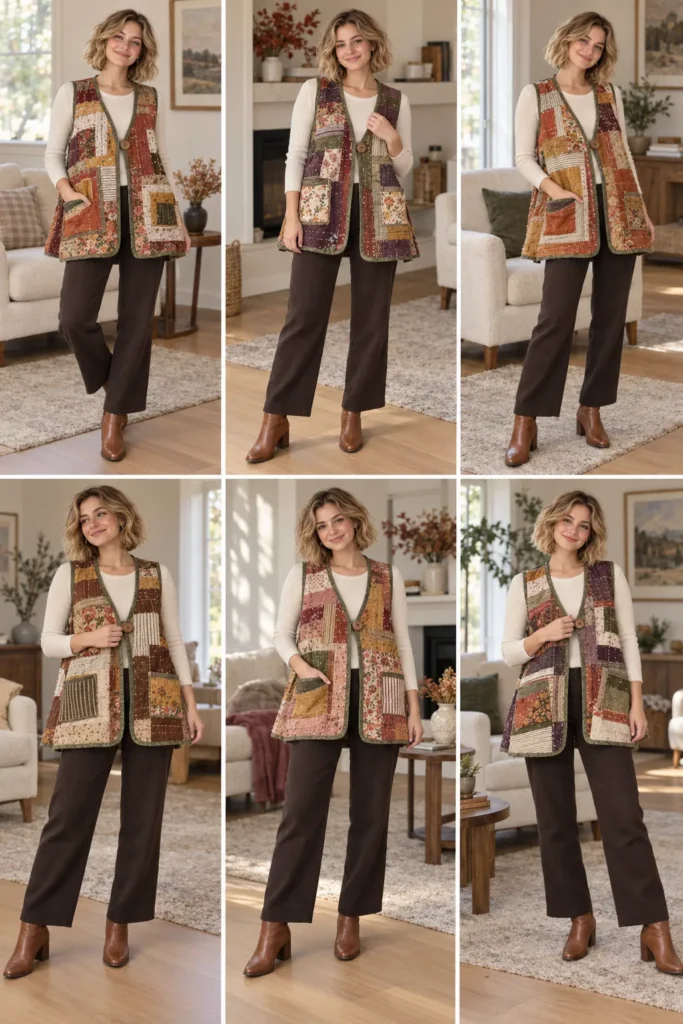
4. Reversible Log Cabin Quilted Vest with Colorful Scrappy Patchwork and Solid Linen Reverse
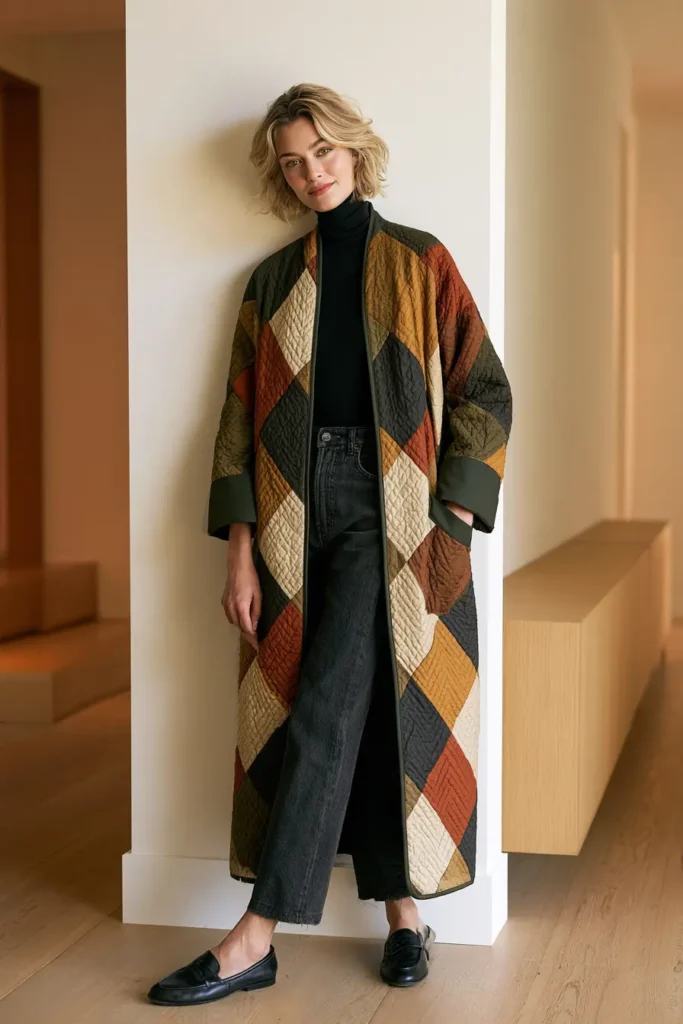
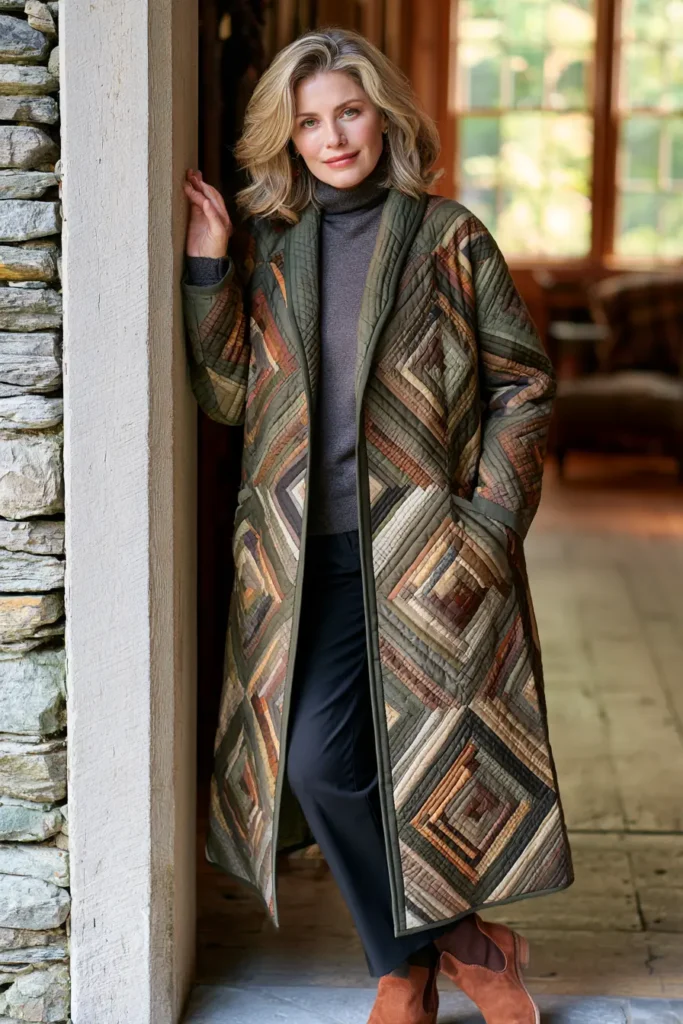
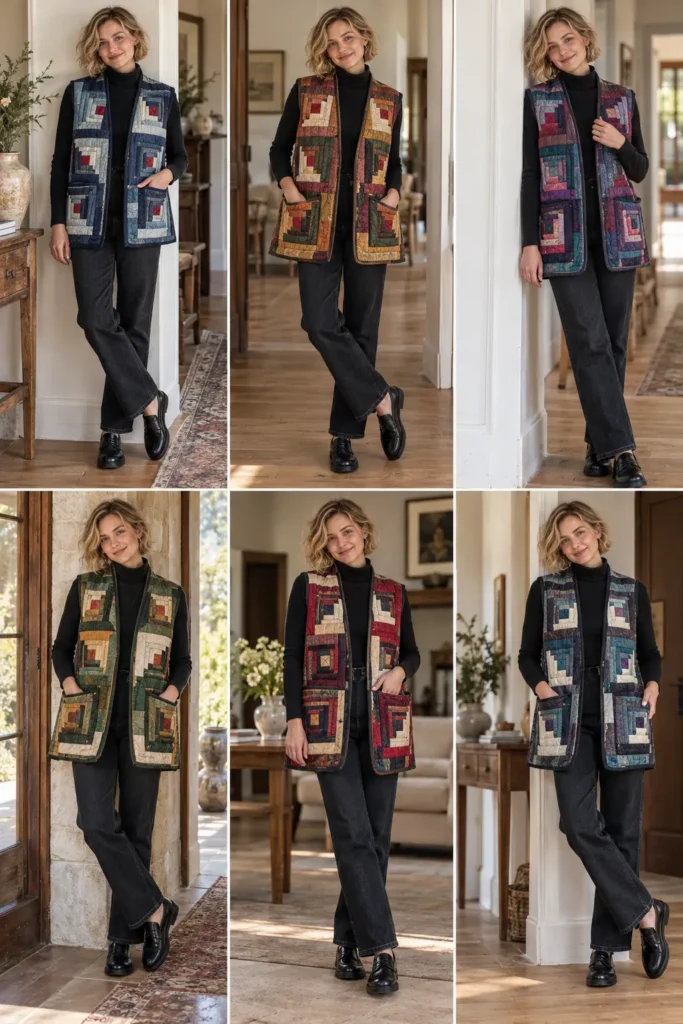
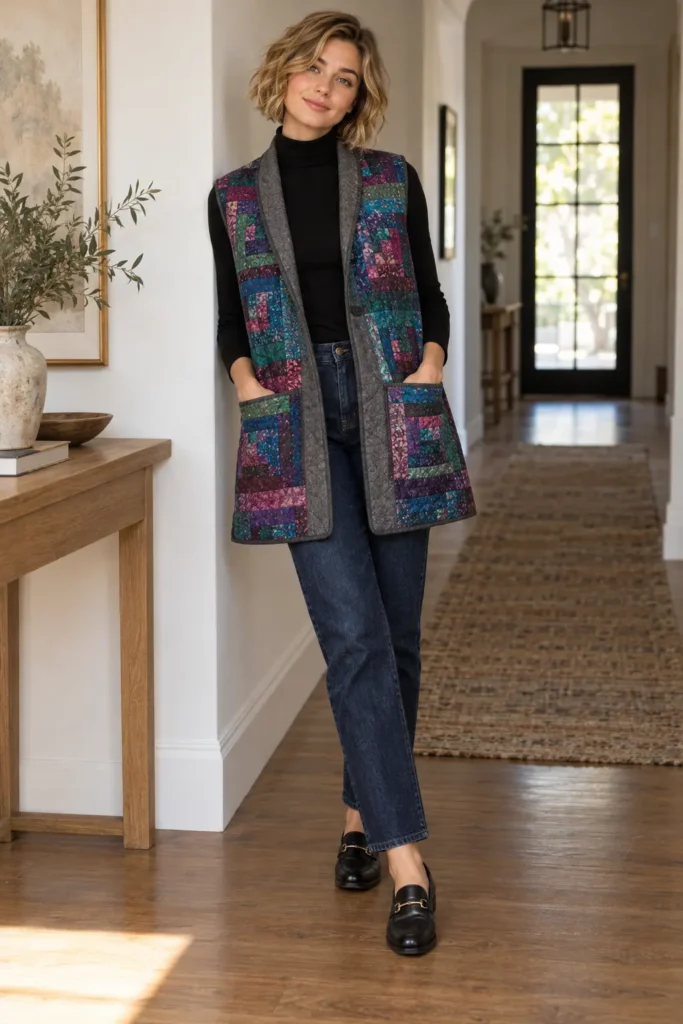
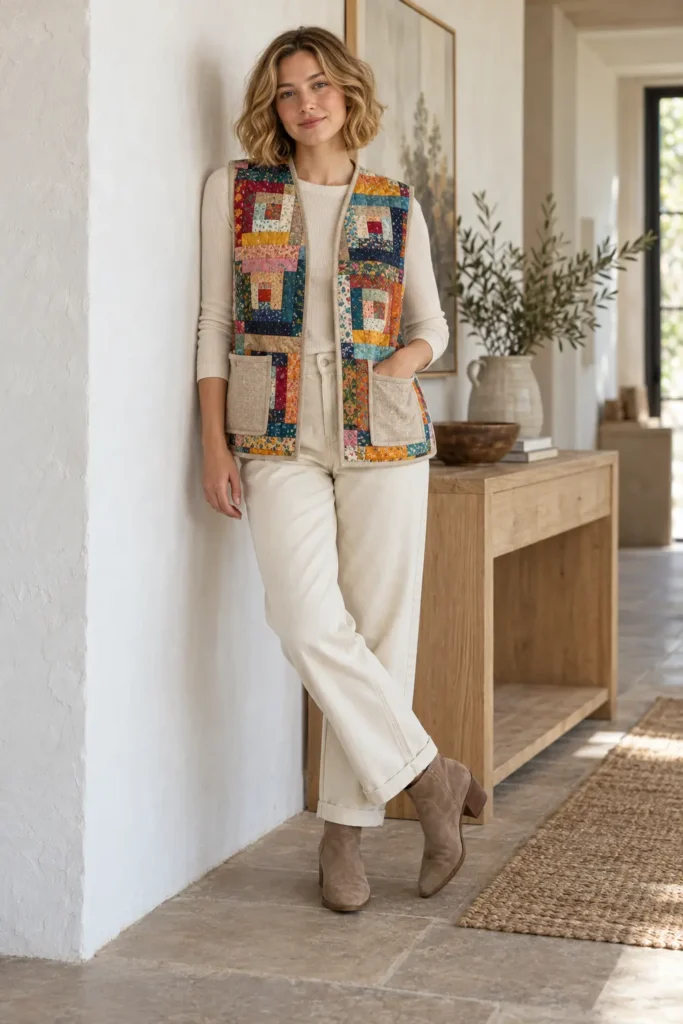
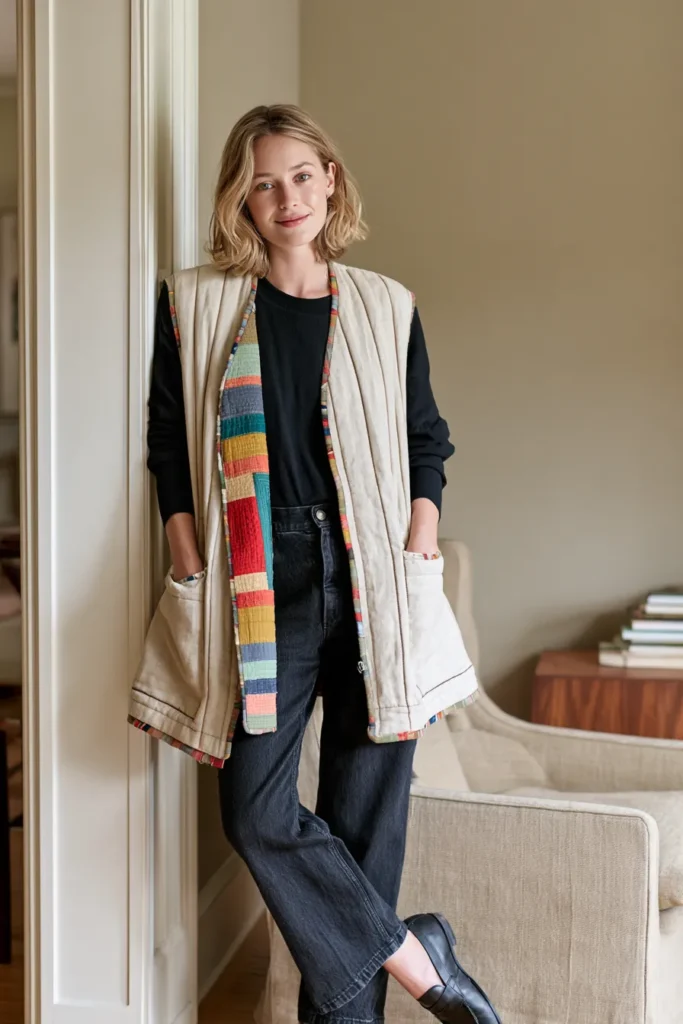
A reversible Log Cabin quilted vest combines the lively character of scrappy patchwork with the understated simplicity of natural linen. One side features colorful Log Cabin blocks assembled from narrow fabric strips that surround contrasting central squares, creating a playful mix of geometric patterns, prints, and textures. Coral, mustard, teal, raspberry, soft plum, and warm ivory work beautifully together, especially when you distribute lighter and darker fabrics thoughtfully throughout the blocks.
This design is particularly appealing for its two distinct wearable surfaces. The colorful patchwork side offers an expressive, handmade appearance, while the solid linen reverse provides a quieter alternative for everyday layering. A relaxed, hip-length silhouette, a softly shaped V-neckline, comfortable armholes, and simple front ties let the vest sit naturally over lightweight sweaters or long-sleeved tops. Unlike a typical lined patchwork vest, both sides are meant to function as finished exteriors.
Design Inspirations – Digitally Modified Images. Texture and color may vary from the actual product.
Choosing Scrappy Fabrics and Balancing Color
Quilting cotton is an excellent choice for the colorful Log Cabin blocks because its stable weave supports accurate strip piecing. Combine small-scale florals, narrow stripes, tiny checks, and solid fabrics for variety without overwhelming the geometric structure.
A successful scrappy arrangement benefits from repeated colors. For example, coral and dusty rose can connect warmer blocks, while teal and sage provide cooler accents. Occasional ivory or oatmeal strips help separate stronger colors and keep the Log Cabin construction recognizable.
Medium-scale blocks generally suit a hip-length vest, allowing enough room for the strip arrangements to remain visible across the front panels.
Creating a Beautiful, Wearable Linen Reverse
The reverse should look intentional, not like an ordinary garment lining. Softened natural flax, warm ivory, or muted sage linen can create an elegant contrast with the colorful patchwork.
Choose a linen weight compatible with the quilting cotton to reduce distortion between layers. Lightweight, low-loft batting helps maintain flexibility, while restrained straight-line quilting can add subtle texture on the linen side without making it feel too busy.
Narrow cotton binding around the neckline, armholes, front opening, and hem creates a clean finish on both surfaces. Reversible fabric ties offer a practical closure without requiring a conventional front facing.
Quilting, Comfort, and Common Mistakes
The biggest challenge with reversible quilted clothing is achieving a finish that looks attractive from either side. Quilting stitches pass through both outer fabrics, so thread color, stitching density, and alignment deserve careful consideration.
Avoid excessively thick batting, bulky Log Cabin seam intersections, and heavy decorative stitching that could stiffen the vest. Also plan pockets and closures so they remain functional and comfortable when the garment is reversed.
Helpful Note: Before selecting the final quilting style, test a small layered sample using the chosen patchwork cotton, batting, and linen. This can help reveal differences in fabric movement, stitch appearance, and overall flexibility.
Other Design Inspirations – Digitally Modified Images. Texture and color may vary from the actual product.
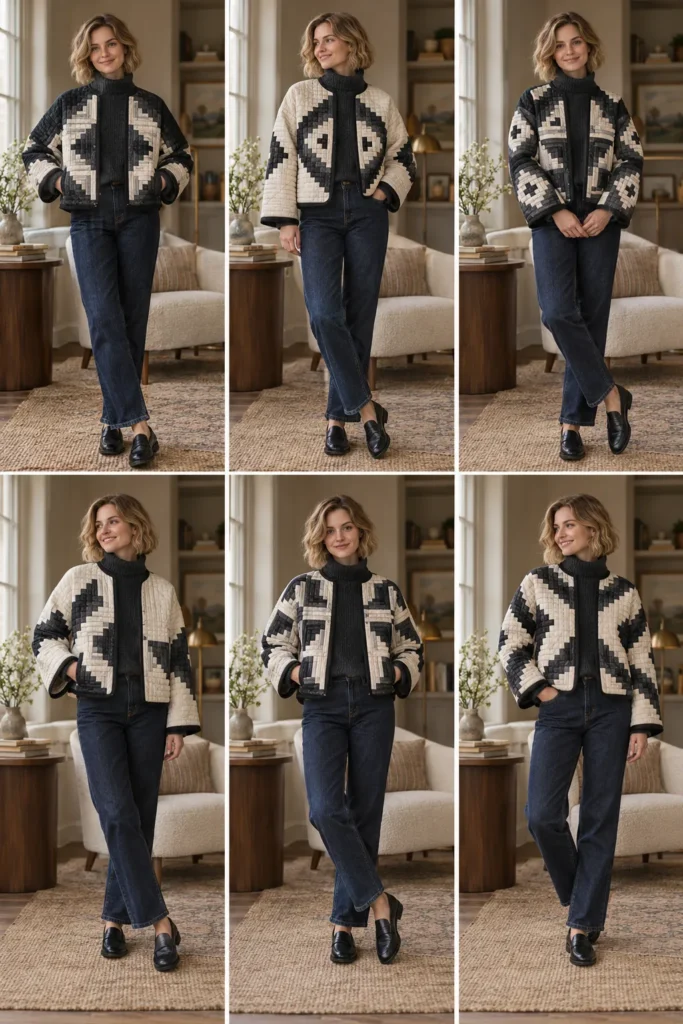
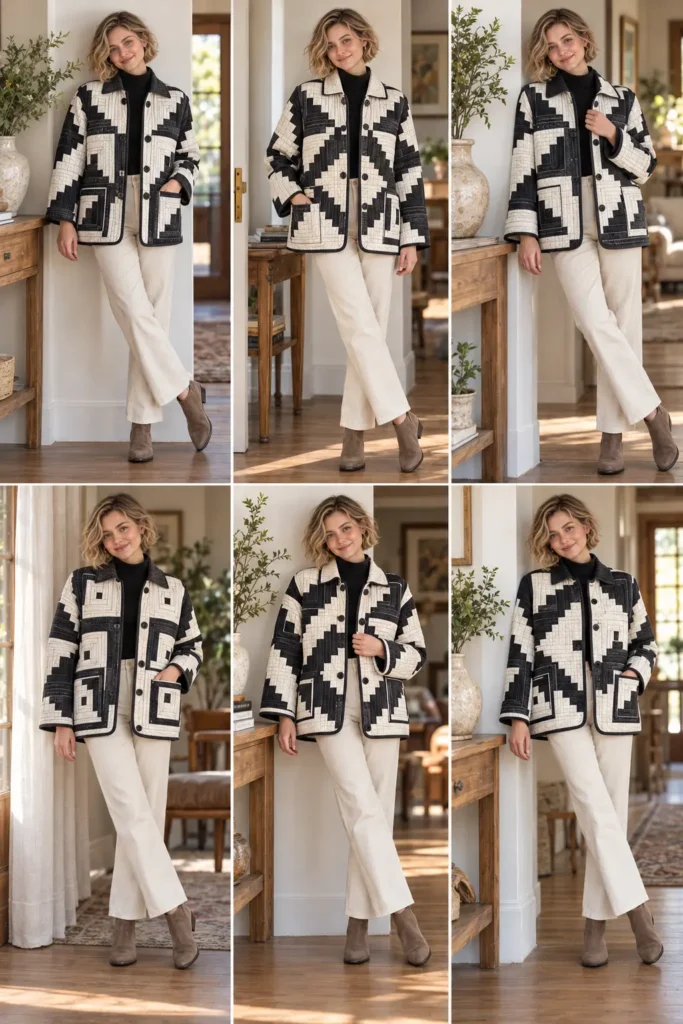
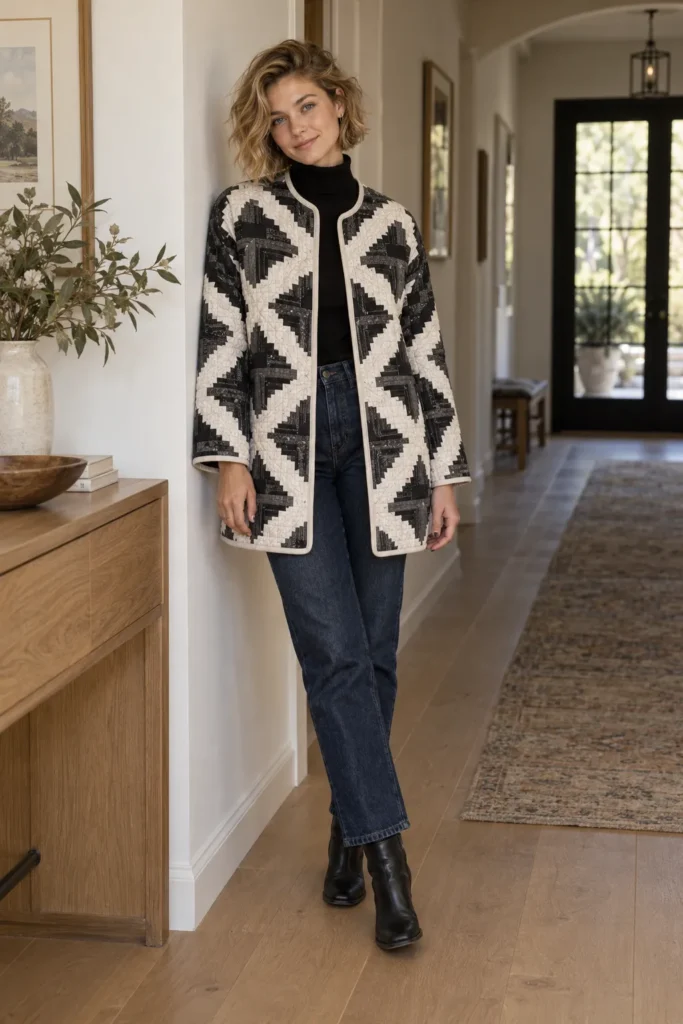
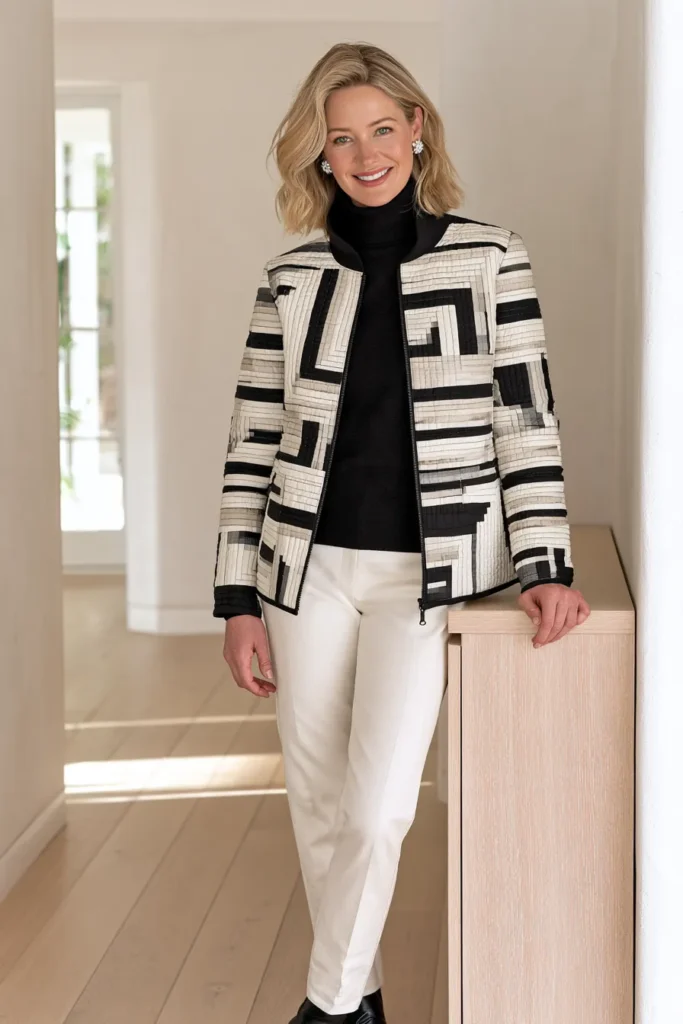
5. Black-and-White Log Cabin Quilt Jacket with High-Contrast Optical Block Placement
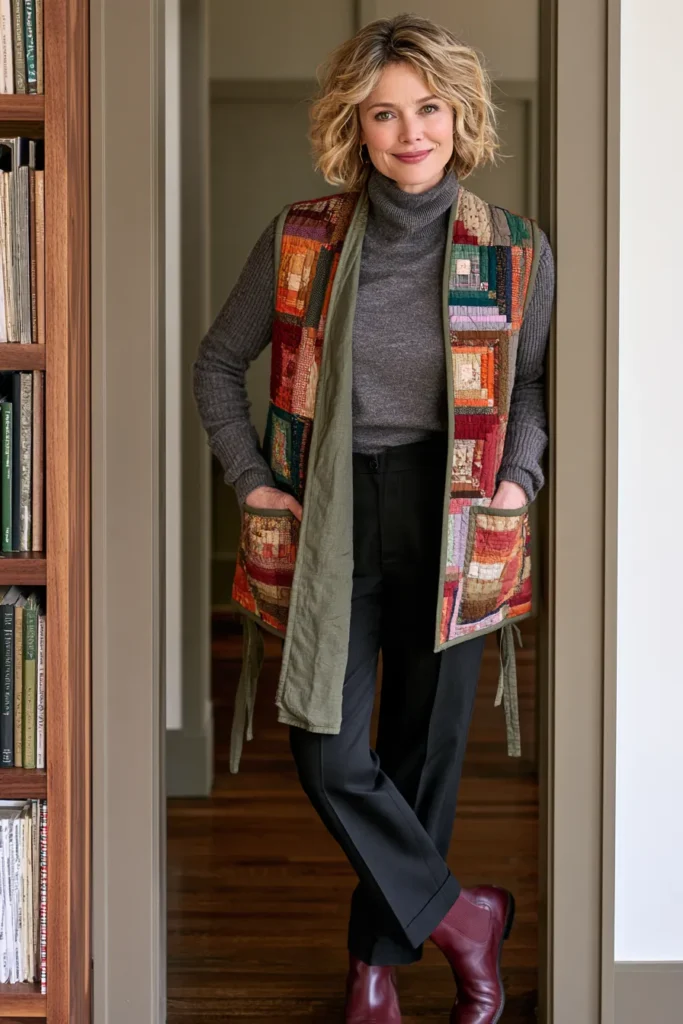
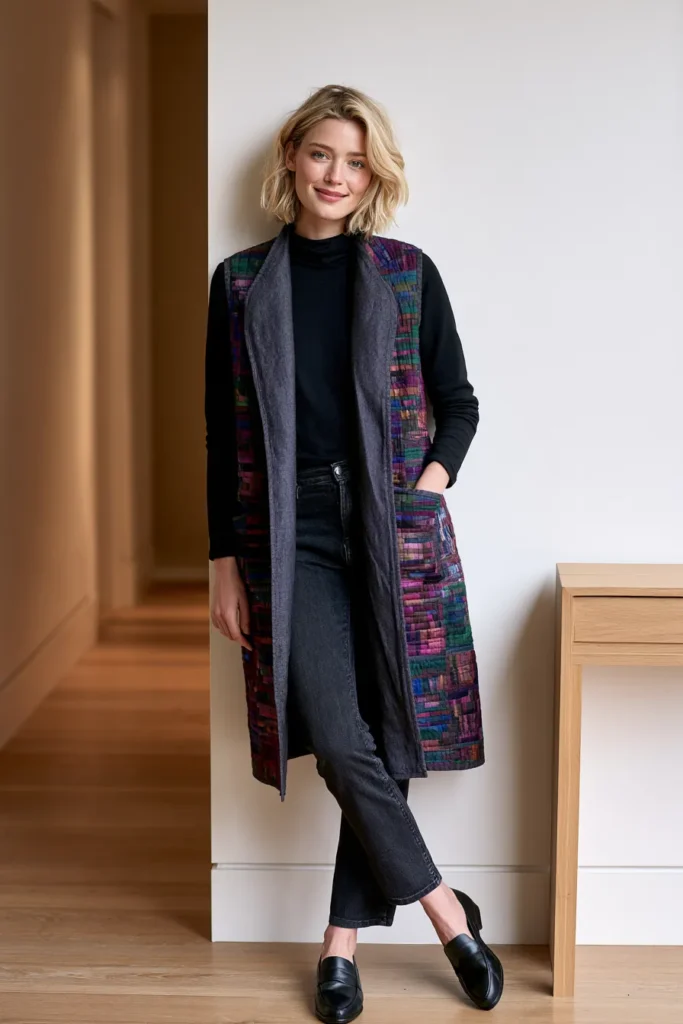
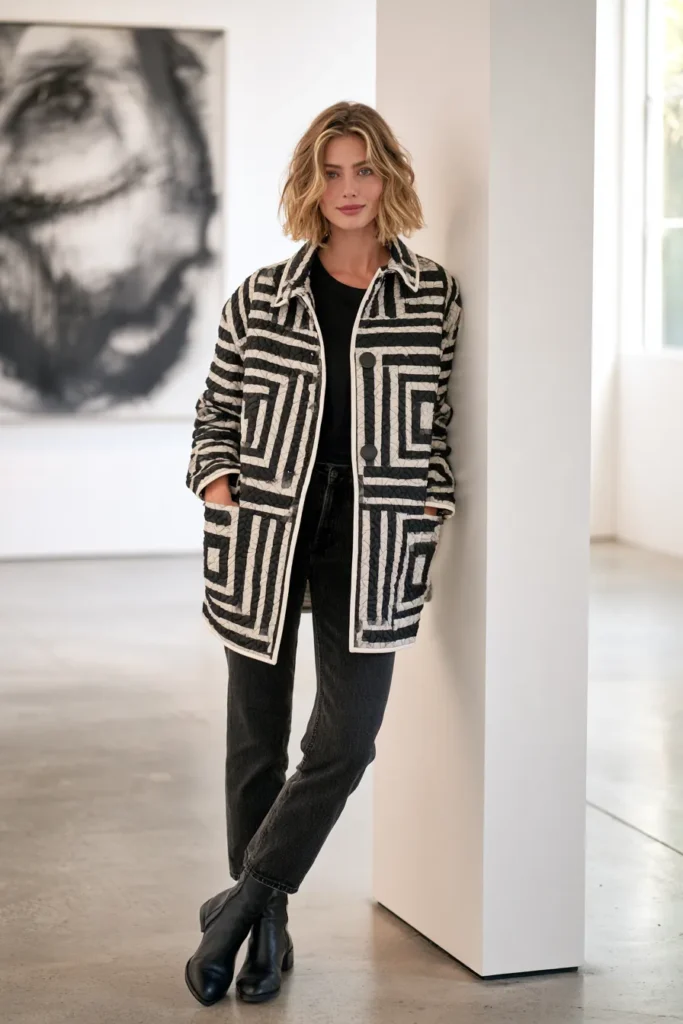
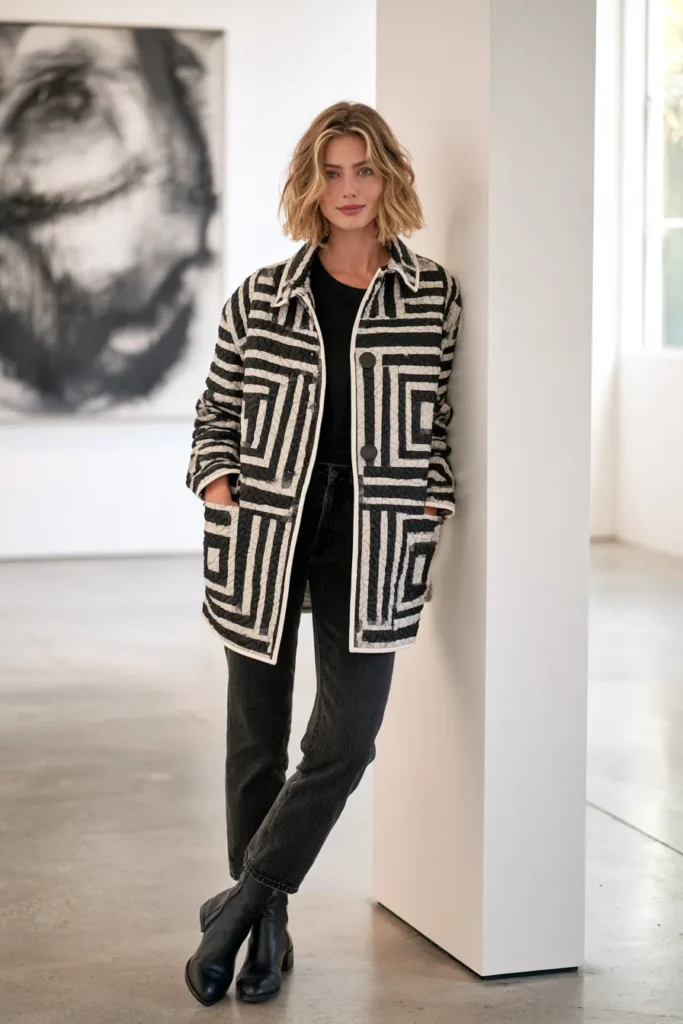
A black-and-white Log Cabin quilt jacket transforms traditional strip piecing into a bold, contemporary design built around striking optical effects. Instead of relying on colorful fabrics or intricate prints, this jacket uses the dramatic contrast between jet black, crisp white, and occasional charcoal tones to create geometric movement. Each Log Cabin block begins with a central square surrounded by progressively longer rectangular fabric strips. By carefully arranging the contrasting sections, the blocks form stepped diagonals, interlocking shapes, and visually shifting patterns that appear to move across the garment.
Unlike a tailored Courthouse Steps blazer featuring delicate micro-piecing, this design emphasizes large-scale geometry and a relaxed, boxy silhouette. A hip-length jacket with gently dropped shoulders, full-length sleeves, a simple stand collar, and a clean front zipper provides an understated foundation for the dramatic patchwork. The oversized blocks, strong monochromatic contrast, and contemporary outerwear styling give the jacket a distinctly architectural character.
Design Inspirations – Digitally Modified Images. Texture and color may vary from the actual product.
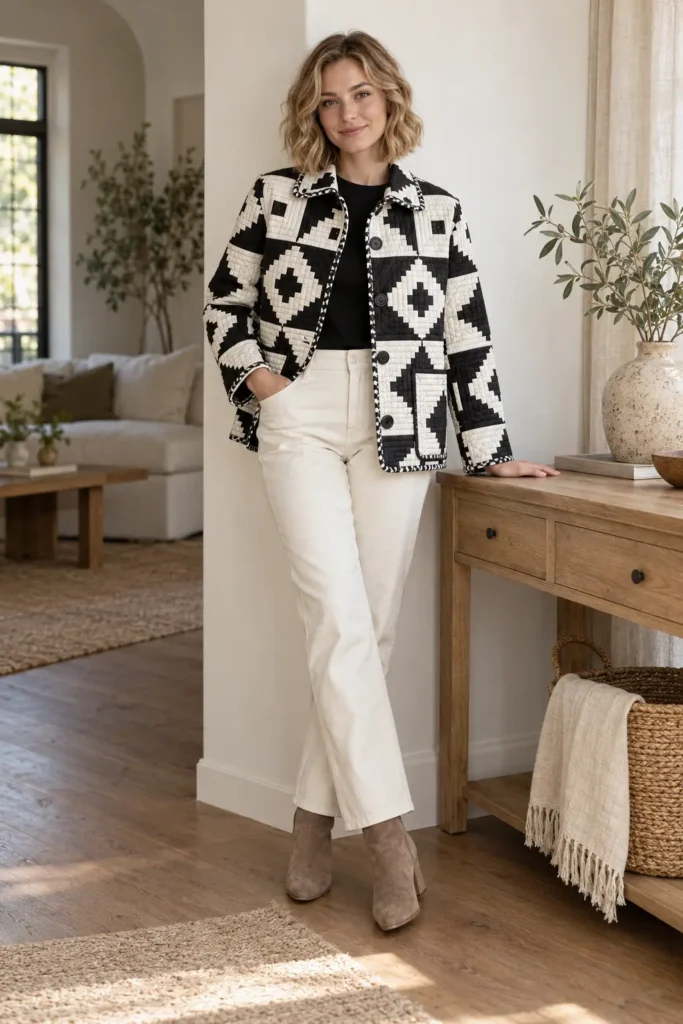
Creating High-Contrast Optical Effects
The optical effect depends primarily on block orientation and the distribution of black and white fabrics. Rotate traditional Log Cabin blocks so light strips concentrate on one diagonal half and dark strips on the other to create striking secondary patterns.
Consider combining solid jet black, soft charcoal, brilliant white, and subtle ivory-white cottons. Broad strips keep the geometric shapes recognizable, while occasional charcoal accents soften transitions without weakening the contrast.
Avoid complicated prints that compete with the block arrangement. Let the piecing create the visual interest rather than printed optical designs.
Block Scale and Placement Across the Jacket
Oversized Log Cabin blocks suit the jacket’s relaxed proportions, giving individual strips enough space to remain clearly visible. Consider arranging the front panels around strong stepped diagonal lines, with coordinating blocks extending across the sleeves and back.
The center-front opening, armholes, and pockets can interrupt carefully planned optical arrangements. Position the most important geometric features away from these areas, and assess how the blocks will appear when the jacket is worn open or zipped.
A simple stand collar, narrow black or ivory binding, and discreet side-entry pockets help preserve the clean, modern appearance.
Quilting Texture and Common Mistakes
Stable quilting cotton and lightweight, low-loft batting help maintain crisp piecing and comfortable movement. Fine straight-line or restrained echo quilting can follow the Log Cabin strips without competing with the larger optical design.
Avoid excessive quilting density, which can stiffen the jacket, and bulky seam intersections around the shoulders and armholes. Another common mistake is unevenly distributing the dark fabrics, which can make one section appear visually heavier than the others.
Helpful Note: Before finalizing the patchwork, photograph the arranged blocks and view the image from a distance. The intended stepped diagonals and optical patterns should remain recognizable even when individual fabric strips become less visible.
Other Design Inspirations – Digitally Modified Images. Texture and color may vary from the actual product.
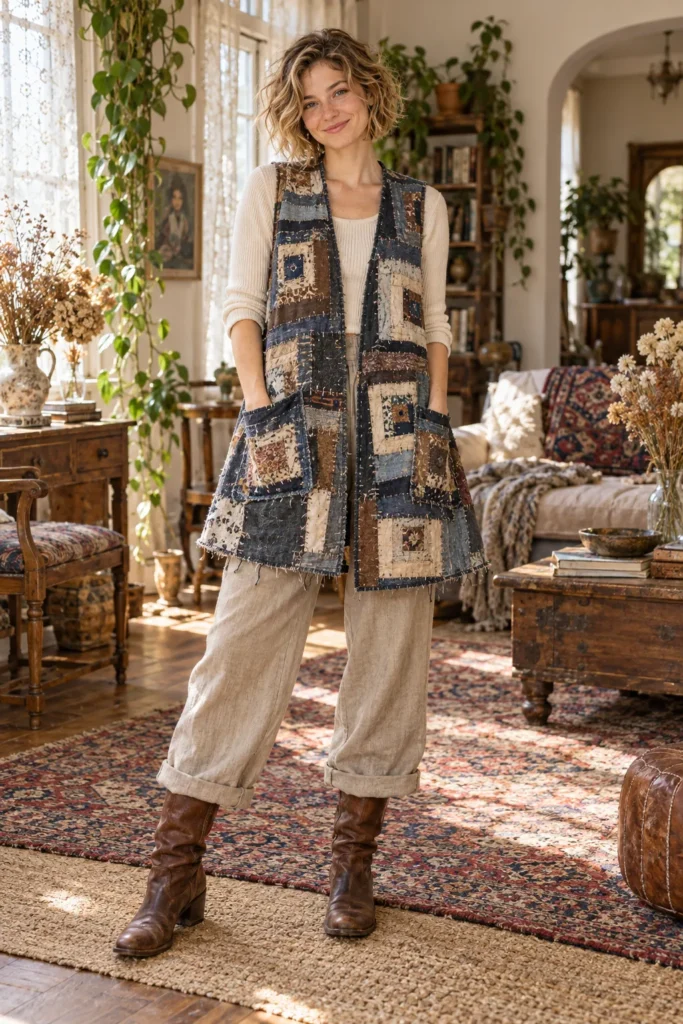
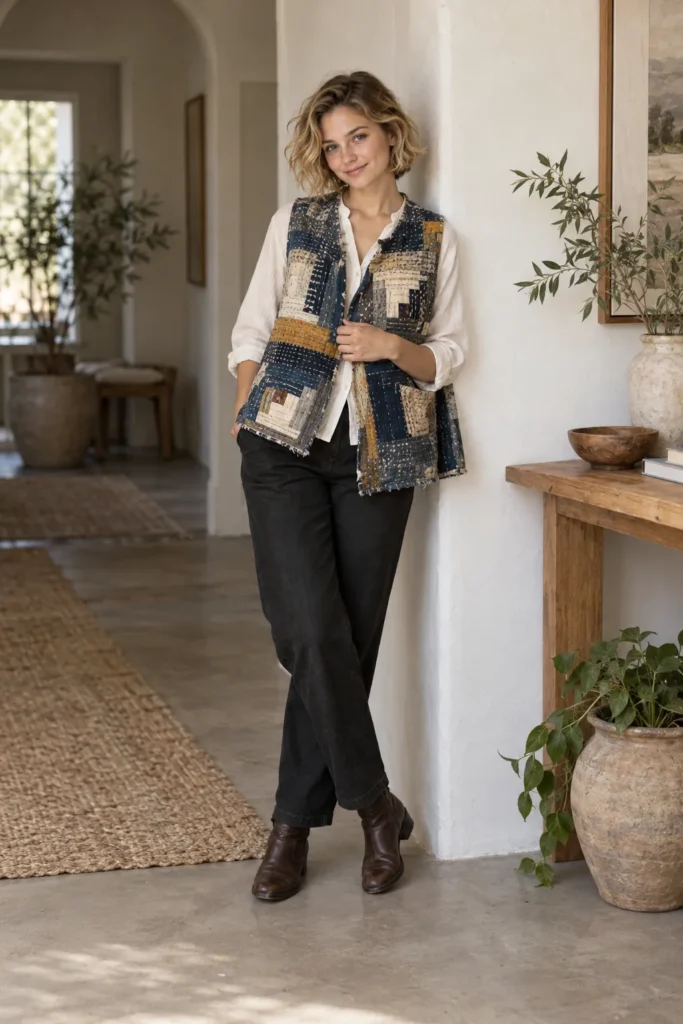
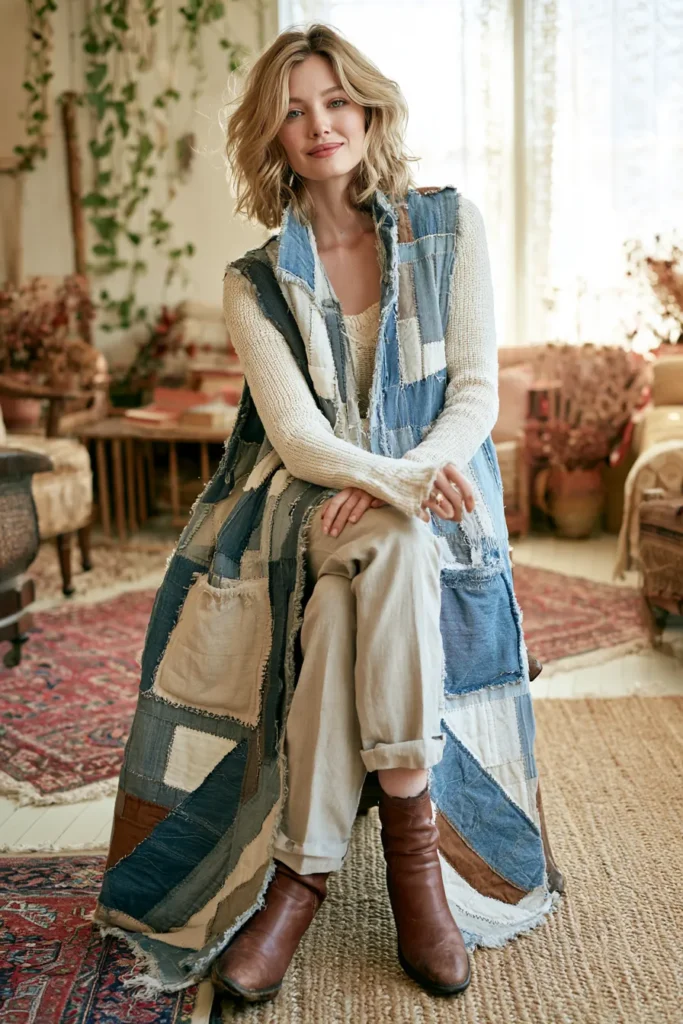
6. Wonky Log Cabin Quilt Swing Vest with Asymmetric Blocks, Raw Edges and Visible Mending
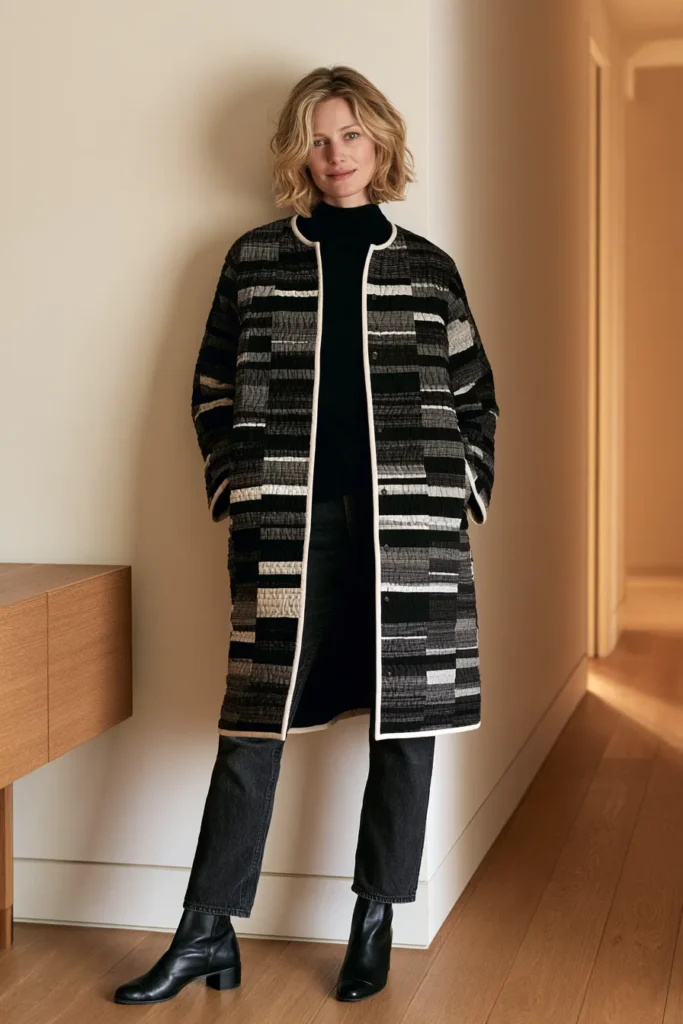
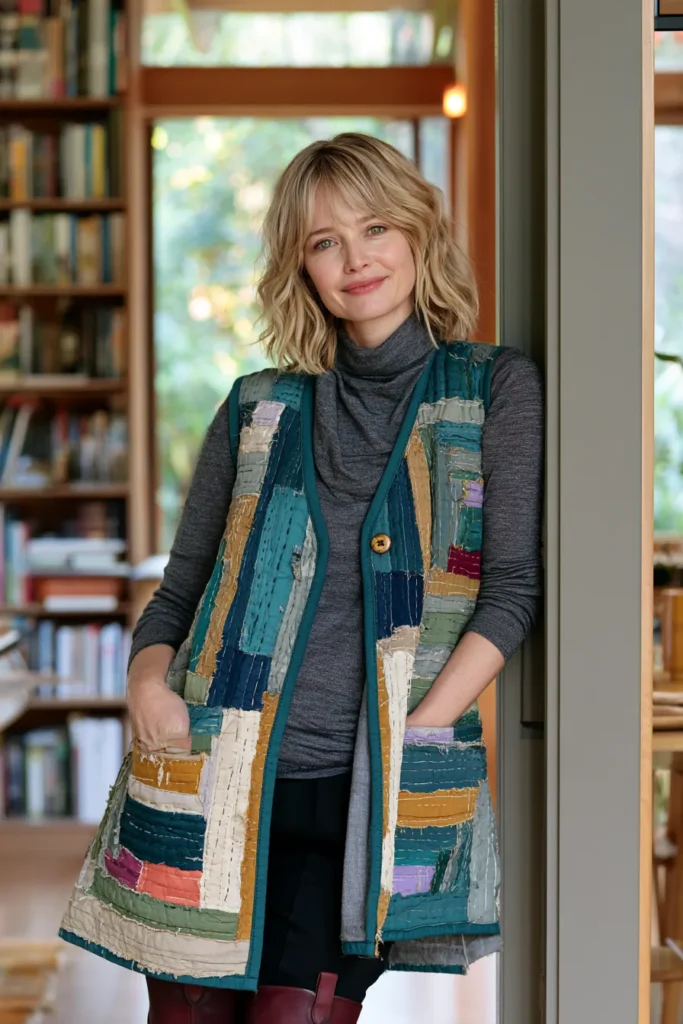
A wonky Log Cabin quilt swing vest brings an expressive, free-spirited character to traditional strip-pieced patchwork. Instead of perfectly centered squares and evenly spaced fabric strips, this design features deliberately off-center blocks, irregular widths, and slightly angled seams. Warm terracotta, faded indigo, moss green, antique mustard, dusty rose, and oatmeal create a richly layered surface, while exposed raw edges and visible hand stitching introduce the character of repaired and reused textiles.
The garment’s distinctive swing silhouette makes it especially appealing. Unlike a straight-cut quilted vest, this sleeveless design fits comfortably around the shoulders before widening into a gently flared, mid-thigh-length hem. A relaxed open front, softly shaped neckline, and generously finished armholes allow the patchwork to move naturally. Asymmetric Log Cabin blocks, textured fabrics, and visible mending create a bohemian-inspired layering piece that feels intentionally imperfect without sacrificing thoughtful construction.
Design Inspirations – Digitally Modified Images. Texture and color may vary from the actual product.
Creating Expressive Wonky Log Cabin Blocks
Wonky Log Cabin construction starts with the familiar idea of adding fabric strips around a central square, but gives you more freedom in placement and proportion. Off-center starting squares, uneven strip widths, and gently angled seams create blocks that appear spontaneous rather than precisely symmetrical.
For visual balance, combine larger irregular blocks with smaller, quieter arrangements. Repeating selected colors across the vest helps connect the different sections, while occasional cream or oatmeal strips provide relief from darker, more heavily patterned areas.
Avoid making every block equally irregular. Mixing restrained and expressive sections gives the patchwork more rhythm and keeps the Log Cabin structure recognizable.
Choosing Fabrics, Raw Edges, and Visible Mending
Soft quilting cotton, lightweight linen, faded shirting, and suitable reclaimed fabrics complement this relaxed aesthetic. Narrow ticking stripes, tiny florals, muted checks, and textured solids can create a collected-over-time appearance.
Selected patches may feature softly frayed raw edges secured with visible stitching. Contrasting running stitches in cream, rust, or ochre can emphasize small repair patches and reinforce the handmade character. Ordinary structural seams should remain secure; intentional fraying is decorative, not a substitute for sound construction.
Lightweight batting and restrained straight-line quilting can add texture without making the vest unnecessarily heavy.
Preserving the Flared Swing Silhouette
The most important construction consideration is maintaining movement through the widening lower panels. Excessively thick fabrics, dense quilting, or bulky seam intersections can prevent the hem from falling naturally.
Place heavier patches away from the armholes and upper shoulders, and distribute textured sections thoughtfully across the lower panels. Narrow binding around the neckline and armholes provides a clean finish, while the flared hem benefits from a flexible, securely finished edge.
Helpful Note: Before finalizing the patchwork, arrange the blocks over the intended vest pattern and check how their proportions change toward the hem. This helps preserve both the recognizable Log Cabin structure and the garment’s distinctive swing shape.
Other Design Inspirations – Digitally Modified Images. Texture and color may vary from the actual product.
More to come …
Hooded Log Cabin Quilted Cocoon Coat with Oversized Geometric Blocks and Contrast Lining
Oversized Plaid Flannel Log Cabin Quilted Shacket with Shirt Collar and Button Front
Color-Blocked Log Cabin Quilted Blazer with Jewel-Tone Panels and Contrasting Centers
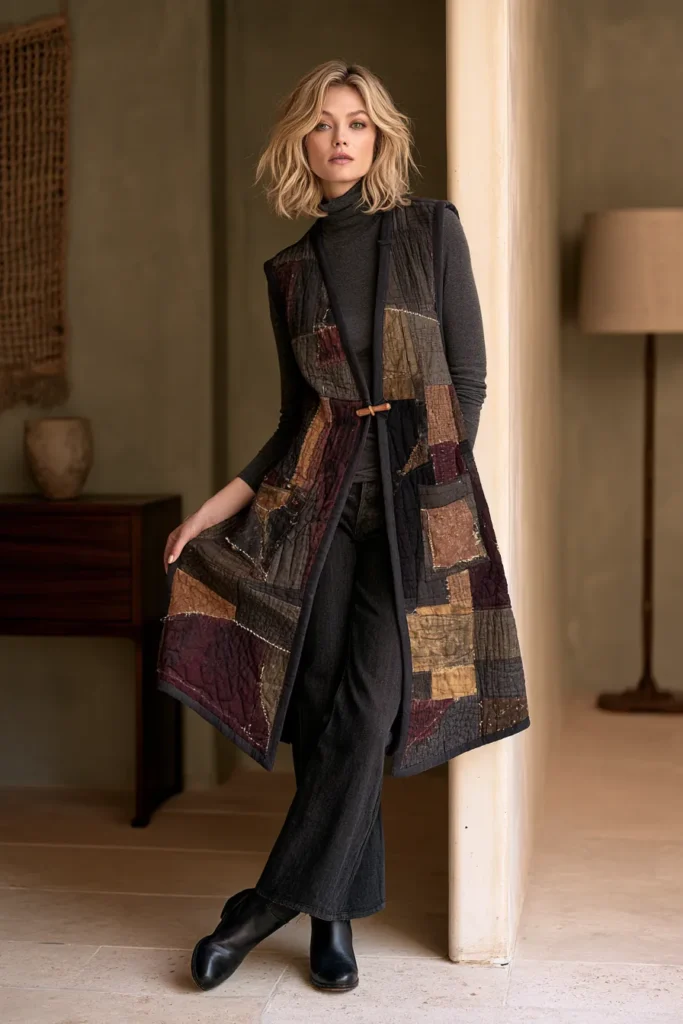
Tailored Black-and-White Courthouse Steps Log Cabin Blazer with Micro-Pieced Blocks
Indigo and Ivory Log Cabin Kimono Jacket with Wide Sleeves and Offset Blocks
Black-and-White Log Cabin Quilt Jacket with High-Contrast Optical Block Placement
Conclusion
The twelve pieces in this collection show that a Log Cabin Quilt Jacket, Coat, and Vest can fit almost anywhere aesthetically without leaving the tradition behind. The same strip-around-a-center construction produces a tailored Courthouse Steps blazer and a raw-edged swing vest, a denim chore jacket built from mixed indigo washes and a flowing indigo-and-ivory kimono with offset blocks, a hooded cocoon coat scaled for winter and a reversible vest light enough for transitional weather. What connects all of them is the logic of the Log Cabin block — the interplay between value, strip placement, and the secondary pattern that emerges when blocks are arranged — even when that logic is being pushed or deliberately broken.
Choose the silhouette first, then the layout, then the fabrics. A well-fitted garment with a legible geometric layout and fabrics that hold their value contrast will work regardless of palette or style; a badly fitting one with beautiful fabric won’t. Use what you have, but plan block placement relative to the garment pattern before cutting. The strip-piecing itself is fast and forgiving — it’s the planning that makes the difference between a piece that looks designed and one that just looks like a quilt cut into a jacket shape.

