
Floral Quilt Pattern Ideas: Vintage Rose Blocks to Modern Botanical Designs
Floral Quilt Pattern Ideas cover a wide stretch of quiltmaking, from hand-appliquéd roses to bold, graphic botanicals. A floral quilt can be built in several ways. Flowers can be constructed shape by shape, as in appliqué, Dresden Plate wedges, and joined hexagons, or the flowers can live in the fabric itself, with printed roses and ditsy blooms framed by strips, squares, or stars. Scale changes the result dramatically. Small prints blend into a soft, collected texture, while oversized leaves and blossoms read as strong silhouettes against open space. That flexibility is why the same subject can feel traditional in one quilt and entirely contemporary in the next.
Floral Quilt Pattern Ideas
The designs here range from vintage-inspired interpretations to modern, graphic ones. Some rely on careful hand work, such as paper-pieced hexagons with fussy-cut centers, while others build interest through scrappy patchwork, blended color gradients, or dramatic dark backgrounds. You will also find quieter approaches, including botanical linework stitched across natural linen, and richly layered ones made from reclaimed handkerchiefs and lace. Looking at them side by side shows how fabric weight, print scale, background color, and finishing details can change a familiar floral idea.
See also: Jelly Roll Quilted Jackets and Vests – Farmhouse Quilt Jackets & Vests – Sashiko Quilt Jackets and Vests – Fall Quilted Jacket and Vest – Nakshi Kantha Jackets and Vests
Why Make This Type of Quilt?
Floral quilts are a practical way to put a fabric stash to work, since small scraps of florals, checks, and solids can become nine-patch blocks, hexagon flowers, or Log Cabin strips. They also suit fabrics with personal history, such as a worn-out dress, a set of handkerchiefs, or a favorite print saved for years.
These can be cut so a single bloom becomes the focal point of a block. Using what you already own can reduce waste, though that depends on the fabrics being sound enough to last. Floral designs also invite experimentation with proportion. The same rose print can look delicate in a small block or become a bold feature when surrounded by plain fabric. Because the style adapts easily to bed quilts, throws, and wall hangings, you can choose the pattern, scale, and level of detail that suits your skills and the time you have.
What Makes These Designs Different?
What separates these floral quilts is where the flower comes from. In appliqué, shapes are cut and stitched onto a background, so wreaths, stems, and leaves can follow smooth curves. Dresden Plate blocks suggest petals with pieced, radiating wedges, usually finished with a center circle. Grandmother’s Flower Garden is built from joined hexagons, often English paper-pieced, in rosette clusters.
Geometric tulips use angular piecing to define petals and stems. In Log Cabin, ditsy nine-patch, and floating star quilts, the structure is standard patchwork and the floral comes from the prints. Watercolor quilts arrange small squares by value and hue to create a gradual blend. Wholecloth quilts are different again, with a single unpieced top where the botanical design comes from quilting stitches. Crazy quilts are irregular patchwork, traditionally joined and embellished along the seams, which gives them a layered, textured look unlike block-based designs.
Tips for Choosing Fabrics
Choose fabrics for how they will behave as well as how they look. Stable, medium-weight quilting cotton is the safest choice for Dresden Plate wedges, Log Cabin strips, nine-patch blocks, and pieced tulips, because it cuts accurately and holds a pressed seam. Lightweight cottons work well for English paper piecing, where fabric is wrapped around templates. For appliqué, pick fabrics that press smoothly around curves without fraying badly.
Reclaimed handkerchiefs and lace should be checked for thin spots, stains, and brittle fibers, and fragile pieces may need a light fusible or sew-in stabilizer before joining sturdier cottons. Linen is a good base for wholecloth quilting but frays and shifts easily, so handle it gently and plan for shrinkage. Prewash reclaimed cottons and any strongly colored fabrics, and test for bleeding before mixing deep darks with pale fabrics. Print scale also matters: large roses need enough yardage for fussy cutting, while tiny florals work best in smaller units.
Color and Fabric Planning
These quilts do not share one palette. Vintage rose and flower garden designs suit dusty pink, cream, sage, and muted red, but fresher combinations such as coral and teal can update the same layouts. Scrappy cottage garden quilts depend on gingham sashing to calm a mix of faded florals, which works best when the checks stay in one or two colors. Dresden Plate daisies and sunflowers need strong contrast between petals and centers, and geometric tulips need clear separation between bloom, stem, and background.
Log Cabin quilts can alternate light and dark garden tones so secondary diagonals emerge across the quilt. A watercolor quilt works differently, because the effect depends on gradual steps from blush through peach and coral to terracotta, with each square close in value to its neighbors. Dark backgrounds change the mood completely: jewel-tone florals glow against deep navy, and hibiscus and monstera leaves look graphic against black. Natural linen, by contrast, lets quilted linework carry the design.
Common Mistakes to Avoid When Sewing
A frequent mistake is cutting a large floral print without planning where the motifs will fall, so roses end up sliced through the middle or fussy-cut centers sit off-center once seam allowances are added. Hexagons, Dresden wedges, and tulip pieces also depend on accurate templates, since small cutting errors compound across a block.
Watercolor layouts fall apart when a single square jumps in value, so arrange and photograph the layout before sewing. Black and navy backgrounds can bleed onto pale fabrics in the first wash, so test and prewash them. Mixing fragile handkerchiefs with heavier cotton without stabilizing them can cause puckering and tearing along the seams. On a wholecloth quilt, stitching spaced too densely can make the quilt stiff and flatten the botanical lines, so test your batting and stitch spacing on a sample first. In scrappy designs, using many prints without a few quiet fabrics to rest the eye can make the quilt look chaotic rather than intentionally collected.
Branded and Trademarked Fabrics, Logos, and Graphics
The design examples intentionally avoid branded fabric lines, company logos, trademarked characters, sports-team marks, and designer signatures. They rely on generic florals, solids, checks, and traditional block arrangements, which keeps the ideas easy to adapt with whatever fabrics you have on hand.
About the Design Inspiration Images
The images in this article are meant as design inspiration. They illustrate possible layouts, fabric pairings, colors, and finishing details, and they are not photographs of quilts that have been sewn, measured, or tested, nor verified patterns. AI tools were used to generate or modify these visual interpretations. Many of the motifs come from long-established quilting traditions, though some may resemble the work of individual makers, whose craftsmanship we respect. We hope the images offer a starting point for creative interpretation, helping you adapt familiar styles to your own materials, preferences, and construction methods.
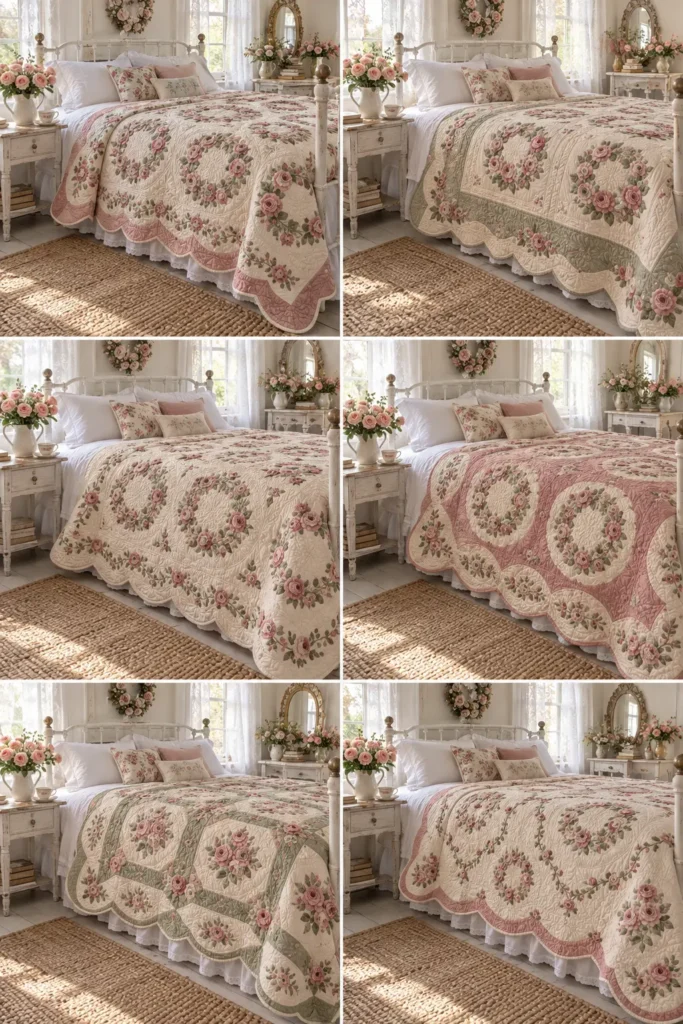
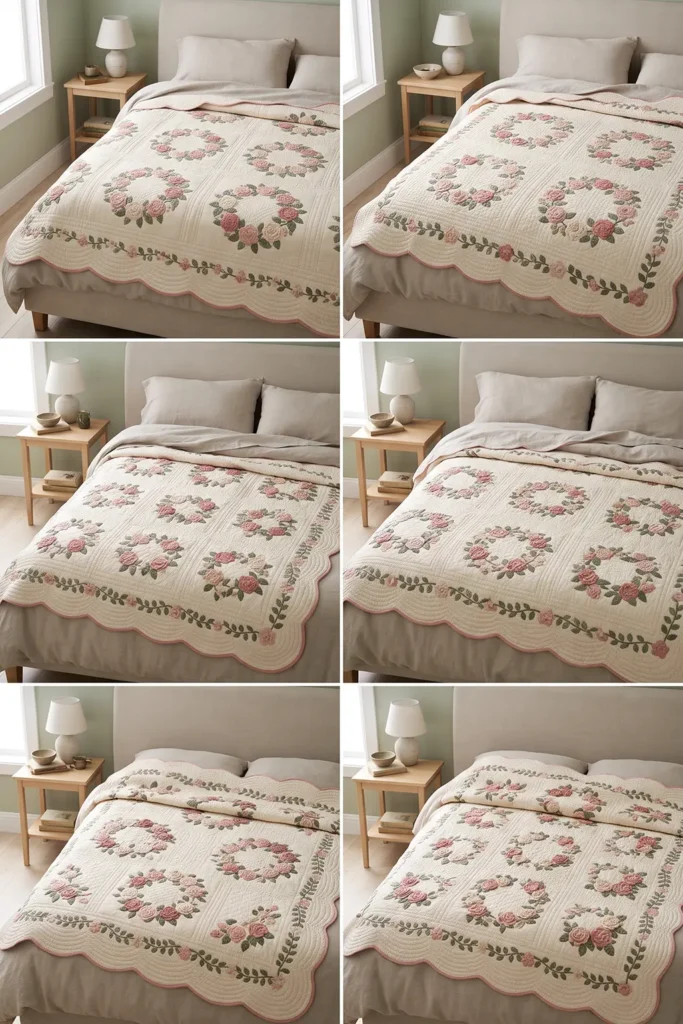
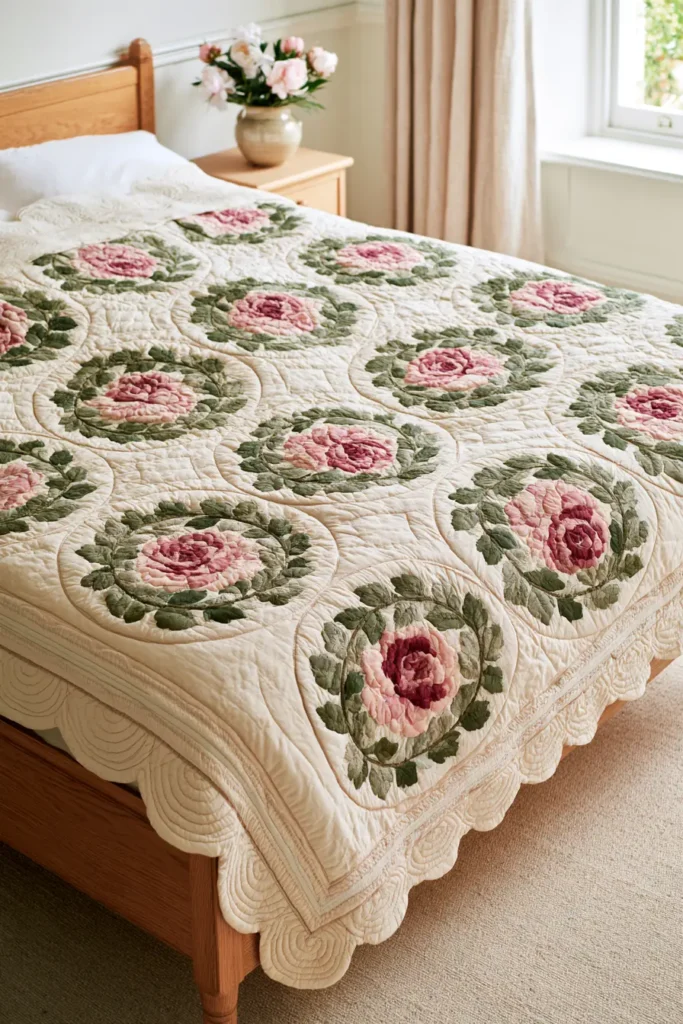
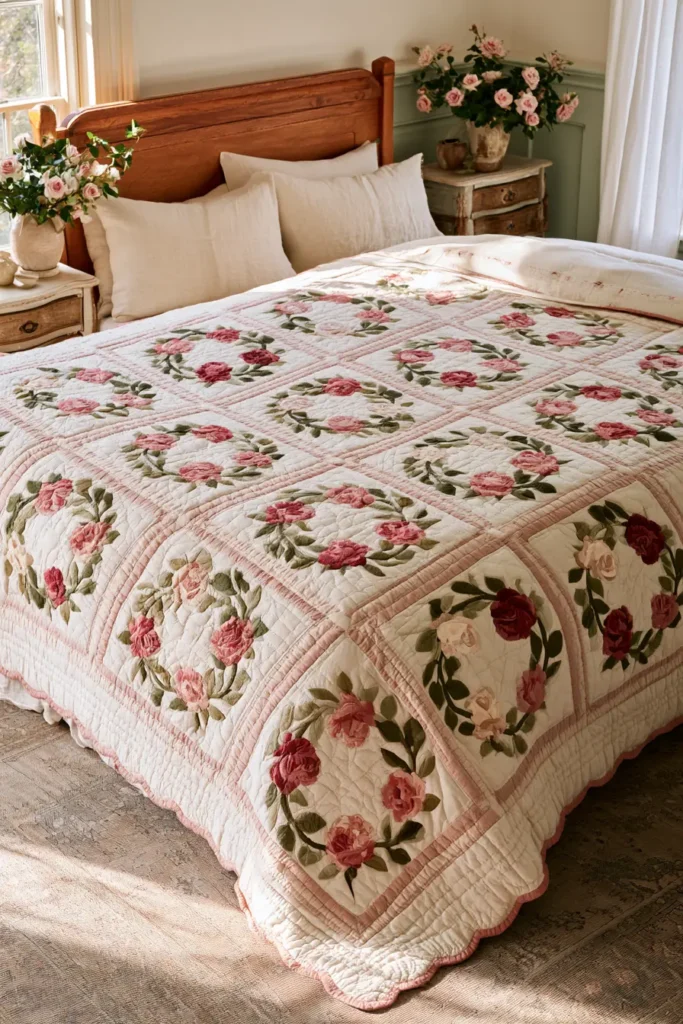
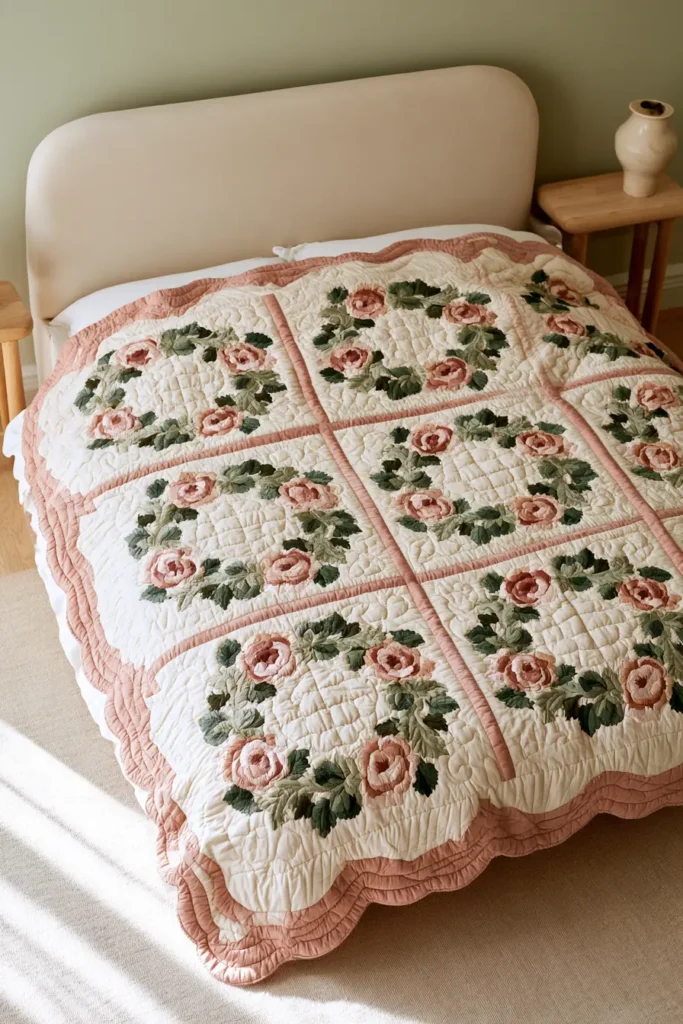
1. Vintage Rose Appliqué Quilt with Classic Wreath Blocks and Scalloped Borders
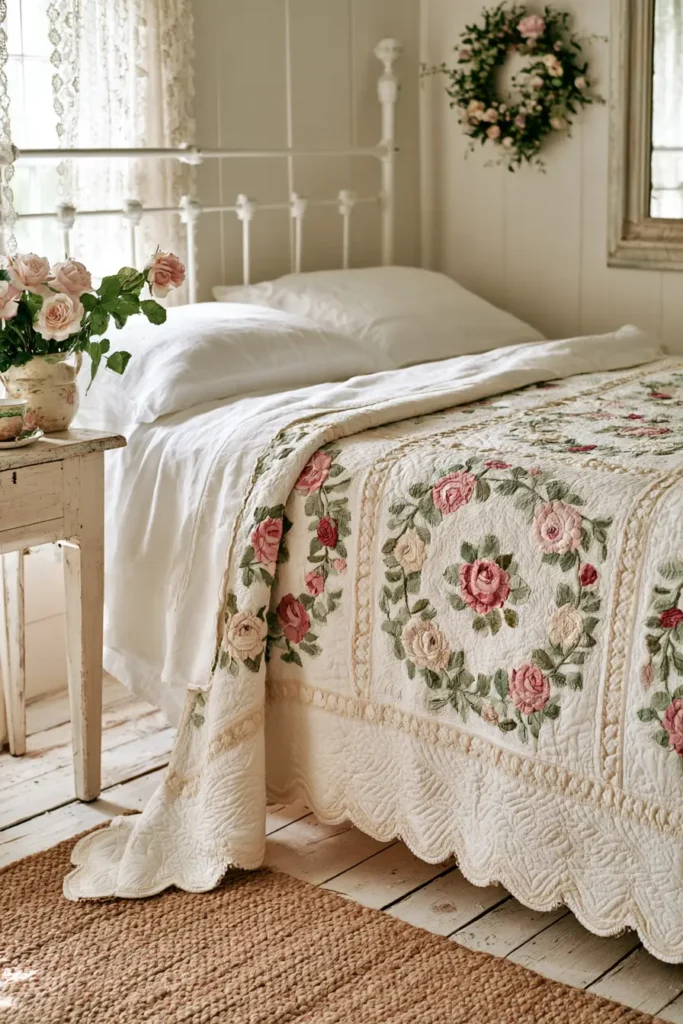
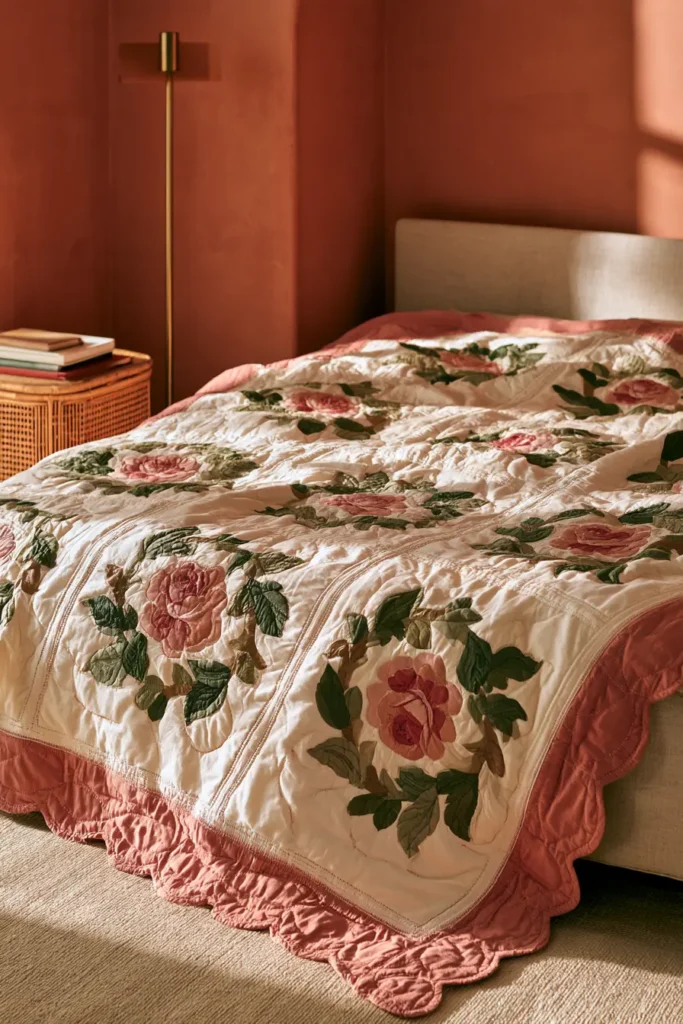
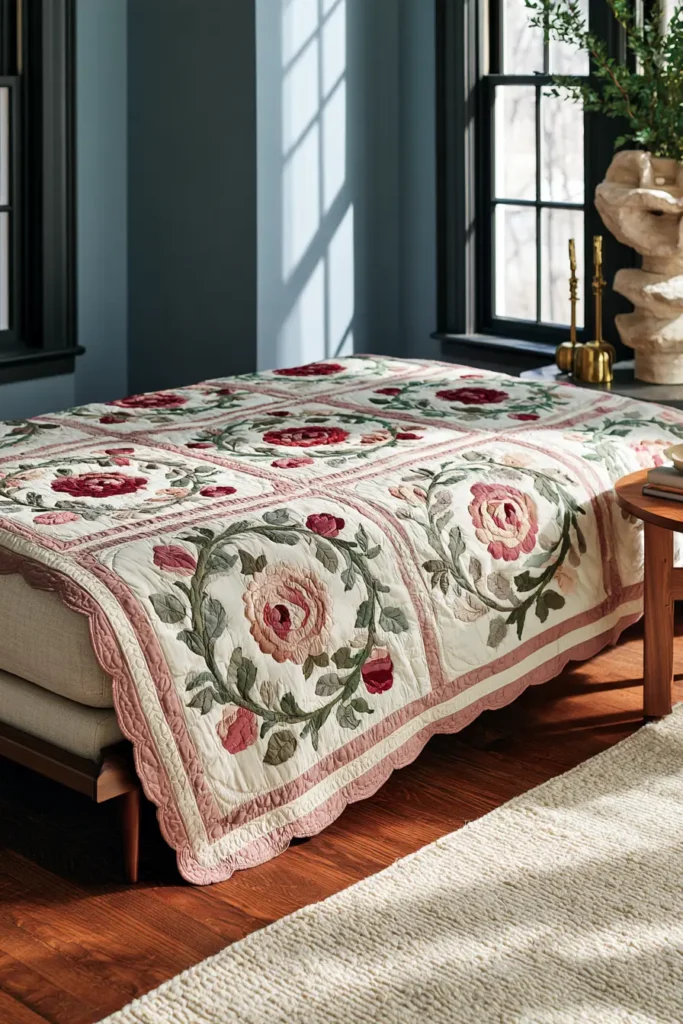
A vintage rose appliqué quilt brings together romantic floral detail, carefully arranged wreath blocks, and gracefully curved scalloped borders. Its defining feature is the repeated circular arrangement of roses, stems, and leaves appliquéd onto a light background. Unlike quilts that depend on printed floral fabrics alone, this design builds its flowers from individual fabric shapes, giving the petals and foliage more definition. Dusty pink, antique rose, muted burgundy, and sage green create a traditional palette, while ivory backgrounds and subtle quilting stitches allow the wreaths to remain the main attraction.
The design draws on the visual character of traditional heirloom appliqué, where balanced motifs, thoughtful fabric placement, and decorative borders contribute to the finished appearance. Each wreath can contain several roses at different stages of bloom, connected by gently curving stems and smaller leaves. Repeating these arrangements across square blocks creates an orderly composition without making the quilt feel rigid. Scalloped outer edges soften the rectangular overall shape and provide a distinctive finish. This combination makes the style particularly appealing for romantic bedrooms, vintage-inspired interiors, and decorative quilts intended to showcase detailed handwork.
Design Inspirations – Digitally Modified Images. Texture and color may vary from the actual product.
Choosing Fabrics and Building a Romantic Rose Palette
Medium-weight woven quilting cotton is a practical choice for the background and appliqué pieces because it provides stability while remaining manageable around curved shapes. For the roses, combine several related shades rather than using one flat pink throughout. Pale blush, dusty rose, muted raspberry, and antique burgundy can create depth within individual blossoms. Small-scale tonal prints, subtle marbling, and lightly mottled cottons work especially well because they suggest natural variation in petals without introducing distracting patterns.
Use sage, olive, and muted forest green for stems and leaves, balancing darker foliage with lighter blossoms. An ivory or warm cream background helps define the curved appliqué shapes and gives the quilt its characteristic heirloom appearance. Avoid highly patterned background fabrics that compete with the wreaths.
A restrained palette usually works better than introducing too many unrelated floral colors. If you want greater variation, distribute deeper rose shades across the quilt rather than concentrating them in only a few blocks. Keeping the background and sashing consistent will help different wreath compositions feel connected.
Wreath Block Arrangement and Scalloped Border Design
The wreath arrangement is the most recognizable feature of this quilt. Each square block contains a circular composition of roses and foliage, with enough background space around the outside to keep the wreath visually distinct. Individual flowers can vary slightly in size and orientation, but the overall arrangement should retain a balanced circular shape.
Consider using larger rose clusters at several points around each wreath, connected by slender curved stems and smaller leaves. This creates movement without allowing the floral elements to become crowded. Leaving open space in the center of each wreath also strengthens the circular composition and prevents the blocks from resembling densely printed floral squares.
Narrow ivory or coordinating sashing can separate the blocks while preserving an uninterrupted heirloom appearance. For a bed quilt, larger wreath blocks provide enough room for the appliqué details to remain visible. Smaller blocks may work well for decorative throws or wall hangings, although intricate petals become more demanding as their scale decreases.
The scalloped border deserves equal attention. Its curves should follow a consistent rhythm around the outer perimeter, complementing the rounded wreath motifs. A narrow bias binding in dusty rose or coordinating sage can emphasize the scalloped silhouette. Plan the curve depth carefully, since excessively tight scallops are harder to bind neatly and may distract from the floral composition.
Appliqué Stitching, Quilting Texture, and Finishing Details
Needle-turn appliqué offers a traditional appearance with smoothly finished fabric edges, while carefully stitched fusible appliqué can provide another practical approach. Whichever method is chosen, the fabric shapes should remain recognizable as sewn appliqué rather than appearing to be printed directly onto the background.
Thread colors that closely match the rose petals and leaves help maintain a refined appearance. Slightly contrasting stitches may be used where a more handcrafted finish is desired, but heavily outlined petals can make the flowers appear overly graphic.
For the quilting itself, delicate echo quilting around the wreaths can emphasize the flower shapes and create subtle texture in the surrounding background. Fine curved quilting lines or restrained feather-inspired motifs can complement the traditional style. Low-loft cotton batting is a practical option when you want the appliqué and stitching details to remain prominent without excessive surface bulk.
The binding should follow the scalloped perimeter smoothly, including the inward curves between scallops. Carefully handled bias binding is particularly useful because it can conform to curved edges more readily than straight-grain strips.
Common Mistakes and Practical Design Considerations
One of the most common mistakes is using too many similar fabric values, causing the roses to disappear into their leaves or backgrounds. Check the contrast between blossoms, foliage, and ivory fabric before committing to the full layout. Rose petals also need enough variation in shape and placement to look natural rather than forming identical circular patches.
Avoid crowding the wreaths with excessive leaves or additional flowers. The open space between the floral elements is important to the design. Similarly, placing wreath blocks too close together without adequate separation can weaken their individual circular outlines.
Scalloped borders require thoughtful planning. Unevenly sized curves, overly deep scallops, or binding pulled too tightly around inward curves can produce an irregular outer edge. Testing a short scalloped sample before finishing a larger quilt is a sensible approach.
This design is especially worth exploring if you enjoy detailed floral compositions and traditional textile finishes. It allows room for personal interpretation through rose shapes, fabric shades, wreath proportions, and stitching styles while retaining the recognizable character of a vintage appliqué quilt.
Helpful Note: Before arranging the full quilt, prepare a sample wreath using your selected rose, leaf, and background fabrics. View it from across the room as well as close up. This helps reveal whether the petals have enough contrast, the circular arrangement reads clearly, and the floral details are appropriate for the intended quilt size.
Other Design Inspirations – Digitally Modified Images. Texture and color may vary from the actual product.
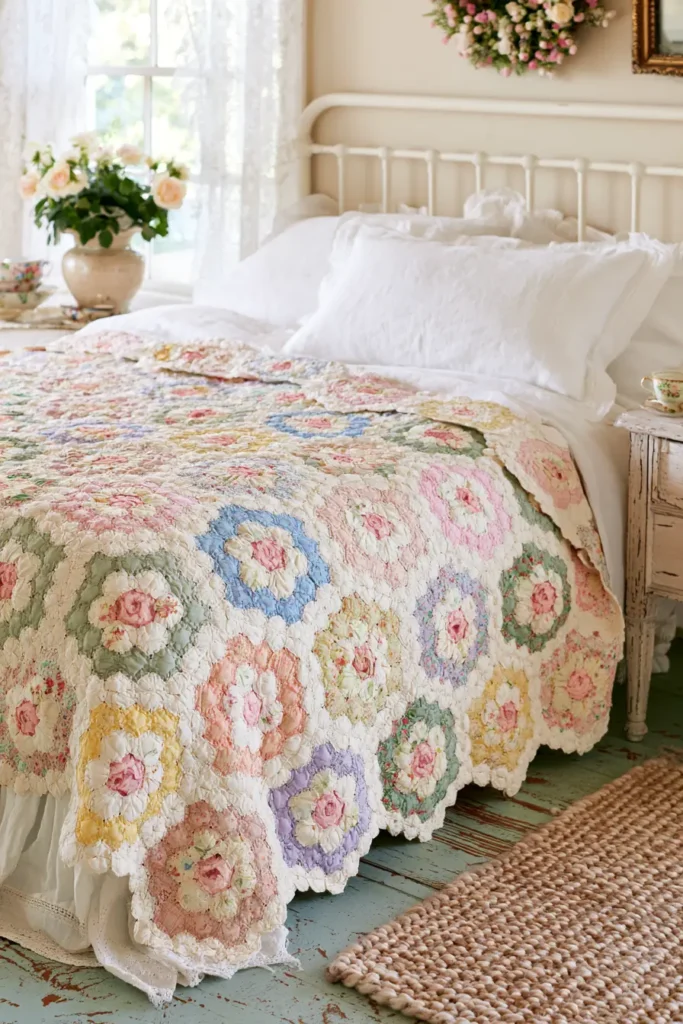
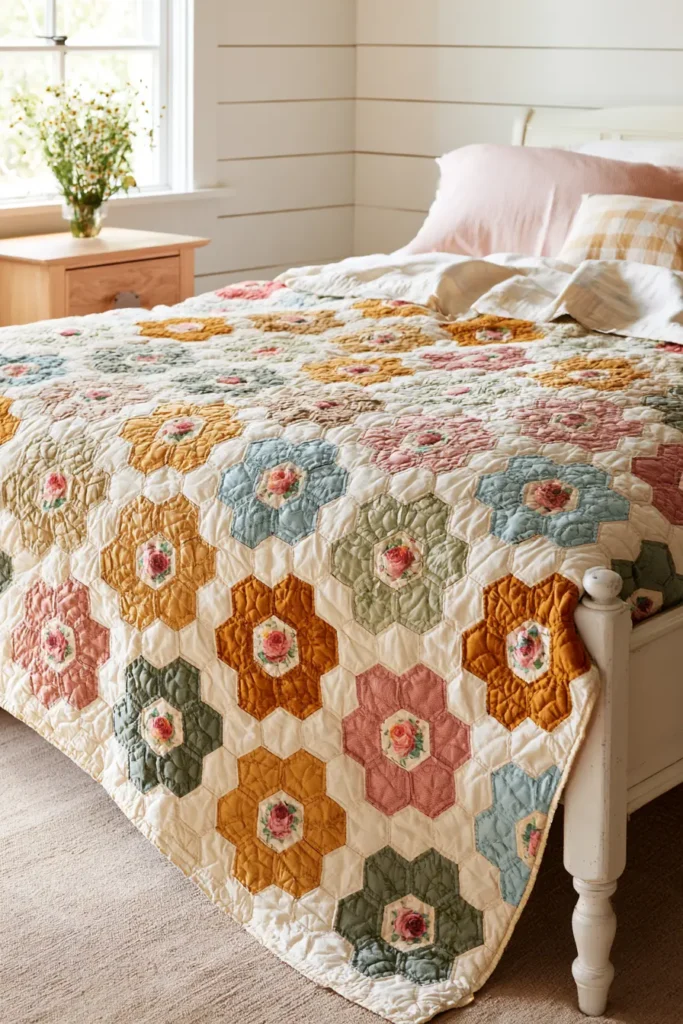
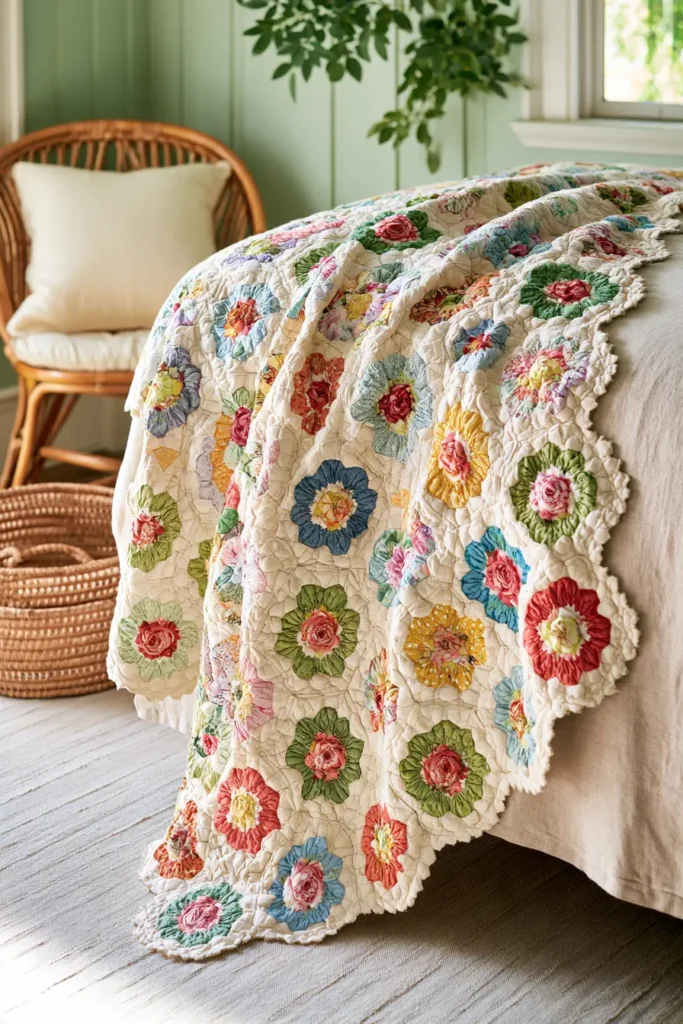
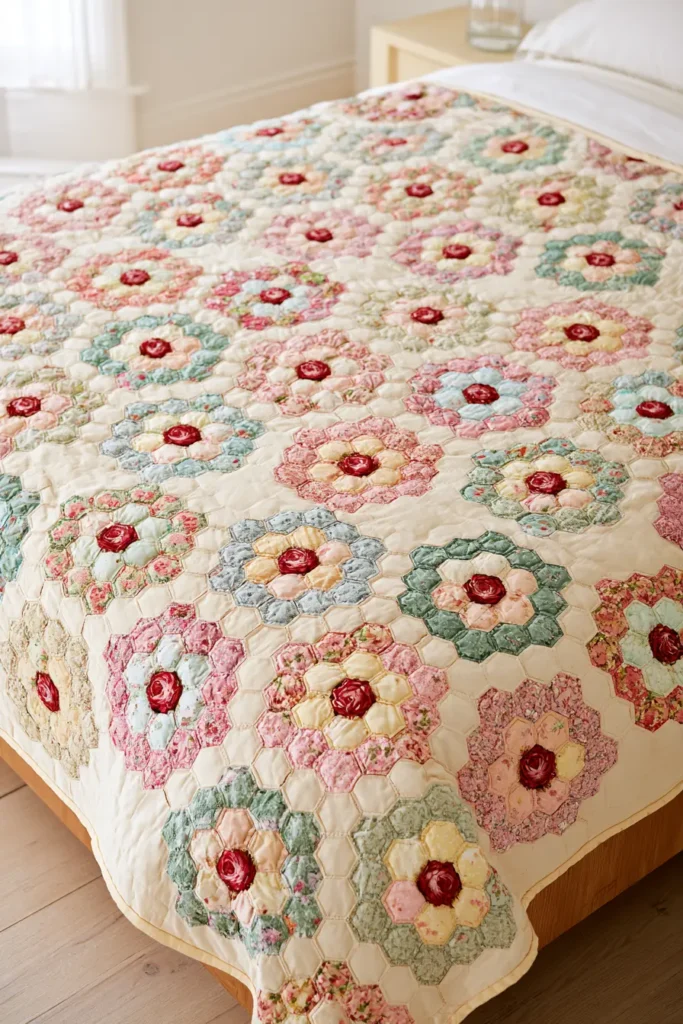
2. Grandmother’s Flower Garden Quilt with Colorful English Paper-Pieced Hexagons and Fussy-Cut Rose Centers
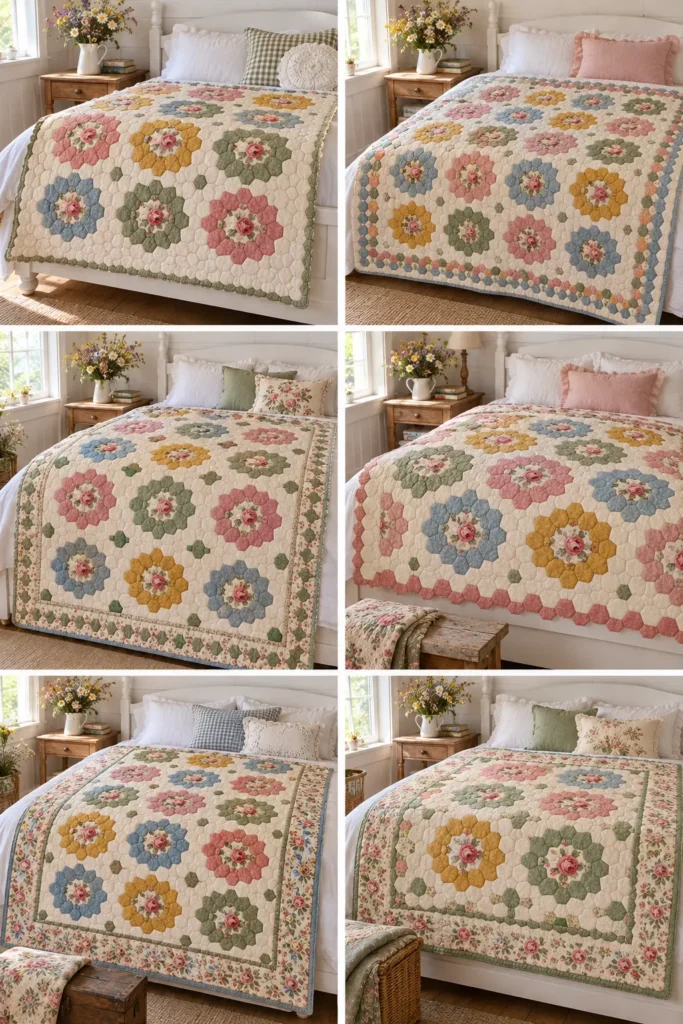
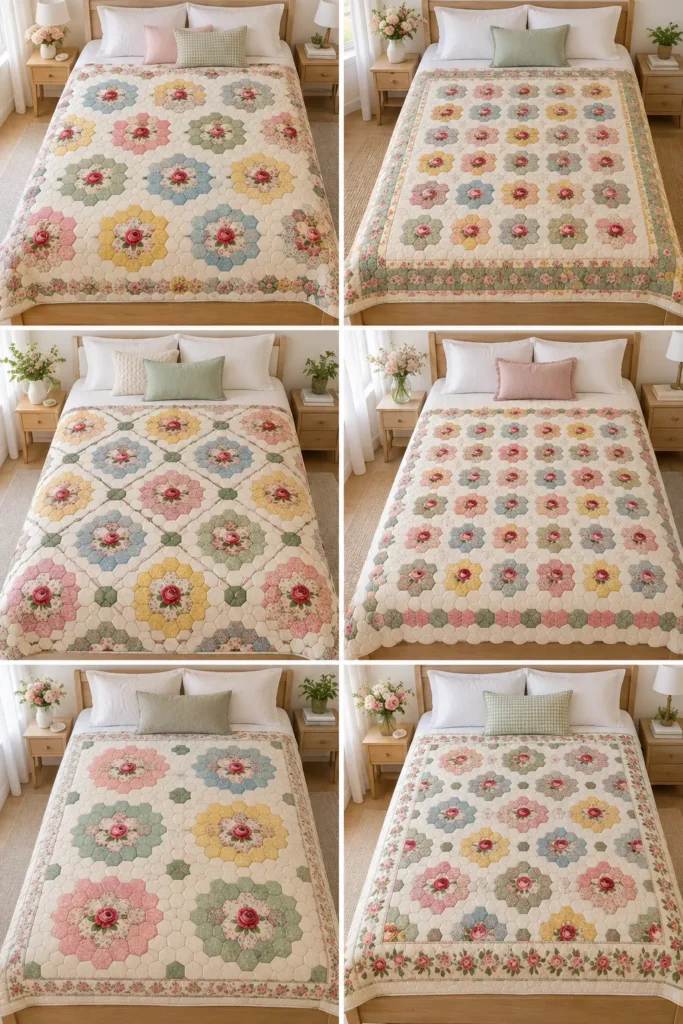
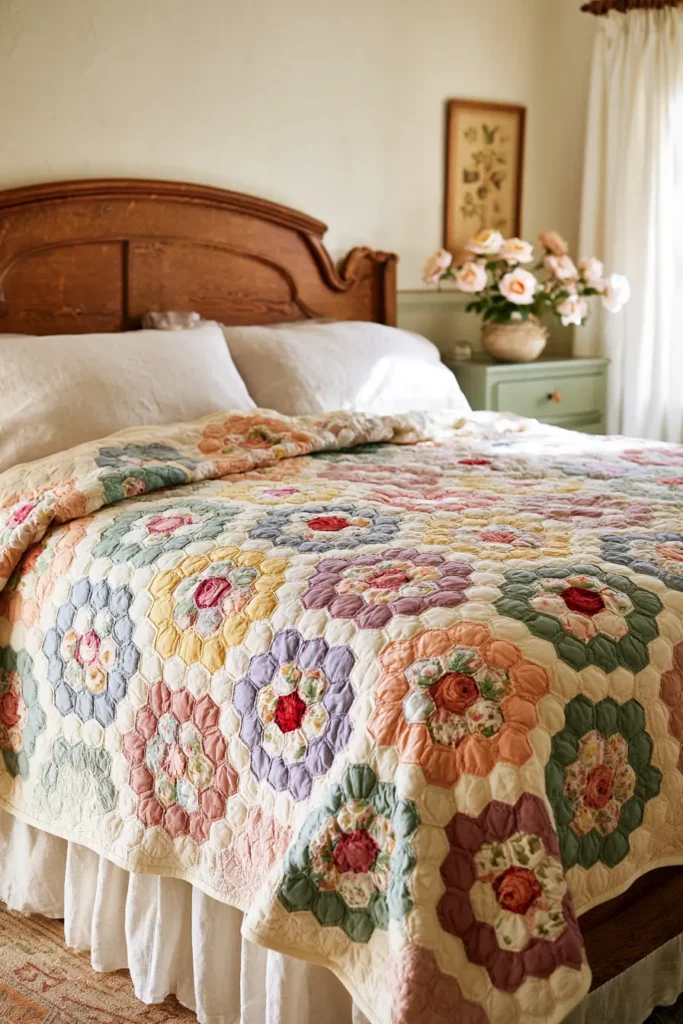
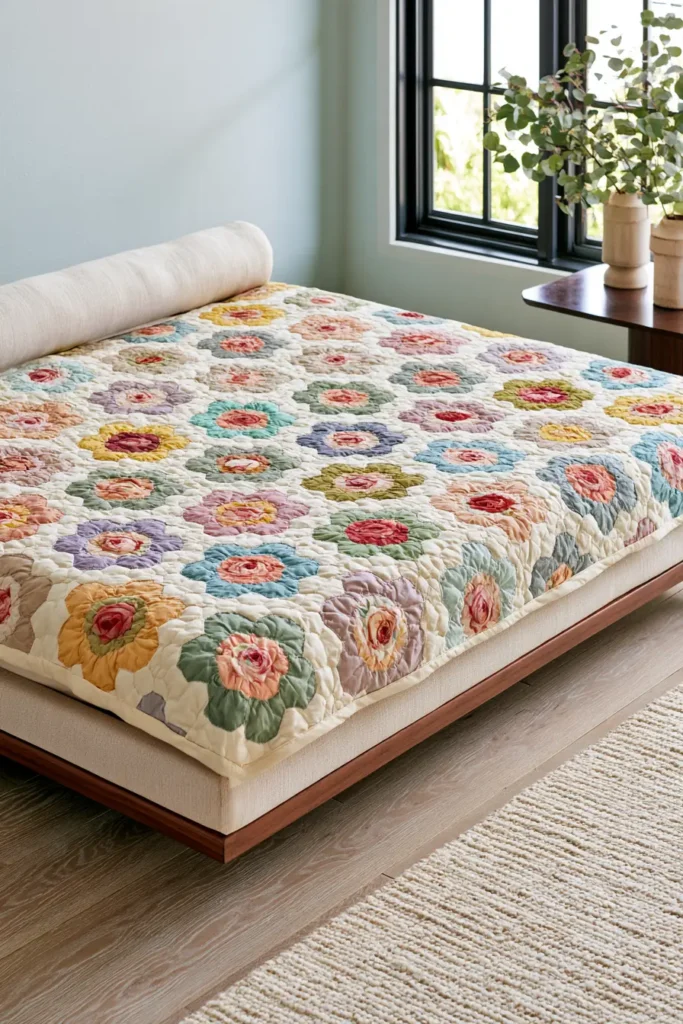
A Grandmother’s Flower Garden quilt is instantly recognizable for its charming hexagonal flower clusters, each formed from small fabric pieces arranged into colorful rosettes. This vintage-inspired interpretation gives the traditional design a romantic floral character by placing carefully fussy-cut rose prints at the center of each flower. Surrounding hexagons in dusty pink, butter yellow, lavender, sage green, and soft blue create a lively patchwork garden, while ivory pathways separate the blooms and emphasize their distinctive six-sided geometry. The result combines intricate geometric piecing with the gentle character of vintage botanical fabrics.
English paper piecing (EPP) is particularly well suited to this design because temporary paper templates help maintain accurate hexagon shapes while the fabric pieces are joined by hand. A classic flower unit consists of one central hexagon surrounded by six petal hexagons, although more elaborate arrangements can include additional rings. Unlike Dresden Plate flowers with wedge-shaped petals or rose wreaths formed through appliqué, Grandmother’s Flower Garden creates its floral motifs entirely through the arrangement of joined geometric pieces. The repeated clusters produce a cheerful, collected-over-time appearance that works beautifully in cottage-style bedrooms, traditional interiors, and colorful handmade throws.
Design Inspirations – Digitally Modified Images. Texture and color may vary from the actual product.
Choosing Floral Fabrics and Fussy-Cut Rose Centers
Small-scale quilting cotton prints are especially appealing for this design because they allow delicate floral details to remain recognizable within individual hexagons. Choose vintage-inspired rose fabrics with clearly defined blossoms, ideally surrounded by relatively quiet backgrounds. Soft raspberry, antique pink, muted coral, and faded red roses can provide attractive focal points without making every flower cluster look identical.
Fussy cutting involves positioning the fabric pattern deliberately so a selected motif appears in a particular part of the finished patch. Here, the goal is to feature an individual rose within each central hexagon. Look for prints with enough space around the blossoms to accommodate seam allowances without cutting away important petals. Fabrics with widely spaced roses are often easier to work with than densely packed floral prints.
For the surrounding petals, combine small botanical prints, subtle gingham, tonal cottons, and coordinating solids. Butter yellow and pale peach can brighten dusty rose centers, while lavender, cornflower blue, soft teal, and sage green introduce gentle contrast. Use stronger colors selectively so the quilt feels lively rather than visually scattered.
Stable, medium-weight quilting cotton is a practical choice for English paper piecing because it folds neatly around templates and maintains its shape during hand sewing. Lightweight cotton lawn can also be suitable, but extremely thin or loosely woven fabrics may require additional care, particularly when combined with heavier cottons.
Creating Colorful Hexagon Rosettes and Garden Pathways
The visual strength of a Grandmother’s Flower Garden quilt comes from the relationship between its individual flower clusters and the spaces connecting them. Each rosette should read clearly as a flower, with six recognizable hexagonal petals surrounding its central rose print. Color placement is important: if the center and surrounding petals are too similar in value, the flower can lose definition.
Try combining a darker rose-print center with medium-value petals, or surround a pale central rose with stronger colors such as raspberry, muted teal, or golden yellow. Alternating lighter and darker flower clusters across the quilt creates visual rhythm without requiring a rigid repeating color sequence.
Ivory or warm cream hexagons between the rosettes provide the traditional garden-path effect. These connecting pieces help individual flowers remain distinct while creating a continuous geometric structure across the quilt. A consistent pathway color also brings unity to an assortment of otherwise unrelated floral scraps.
Hexagon size influences the overall appearance. Smaller pieces create delicate, intricate flower clusters and offer opportunities to use tiny floral motifs. Larger hexagons produce bolder flowers, make individual prints easier to appreciate, and require fewer pieces to cover the same area.
Before committing to a large quilt, consider arranging several completed flower units together to evaluate their color relationships. A successful layout balances brighter blossoms with quieter arrangements and distributes strong colors throughout the design rather than concentrating them in one area.
English Paper Piecing, Quilting Texture, and Finishing
English paper piecing uses temporary templates to support accurately shaped fabric pieces during assembly. The method is particularly useful for hexagons because their angled edges and intersections require consistent alignment. Traditional hand sewing allows the pieces to be joined with controlled, relatively small stitches while preserving their characteristic six-sided outlines.
The finished patchwork should remain relatively flat, with subtle seam texture rather than heavily raised or stuffed sections. Once the top is ready for quilting, low-loft cotton batting is a suitable option for maintaining a flexible textile and keeping the intricate hexagonal pattern prominent.
Simple quilting often complements this design better than elaborate stitching that competes with the fabric arrangement. Gentle hand quilting inside selected hexagons, restrained stitching along flower outlines, or carefully planned machine quilting can add texture while preserving the visual clarity of the rosettes.
Finishing choices also affect the quilt’s appearance. A straight outer edge with narrow coordinating binding creates a tidy, practical finish, while preserving a stepped hexagonal perimeter produces a more traditional geometric silhouette but requires greater care in finishing the edges.
For a vintage-inspired bedroom, the colorful patchwork pairs naturally with cream bedding, warm wood furniture, and understated botanical accessories. The same design can also work as a sofa throw, particularly when the hexagon flowers are large enough to remain recognizable when the quilt is draped.
Common Mistakes and Practical Tips for Hexagon Quilts
One common mistake is choosing floral prints that are too large for the center hexagons. A beautiful rose may become unrecognizable if most of its petals disappear into the seam allowances. Test the placement of the motif within the intended template before cutting multiple centers.
Another issue is inconsistent hexagon sizing or fabric folding around the templates. Small inaccuracies can accumulate as flower units are joined, making it difficult to maintain flat, evenly aligned patchwork. Use consistent templates and handle the fabric edges carefully, especially where several corners meet.
Color balance deserves equal attention. Too many highly saturated petals can make the quilt appear busy, while excessive use of similar pale colors may cause the flowers to blend into the connecting pathways. Distribute contrasting colors deliberately and allow the cream background hexagons to provide visual rest.
When using reclaimed or older floral cottons, inspect the fibers for thinning, fading, and weakness. Fabrics that are too fragile may not withstand repeated handling or regular use. Combining materials with similar weights and compatible care requirements will generally produce a more consistent finished surface.
Avoid overly dense quilting that obscures the hexagon outlines or makes the quilt unnecessarily stiff. The appeal of this design lies in its recognizable flower clusters, carefully selected fabrics, and precise geometric arrangement.
Helpful Note: When choosing rose prints for fussy-cut centers, make a simple window template matching the visible finished area of your hexagon. Move it across the fabric to check how different blossoms will appear after sewing. This helps you identify suitable motifs and estimate how much extra fabric you may need for accurate placement.
Other Design Inspirations – Digitally Modified Images. Texture and color may vary from the actual product.
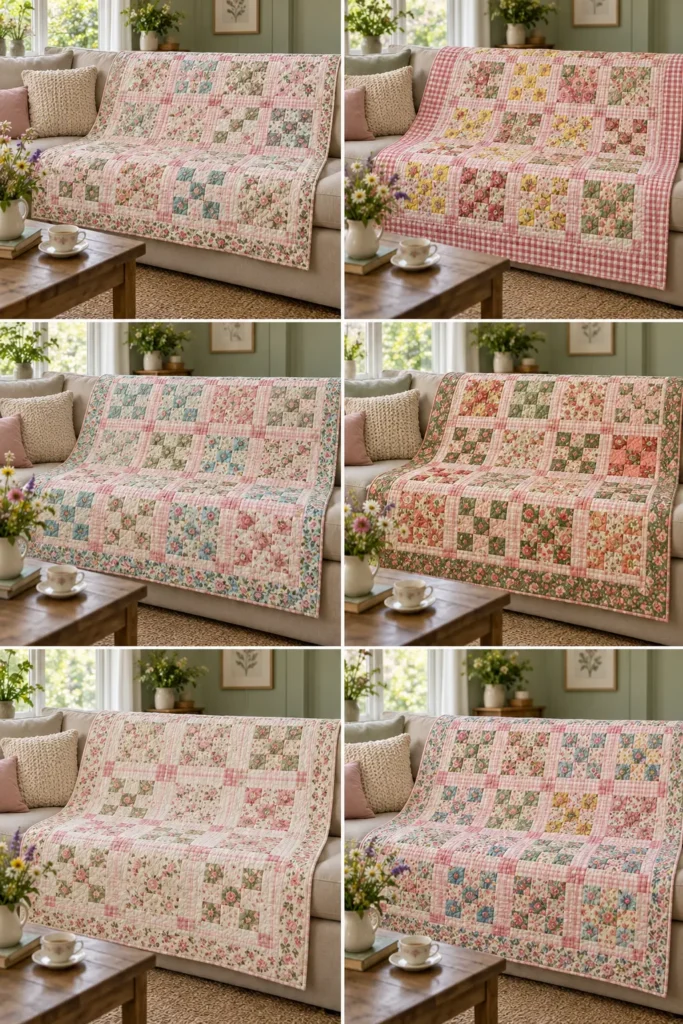
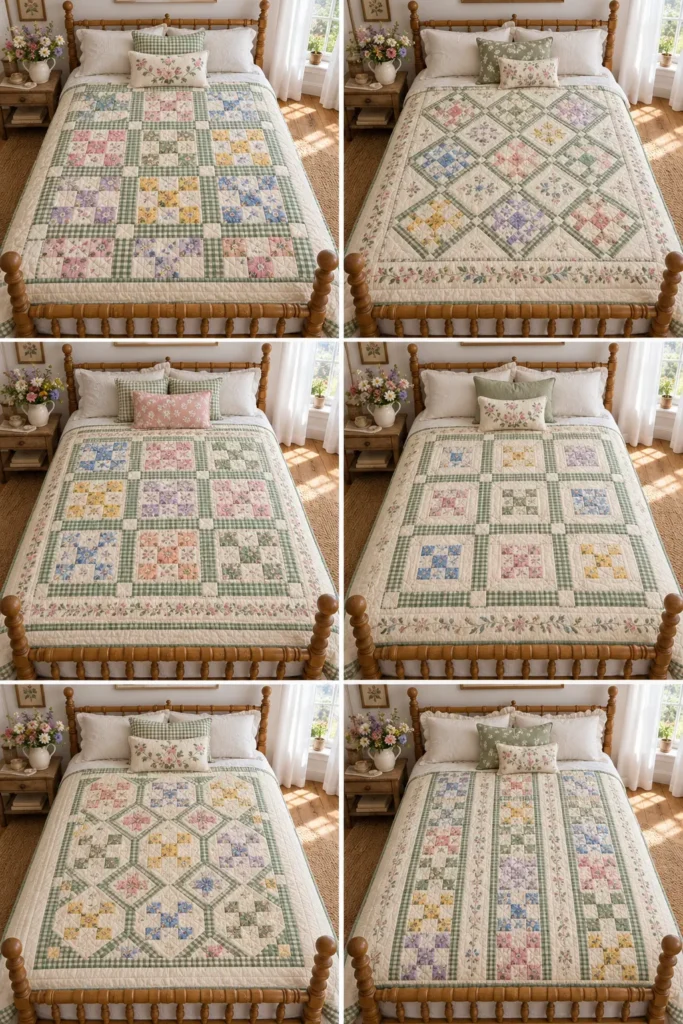
3. Scrappy Cottage Garden Patchwork Quilt with Ditsy Floral Nine-Patch Blocks and Gingham Sashing
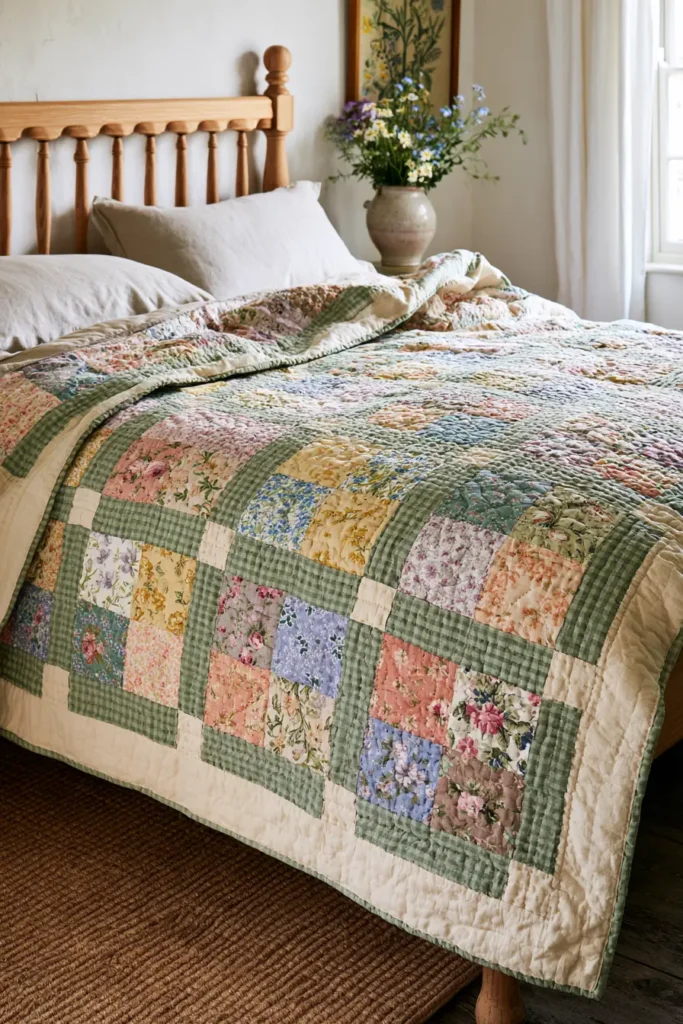
A scrappy cottage garden patchwork quilt captures the relaxed charm of vintage floral fabrics through a neatly organized arrangement of traditional nine-patch blocks. Each block combines nine small fabric squares into a simple three-by-three grid, creating a repeating pattern filled with miniature rosebuds, scattered daisies, delicate lavender sprigs, and tiny blue wildflowers. Soft pink, butter yellow, sage green, dusty lavender, and pale cornflower blue give the quilt a cheerful garden-inspired palette. Narrow gingham sashing separates the blocks, introducing a gentle checked pattern that complements the florals while keeping the overall layout structured and easy to appreciate.
The appeal of this design comes from its balance between scrappy fabric variety and traditional patchwork geometry. Nine-patch quilting has a long-established place in patchwork traditions, and its straightforward construction makes it particularly suitable for combining small fabric remnants. Unlike a Log Cabin quilt, where strips build outward around a central square, the nine-patch creates a balanced grid of equally sized pieces. The gingham sashing adds another recognizable cottage-inspired detail, giving the quilt a more intentional appearance than an uninterrupted collection of mixed floral squares. This combination works especially well for welcoming bedrooms, vintage-inspired guest rooms, and comfortable living spaces with natural wood furniture and soft neutral textiles.
Design Inspirations – Digitally Modified Images. Texture and color may vary from the actual product.
Choosing Ditsy Floral Fabrics and Cottage Garden Colors
Small-scale floral prints are the foundation of this quilt’s character. Look for quilting cottons featuring miniature roses, forget-me-nots, scattered daisies, tiny leaves, and delicate botanical sprigs. Prints with relatively small motifs work particularly well because individual flowers remain visible within the nine-patch squares without overwhelming the surrounding fabrics.
A successful scrappy palette does not require every fabric to match perfectly. Instead, choose a few recurring colors that connect the assortment. Dusty pink, muted coral, butter yellow, sage green, and soft lavender create a romantic cottage garden effect, while pale blue and warm ivory prevent the palette from becoming too heavily pink.
Combine floral prints with occasional coordinating solids or subtle tone-on-tone cottons. These quieter patches give the eye somewhere to rest and make the more detailed prints stand out. For example, a square of sage-green cotton beside a tiny pink rose print creates gentle contrast, while cream fabric can brighten a block containing several darker florals.
Medium-weight woven quilting cotton is a practical choice because it maintains its shape during cutting, sewing, and pressing. Fabric remnants can contribute to the scrappy appearance, but they should have compatible weights and similar care requirements. Avoid combining very thin cotton lawn with heavy upholstery fabrics, as differences in thickness and handling can produce uneven seams.
Vintage-inspired prints can also work beautifully without requiring genuinely old fabric. If using reclaimed cottons, examine them for fading, weak fibers, and worn areas before incorporating them into the quilt.
Creating Nine-Patch Blocks with Gingham Sashing
The defining feature of this design is its repeated arrangement of nine-patch blocks separated by gingham sashing. Each block contains three rows of three square patches, allowing small floral prints and coordinating fabrics to form a recognizable geometric pattern.
For a lively but balanced appearance, vary the floral combinations between blocks while maintaining a consistent overall color family. Some blocks might emphasize blush and cream, while others feature lavender, pale blue, and butter yellow. Repeating a few fabrics in different areas helps connect the blocks without making the arrangement appear overly planned.
Consider using stronger prints in selected corner or center squares, then balancing them with quieter fabrics nearby. An occasional darker raspberry or olive-green patch can add depth, but distributing these accents across the quilt is more effective than concentrating them in one section.
Gingham sashing provides the visual framework. A small sage-green-and-ivory check creates a traditional cottage appearance, while dusty blue gingham offers a slightly fresher interpretation. Choose a gingham check that is noticeably smaller than the main nine-patch squares so the sashing remains a supporting detail rather than competing with the floral blocks.
The sashing width also influences the finished appearance. Narrow strips keep the floral blocks visually connected, while wider strips emphasize the individual nine-patch units and introduce more breathing space. Small cream cornerstones at the sashing intersections can provide additional separation if the checked fabric makes those intersections appear too busy.
Before finalizing the arrangement, view the blocks together from a distance. The nine-patch structure should remain recognizable, with the gingham forming a consistent grid across the quilt.
Quilting Texture and Finishing Details
This design benefits from restrained quilting that complements its traditional patchwork construction. Simple straight-line quilting along or near the block seams can reinforce the geometric arrangement without competing with the floral fabrics. Gentle diagonal quilting across the blocks is another option, introducing movement while maintaining the quilt’s orderly appearance.
Low-loft cotton batting is suitable for a classic, relatively flat patchwork finish. It allows the quilt to remain flexible and helps the individual fabric squares lie smoothly. A cotton-rich batting or other compatible low-loft option may also work, depending on the desired drape and care requirements.
Pressing the patchwork seams carefully helps maintain accurate block dimensions and reduces unnecessary bulk where several squares meet. Because gingham has a visible checked pattern, its alignment deserves particular attention. Crooked checks can make otherwise accurately sewn sashing appear uneven.
For the outer edge, a narrow sage-green binding creates a cohesive finish, especially when paired with green gingham sashing. Alternatively, dusty rose or muted blue binding can pick up a recurring color from the patchwork.
A simple cream outer border is another attractive option if the quilt needs additional visual breathing space. Keep the finishing details understated so the ditsy floral fabrics and gingham grid remain the main decorative features.
Common Mistakes and Practical Design Tips
One of the easiest mistakes is introducing too many competing floral prints without a consistent color strategy. Scrappy does not have to mean completely random. A varied assortment works best when recurring colors, similar print scales, or repeated background tones provide some visual unity.
Using gingham with very large or strongly contrasting checks can also weaken the finished appearance. Since both the floral patches and the sashing contain patterns, an overly bold gingham may distract from the nine-patch blocks. Smaller checks in muted colors generally provide a more balanced result.
Pay attention to fabric values as well as colors. If every patch is similarly pale, the quilt may look visually flat. Incorporating a few medium and darker values helps define individual blocks while preserving the relaxed cottage garden character.
Accurate patch dimensions matter because small inconsistencies can accumulate across a repeated nine-patch layout. Maintain consistent seam allowances and press carefully to keep the squares aligned. Avoid stretching fabric along the edges, especially when joining blocks to longer sashing strips.
Finally, distinguish this design from more irregular scrappy patchwork by preserving its recognizable grid. The charm should come from the assortment of floral fabrics, not from unevenly shaped patches or inconsistent block construction.
Helpful Note: Arrange several sample nine-patch blocks alongside your chosen gingham before committing to the full quilt. Photograph the arrangement and view it in grayscale as well as color. This can reveal areas with insufficient contrast, overly dominant prints, or unevenly distributed dark fabrics that may be less obvious when examining individual squares.
Other Design Inspirations – Digitally Modified Images. Texture and color may vary from the actual product.
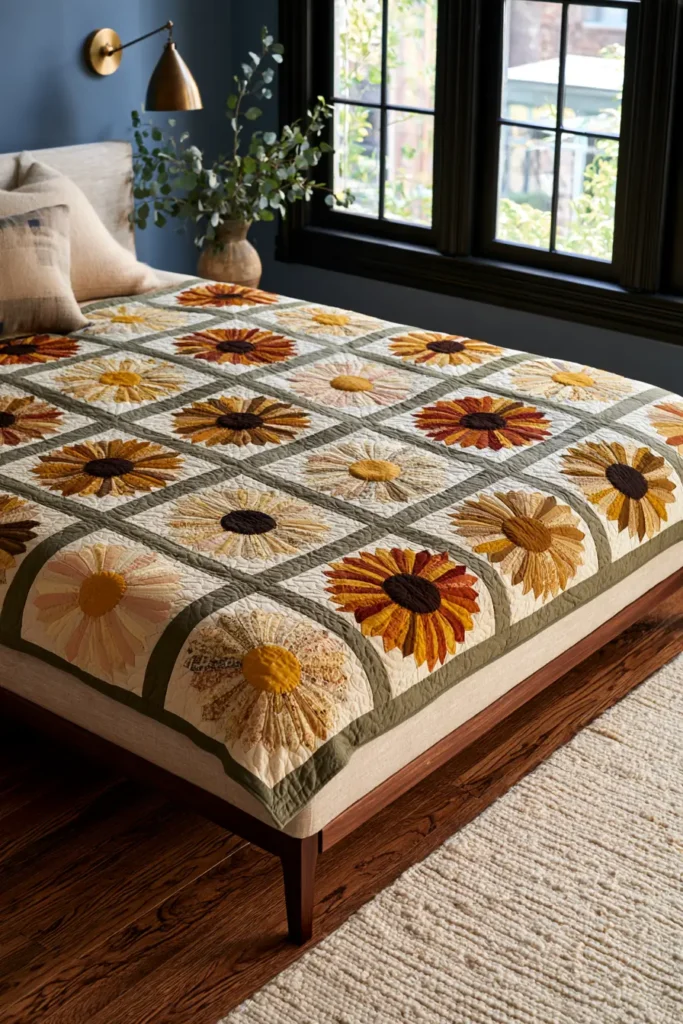
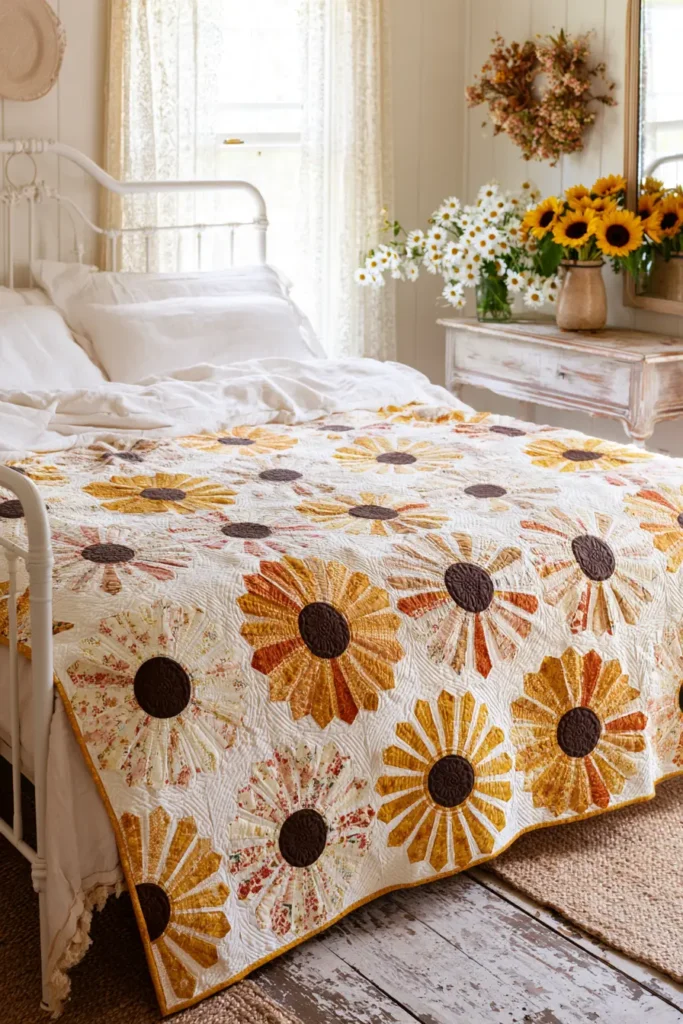
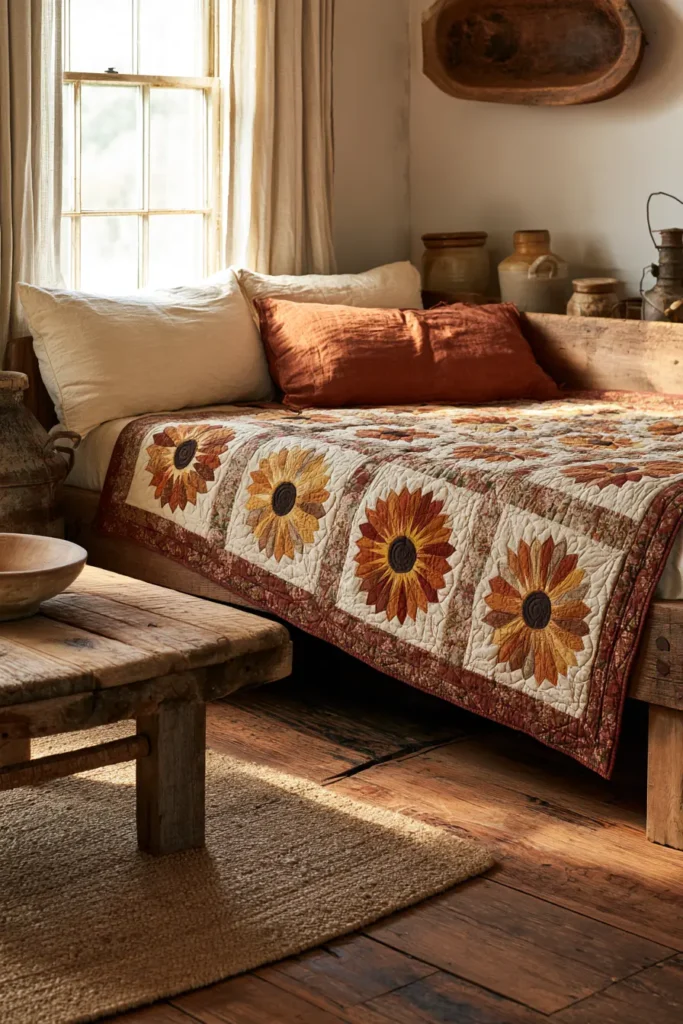
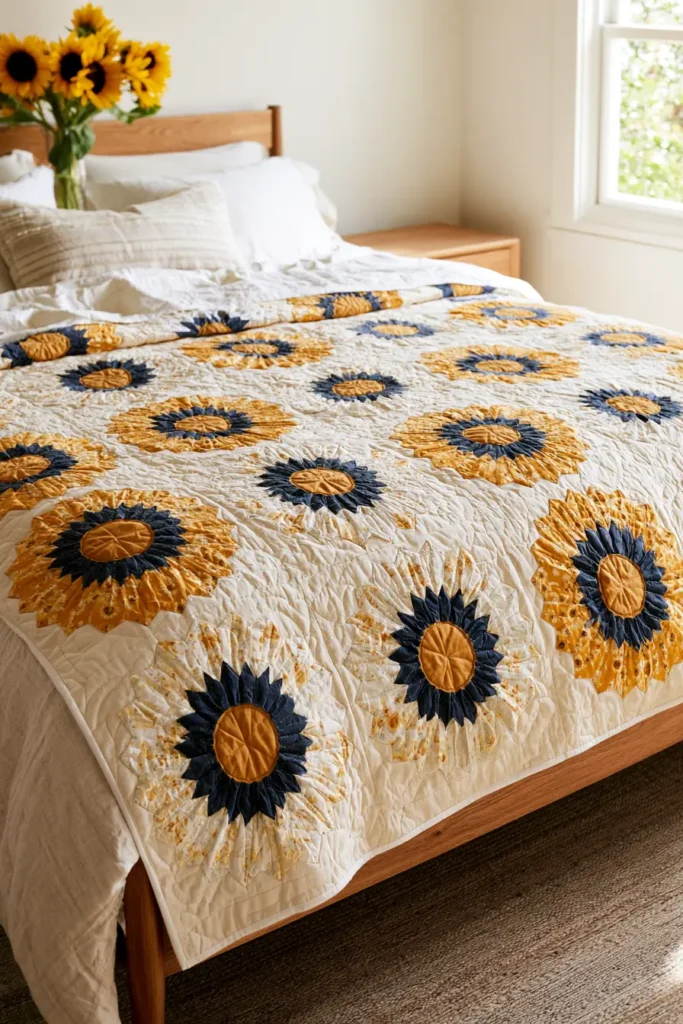
4. Dresden Plate Daisy and Sunflower Quilt with Radiating Petals and Bold Contrasting Centers
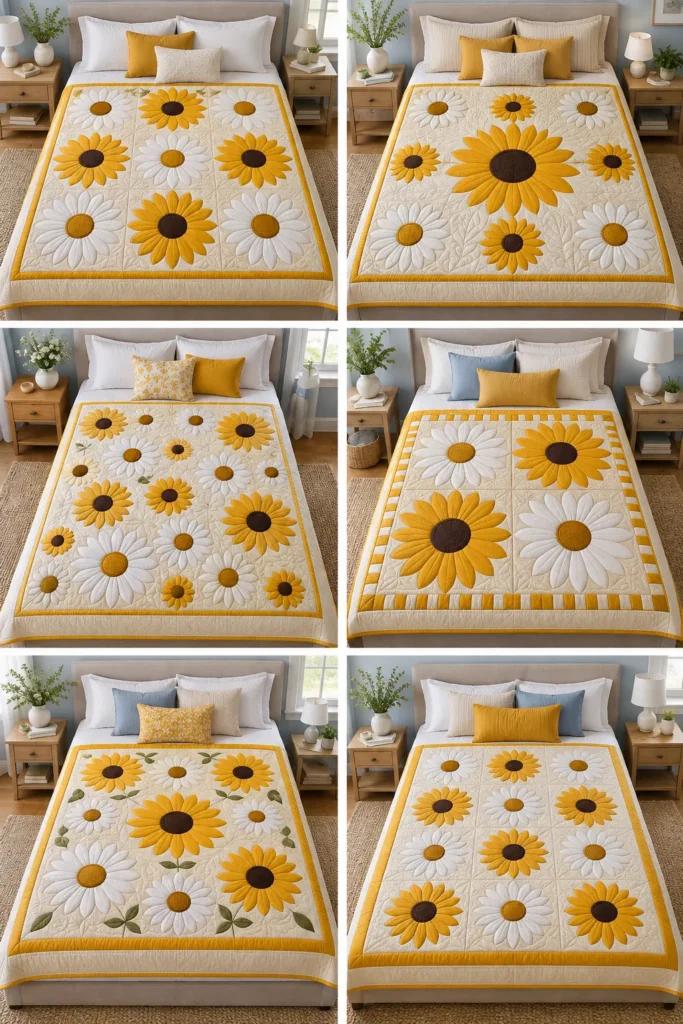
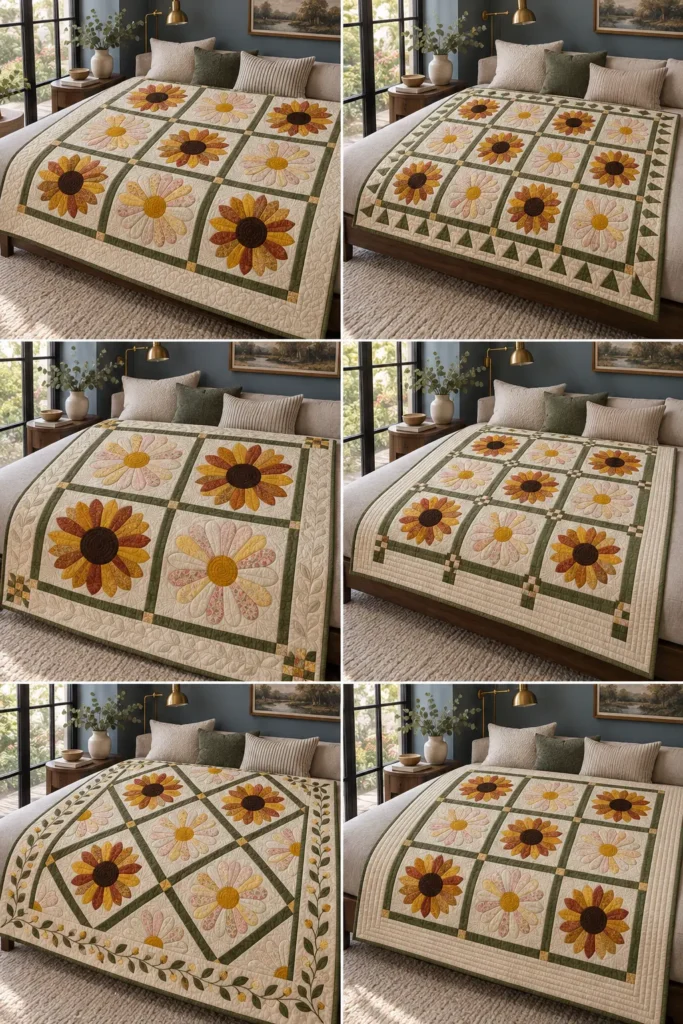
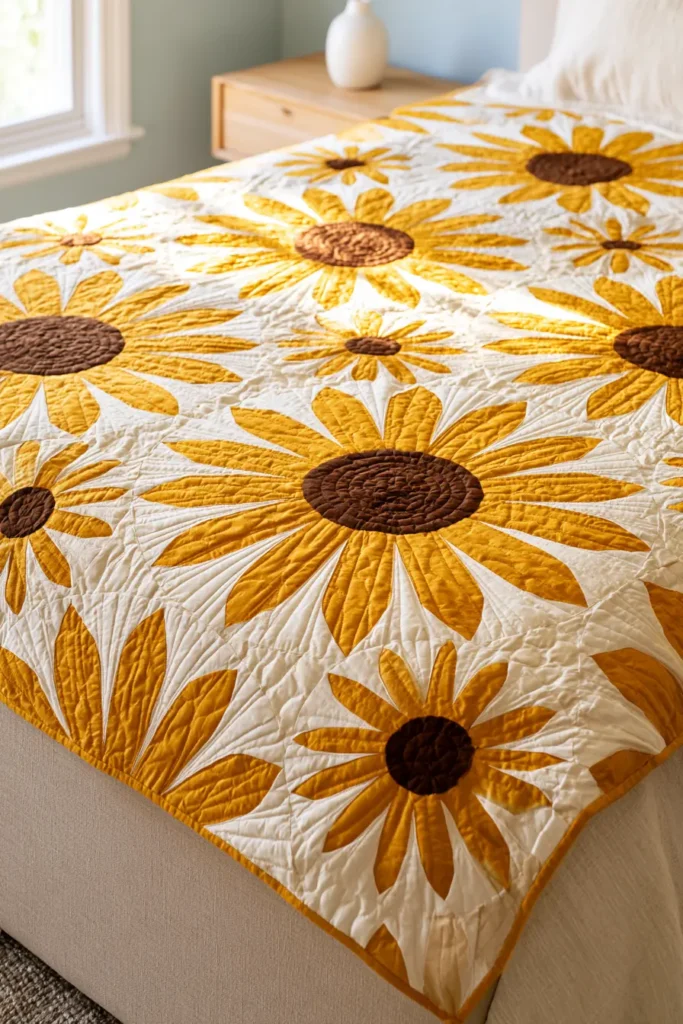
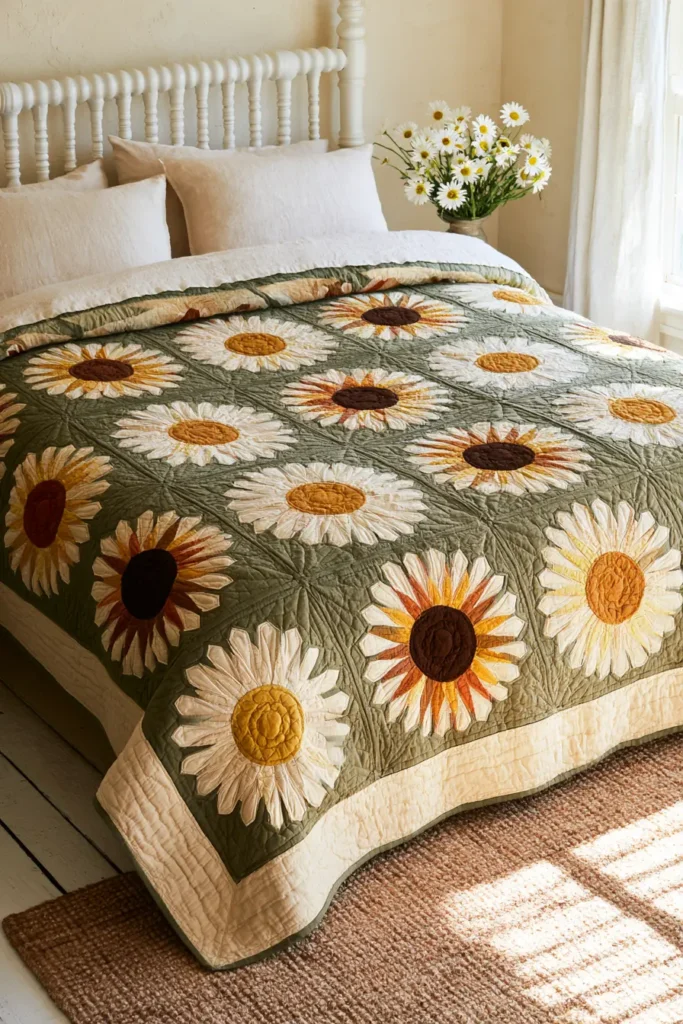
A Dresden Plate daisy and sunflower quilt celebrates the beauty of circular floral patchwork, using radiating fabric petals and bold contrasting centers to create cheerful, garden-inspired blocks. The design combines two recognizable flowers: delicate daisies with ivory, butter-yellow, and pale blush petals surrounding golden centers, and vibrant sunflowers with mustard, amber, and burnt-orange petals surrounding deep chocolate-brown centers. Arranged across warm cream backgrounds, these flowers create a lively composition that balances traditional patchwork craftsmanship with the relaxed warmth of farmhouse décor.
Dresden Plate quilting is a traditional patchwork technique in which wedge-shaped fabric pieces, often called blades, are joined to form circular or fan-shaped arrangements. Individual blade ends may be pointed or rounded, depending on the chosen pattern. A circular fabric center typically covers the inner blade edges, creating the distinctive flower-like appearance. Unlike Grandmother’s Flower Garden quilts, which form flowers from joined hexagons, Dresden Plate designs create their petals through radial piecing. They also differ from traditional floral appliqué, where individual rose petals and foliage are arranged directly onto the background. Here, the repeated wedge structure gives each flower its recognizable geometric character, while fabric selection and petal shape distinguish daisies from sunflowers.
Design Inspirations – Digitally Modified Images. Texture and color may vary from the actual product.
Choosing Fabrics for Daisy and Sunflower Dresden Plates
The strongest fabric combinations emphasize the differences between the two flower types while maintaining a coordinated garden-inspired palette. For daisy blocks, consider ivory, cream, pale butter yellow, delicate blush, and muted peach. These lighter fabrics create an airy appearance, particularly when paired with golden-yellow or warm mustard centers. Subtle tonal prints and small-scale botanical patterns can introduce gentle variation without distracting from the petal shapes.
Sunflower blocks benefit from deeper, warmer colors. Combine golden yellow, amber, rich mustard, terracotta, and restrained burnt orange to create the impression of sunlit petals. Dark chocolate brown, warm espresso, or muted rust fabrics work particularly well for the centers, providing the strong contrast associated with sunflower designs.
Medium-weight woven quilting cotton is a practical choice for Dresden Plate construction because it holds accurately pieced wedge shapes and presses neatly. Fabrics with small-scale prints, gentle mottling, or subtle tonal variation can provide depth within the petals. Avoid oversized floral prints that become fragmented when divided into narrow blades, particularly when the original motif is no longer recognizable.
A warm ivory background creates a traditional farmhouse appearance while allowing both light daisies and deeper sunflowers to stand out. However, pale daisy petals need sufficient contrast against the background. Slightly deeper cream, soft gold, or blush outlines within the fabrics can help maintain definition.
For a more cohesive quilt, repeat selected colors across both flower types. A touch of terracotta within some daisy blocks or pale yellow within sunflower petals can connect the designs without making the flowers appear identical.
Creating Distinct Petal Shapes and Bold Contrasting Centers
The defining visual feature of a Dresden Plate quilt is its circular arrangement of fabric blades. Each flower should have a balanced radial structure, with the petals joining neatly to form a complete plate.
For a daisy-inspired appearance, choose a Dresden Plate pattern with relatively slender blades and softly rounded or gently pointed outer ends. Lighter-colored petals and bright golden centers reinforce the daisy character. Sunflower-inspired plates can use broader, more pronounced pointed blades, provided the chosen template and blade count form a complete, accurately pieced circle.
These differences are design options rather than requirements of Dresden Plate construction. Using different blade templates for the two flower styles is possible, but each complete plate should follow its own compatible pattern so the wedges meet correctly.
The center circles also deserve careful attention. A daisy center might feature golden-yellow cotton with subtle tonal variation, while a sunflower center can use dark brown fabric with a small-scale speckled print that suggests the flower’s seed-filled disk. The centers should be large enough to cover the inner blade edges neatly without overwhelming the surrounding petals.
Consider varying the center diameter slightly between the flower types, using an appropriately planned pattern. Sunflowers can have visually prominent dark centers, while daisies may feature smaller golden circles.
The goal is to make the two flower types recognizable through their proportions, fabric colors, and center treatments rather than merely changing the color of otherwise identical blocks.
Arranging Dresden Plate Flowers and Choosing a Quilting Style
A repeated grid of large Dresden Plate blocks creates an orderly layout that allows the circular flowers to remain the main attraction. Alternating daisy and sunflower blocks introduces a pleasing rhythm, while generous background space prevents the design from becoming overcrowded.
Distribute the darker sunflower centers across the quilt rather than grouping them in one area. These strong focal points naturally attract attention, so balanced placement helps maintain an even composition. The lighter daisies can provide visual relief between the richer golden flowers.
Narrow olive-green or muted sage sashing can add a subtle garden-inspired framework between the blocks. Alternatively, joining the cream background blocks without contrasting sashing creates a more continuous, open appearance.
For quilting, gentle echo stitching around the Dresden Plate outlines emphasizes the circular motifs and helps the flowers stand out against the background. Straight-line quilting through the surrounding areas can introduce a restrained geometric contrast. Lightly curved quilting motifs are another option, particularly when the background spaces are generous enough to accommodate them.
A low-loft cotton batting helps maintain a traditional, relatively flat quilt surface while allowing the radial seams and center appliqué to remain visible. Fine cotton quilting thread in coordinating ivory or cream can keep the stitching understated.
A straight outer border finished with moss-green, muted olive, or warm cream binding complements the floral palette without competing with the colorful plates. This style works especially well as a bed quilt or decorative throw in a bright country bedroom, farmhouse living room, or welcoming guest space.
Common Mistakes When Planning Dresden Plate Flowers
One of the most important considerations is wedge accuracy. If the blade angles or seam allowances vary, the assembled plate may not form a complete circle or may refuse to lie flat. Use a reliable Dresden Plate template and test a sample before committing to a larger collection of blocks.
Petal contrast is another common issue. Ivory daisy petals can disappear against a similarly colored background, while sunflower petals in several nearly identical gold shades may appear flat. Use enough variation in color value to define the individual wedges without introducing excessive visual clutter.
Avoid choosing center circles that are disproportionately large or small. Oversized centers can conceal too much of the petal structure, while undersized centers may fail to cover the inner blade edges neatly.
Fabric consistency also matters. Combining stiff, heavy fabrics with lightweight quilting cotton can make the radial seams bulky and difficult to press. Similar fabric weights generally produce smoother, more manageable plates.
Finally, avoid making every flower block visually identical. Small variations in fabric placement, petal shades, and print selection create a more natural garden-inspired appearance while preserving the recognizable Dresden Plate construction.
Helpful Note: Before selecting fabrics for the entire quilt, arrange a sample daisy plate and sunflower plate against the same background. View them from several feet away to check whether the flower types are immediately distinguishable. If they look too similar, adjust the blade shapes, center proportions, or contrast between petals and centers before planning the full arrangement.
Other Design Inspirations – Digitally Modified Images. Texture and color may vary from the actual product.
5. Geometric Tulip Quilt with Color-Blocked Petals, Pieced Stems, and Bold Rows
Design Inspirations – Digitally Modified Images. Texture and color may vary from the actual product.
Other Design Inspirations – Digitally Modified Images. Texture and color may vary from the actual product.
6. Floral Log Cabin Quilt with Rose-Print Centers and Contrasting Garden-Toned Strips
Design Inspirations – Digitally Modified Images. Texture and color may vary from the actual product.
Other Design Inspirations – Digitally Modified Images. Texture and color may vary from the actual product.
More to come …
Modern Botanical Appliqué Quilt with Oversized Leaf Silhouettes and Bold Negative Space
Watercolor Floral Quilt with Blended Fabric Squares in a Blush-to-Terracotta Ombré
Tropical Hibiscus Quilt with Oversized Blossoms, Monstera Foliage, and a High-Contrast Black Background
Moody Floral Quilt with Floating Star Blocks and Jewel-Tone Prints on a Deep Navy Background
Vintage Floral Crazy Quilt with Upcycled Handkerchiefs, Lace, and Embroidered Seams
Minimalist Floral Wholecloth Quilt with Quilted Botanical Linework on Natural Linen
Conclusion
Taken together, these Floral Quilt Pattern Ideas show that a flower motif is only the starting point. Construction, scale, contrast, and background choices shape the finished quilt as much as the print does. Appliqué and hexagons favor hand work and detail, while strip piecing and nine-patch blocks make better use of busy scraps. Watercolor squares and dark backgrounds change the mood, and wholecloth stitching or crazy-quilt seams add surface texture of very different kinds. Thoughtful fabric choices, such as stable cottons, tested reclaimed textiles, and prints matched to the block size, matter in every one of them.
Before committing to a full quilt, make one test block or a small group of squares in the fabrics you actually have. Compare a light and a dark background, check how a print looks at the size you plan to cut it, and rearrange the layout until the color flow feels right. Think about the quilt’s size and use too, since a daily-use throw has different needs than a display piece. A short trial like this often settles the major decisions and leaves you with a plan that suits your own fabrics and style.

