
Modern Quilt Jacket, Coat, and Vest: Ideas for Stylish Layering and Contemporary Looks
A Modern Quilt Jacket, Coat, and Vest takes the same three-layer construction that makes a bed quilt warm and durable — pieced top, batting, backing, stitched through — and builds it into outerwear designed to be worn rather than draped. Contemporary versions differ from their predecessors in how the quilting relates to the garment silhouette: the patchwork blocks, quilting lines, and seam placements are chosen with the finished shape in mind, not adapted afterward.
A geometric half-square triangle layout that works well across a flat quilt surface can be engineered to follow the lines of a bomber jacket or a structured blazer in a way that feels intentional rather than incidental. Across the twelve designs gathered here, that alignment of construction and garment design produces pieces that sit comfortably in the contemporary wardrobe alongside bought clothing rather than reading as novelties or costumes.
Modern Quilt Jacket, Coat, and Vest
This collection of Modern Quilt Jacket, Coat, and Vest ideas offers a range of approaches, from aesthetics to construction complexity. Some pieces lean into the utility tradition — a denim chore jacket with geometric patchwork and working pockets, a belted trench with graphic panel work — while others work in a more refined direction: a minimalist linen jacket with channel quilting in neutral tones, a tailored blazer with structured shoulders.
The collection includes cropped spring layers and long winter coats, reversible vests and hooded cocoon shapes, scrappy kimono jackets, and high-contrast black-and-white coats. The fabrics range from upcycled vintage quilts repurposed into longline coats to new cotton and linen chosen for color and print. Together they make the case that quilted outerwear is as varied as any other garment category — what they share is construction logic, not a fixed aesthetic.
See also: Jelly Roll Quilted Jackets and Vests – Farmhouse Quilt Jackets & Vests – Sashiko Quilt Jackets and Vests – Fall Quilted Jacket and Vest – Nakshi Kantha Jackets and Vests
Why Make This Type of Garment
The practical argument for a handmade quilted jacket or coat is the same as for any handmade garment: it fits your body, uses the fabrics you choose, and can’t be replicated from a shop. But quilted outerwear has a specific additional appeal — the construction itself is the decoration. In a conventional jacket, the fabric is the visible surface and the structure is hidden inside. In a quilted jacket, the piecing, quilting lines, and seam placement are all on show, so every construction decision is also a design decision. That changes how making feels.
Choosing where a block boundary falls relative to a shoulder seam, or how quilting lines interact with a collar’s shape, feels more like designing a garment from scratch than following a pattern. It’s also a productive use of patchwork skills already developed through quilt-making—the same strip-piecing, block construction, and quilting techniques transfer directly to a jacket panel, just at a different scale, with garment construction following afterward.
What Makes These Designs Different
Modern quilted outerwear differs from historically derived quilted clothing traditions because it draws primarily on contemporary garment design rather than any single textile heritage. A traditional Japanese haori and the historically quilted petticoat of eighteenth-century Europe both used quilted cloth shaped into garments, but the designs in this article are better understood as modern fashion garments built with quilting construction, rather than revivals of specific historical forms.
They also differ from the quilt coat as it’s understood in recent handmade fashion—where an entire vintage quilt is cut up and reconstructed as outerwear, a form of textile preservation. Here, the patchwork panels are made for the purpose, sized and composed with the garment in mind from the start. The result is outerwear in which the quilting structure and the garment structure are developed together, unlike buying a commercial jacket and quilting it, or cutting garment pieces from an already-made quilt.
Tips for Choosing Fabrics
Garment-weight fabric behaves differently from quilting cotton on the body, and the distinction matters here. Quilting cotton is crisp, holds its shape well, and pieces accurately—all useful qualities in a jacket panel. But it can feel stiff in a finished garment, particularly at seam junctions where multiple layers converge. For lighter, more wearable results, consider substituting some or all quilting cotton with chambray, cotton lawn, or lightweight denim for the pieced top, reserving quilting cotton for areas where crispness is an asset (geometric blocks that need clean edges, panels with fine piecing).
For the linen and minimalist designs, quilting-weight or medium-weight linen, pressed and handled carefully, behaves well in a jacket context, though it frays more than cotton at raw edges and benefits from careful seam finishing. Low-loft cotton batting is the standard choice for wearable quilted garments — it gives warmth without bulk and doesn’t compress into stiff areas under the arms or across the back. Prewash all fabrics before cutting, including the batting if it’s a cotton type prone to shrinkage, so nothing distorts after the first launder.
Color and Fabric Planning
The color range across these twelve designs is genuinely wide, and the right planning approach depends entirely on which type of piece you’re making. The high-contrast black-and-white coat and the color-blocked vest are built on deliberate graphic contrast — here the color plan is simple (two tones, maximum separation) and the interest comes from proportion and placement rather than from color variety.
The pastel bomber and the scrappy earth-tone kimono work differently: both use multiple colors, but the pastel version needs all its tones at a similar value level to stay cohesive, while the earth-tone kimono can handle more contrast because the palette’s neutrality holds it together regardless of variation. The upcycled vintage quilt longline coat reverses the usual planning process entirely—the quilt’s colors are already fixed, and the design decision is which blocks to feature and how to orient them on the garment.
For any of these pieces, planning the color layout on the actual garment pattern pieces rather than on a flat design grid is worth doing before cutting — a color that works well in the center of a quilt block may read very differently when it falls across a shoulder seam or a collar edge.
Common Mistakes to Avoid When Sewing
The most consequential mistake specific to quilted garments is cutting patchwork panels without accounting for seam allowances in both the patchwork and the garment pattern. A block that finishes at ten inches in a flat quilt needs to be twelve and a half inches to account for the garment’s half-inch seam allowance around the perimeter, plus any trimming during quilting.
Not building in that extra size means you can’t cut pattern pieces cleanly from the panel, and the patchwork design gets chopped at the edges. A related problem is placing thick patchwork seam junctions at garment stress points—underarms, shoulder seams, and front openings—where seams cross, and bulk accumulates; in a quilted jacket that’s already several layers thick, those intersections can be genuinely uncomfortable to wear and difficult to sew through. Shift the pattern piece slightly on the panel to move the worst junctions away from those areas.
On the design side, planning a geometric patchwork layout on a flat surface without accounting for how the pieces will sit when the garment is on a body is a common disappointment — a perfectly aligned chevron on a flat jacket front may appear to shift or distort when the garment is worn, because the body underneath isn’t flat. Mock up the panel on a dress form or a willing person before committing to a full set of panels.
Branded and Trademarked Fabrics, Logos, and Graphics
The designs in this article use generic fabric types, prints, and colorways rather than pieces from specific fabric collections, manufacturers, or designers. When denim, linen, or reclaimed cloth is referenced, these are general material descriptions, not endorsements of any specific brand or product line. Readers using their own fabric stashes or reclaimed garments should note that pieces with prominent brand logos, licensed characters, or trademarked insignia may not be appropriate for garments intended for sale or publication, though they’re generally fine for personal projects.
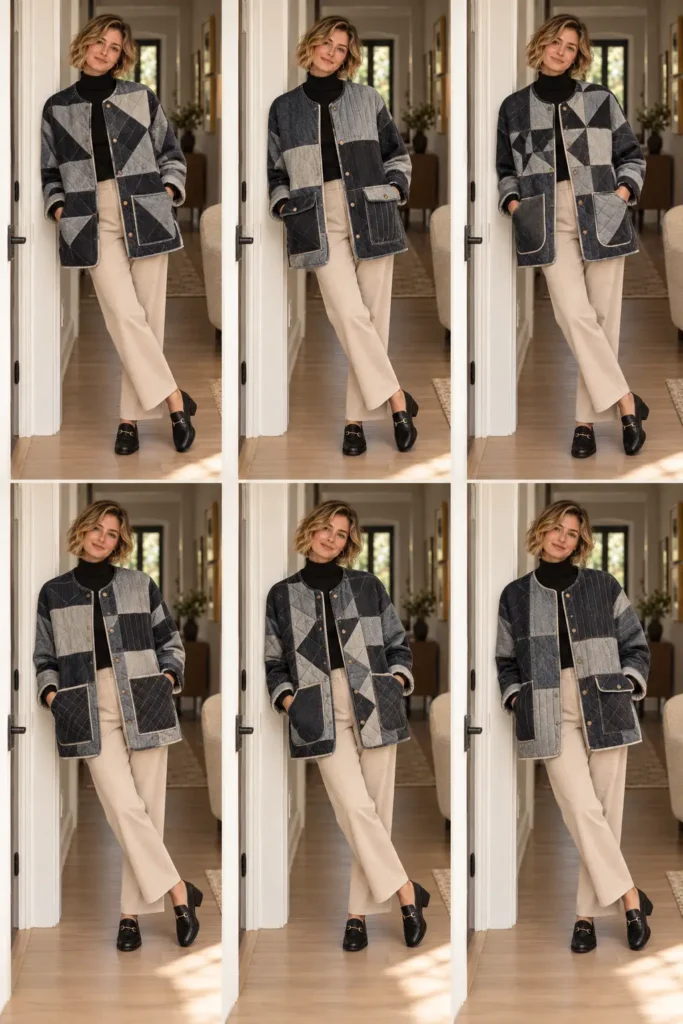
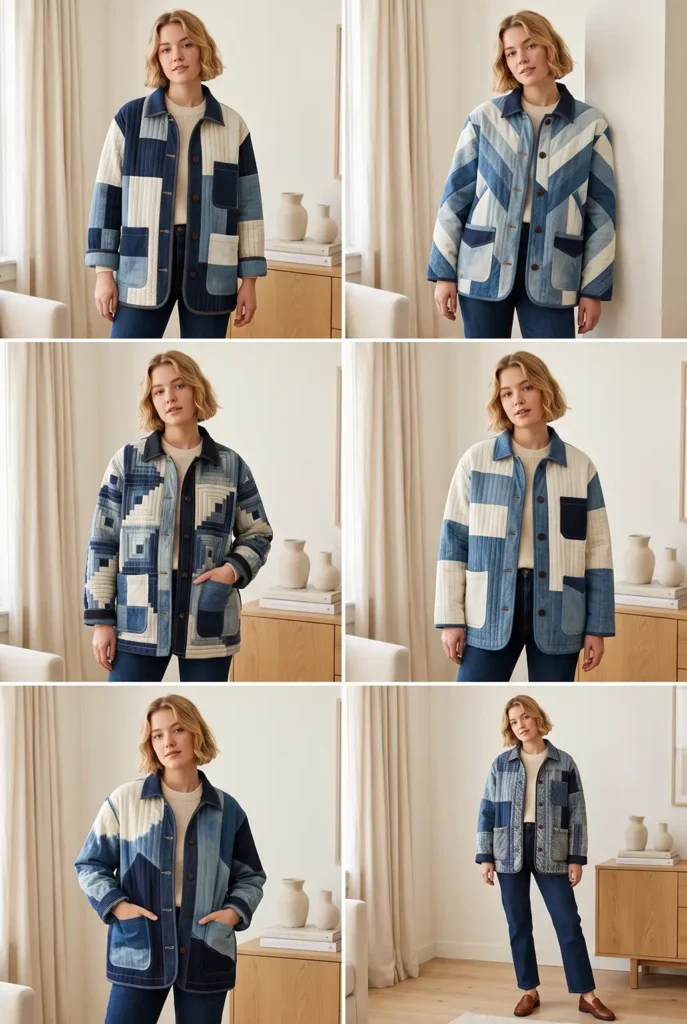
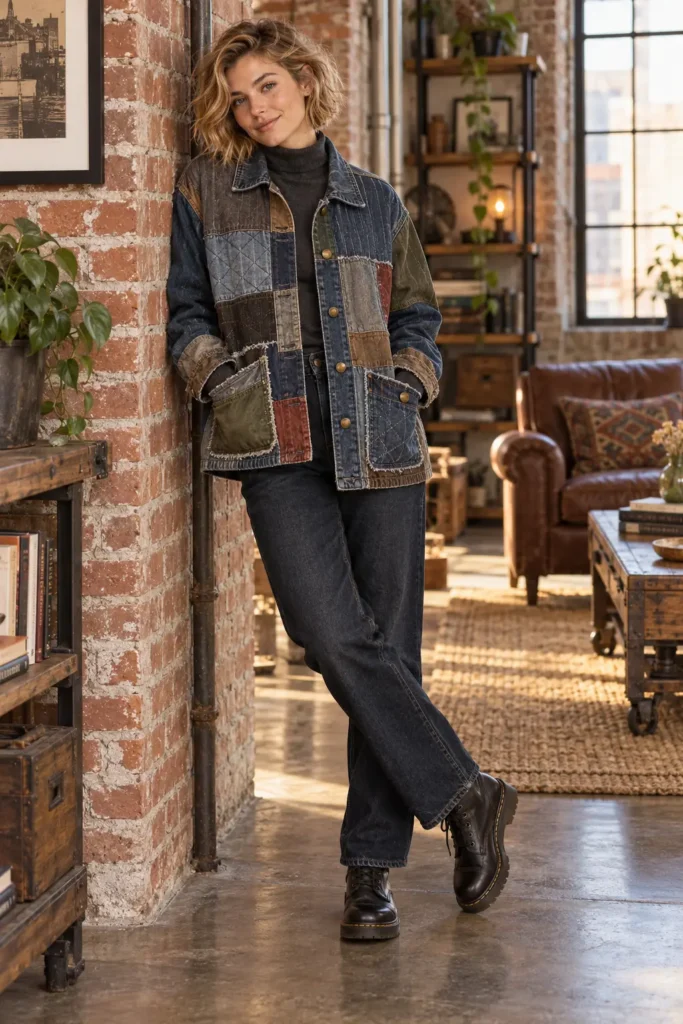
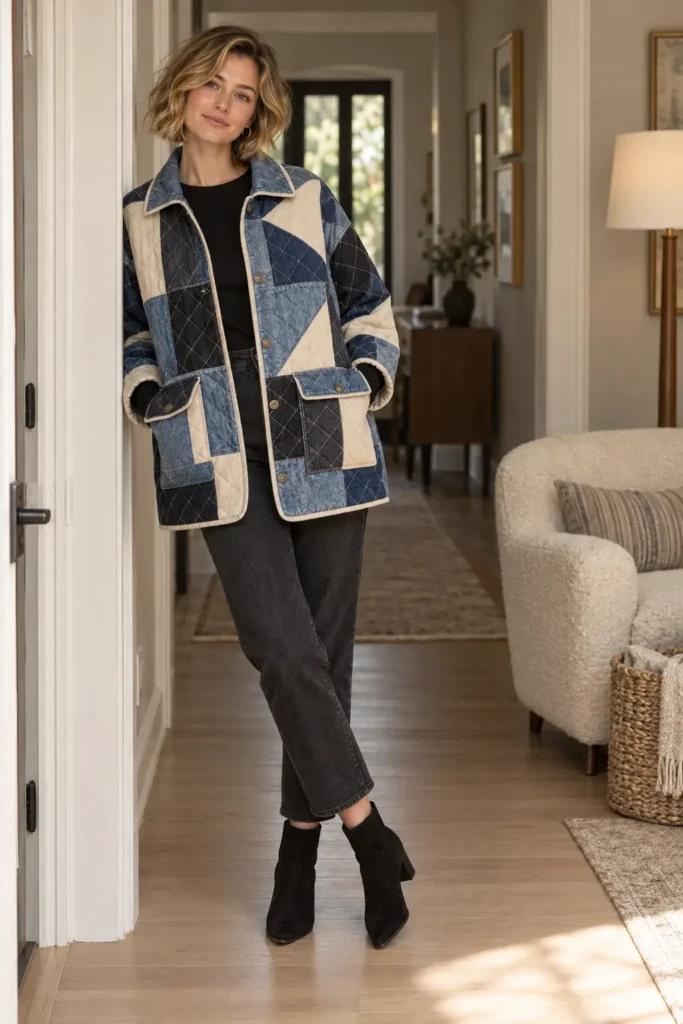
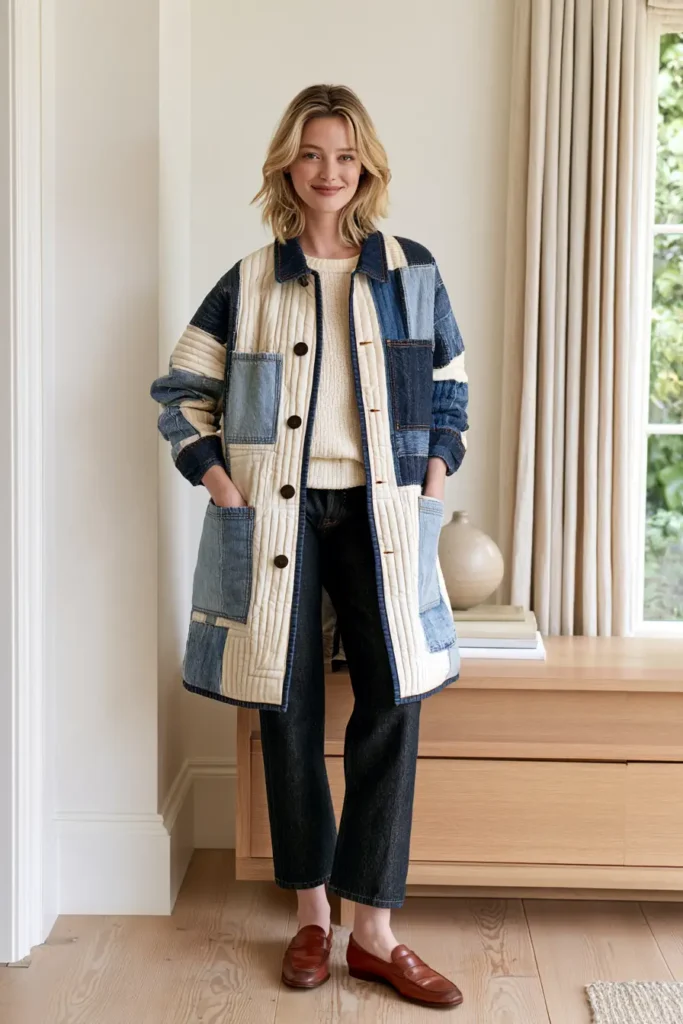
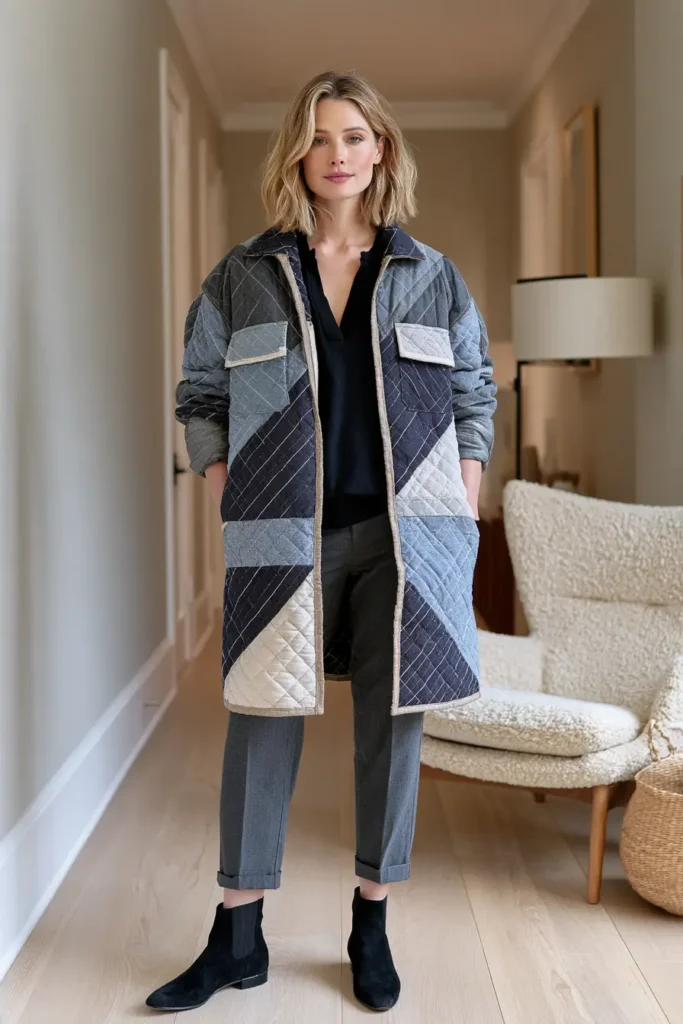
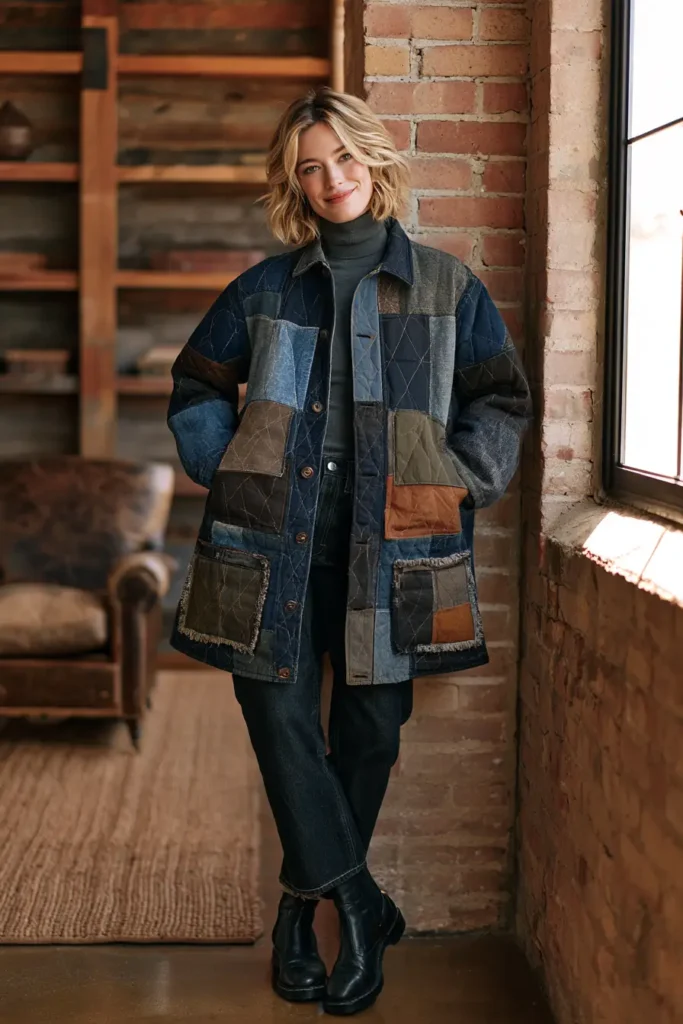
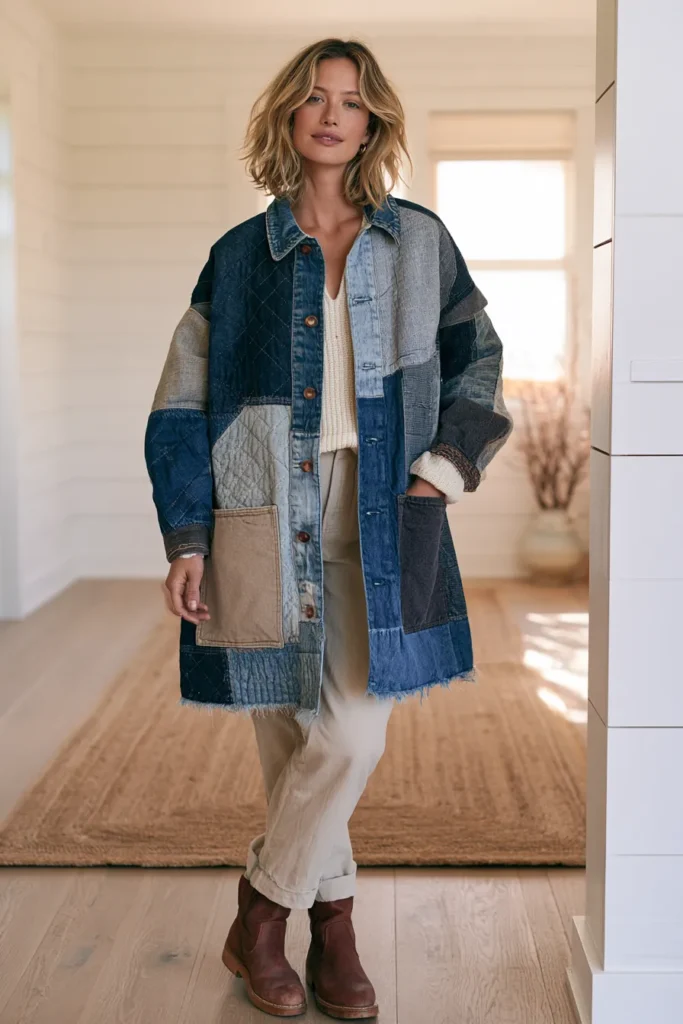
1. Oversized Denim Quilt Chore Jacket with Bold Geometric Patchwork and Utility Pockets
An oversized denim quilt chore jacket brings together the practical character of traditional workwear and the graphic appeal of contemporary patchwork. Its relaxed, slightly boxy silhouette, dropped shoulders, generous sleeves, and prominent utility pockets create an easy layering piece with a distinctive handmade appearance. Large geometric patches in deep indigo, faded blue, charcoal, and pale chambray form striking angular compositions, while visible quilting adds texture and definition without overwhelming the design.
Unlike conventional denim jackets or randomly arranged scrap-patchwork coats, this style relies on deliberate color placement and bold geometric shapes. Oversized rectangles, squares, diagonal panels, and half-square triangles create visual movement across the garment. The design draws inspiration from classic chore jackets, originally valued for their durable construction and practical pockets, while introducing a more contemporary, artistic approach to fabric piecing.
Design Inspirations – Digitally Modified Images. Texture and color may vary from the actual product.
Choosing Denim Fabrics and Building Color Contrast
Lightweight to medium-weight denim, cotton chambray, and soft cotton twill work particularly well for this design. Pair deep indigo with weathered blue, stonewashed gray, and small areas of cream or faded ivory to create enough contrast to distinguish individual geometric sections.
Reclaimed jeans can add attractive variations in fading and texture, as long as the fabric remains structurally sound. Prewash compatible fabrics, and avoid pairing rigid, heavyweight denim with extremely lightweight material unless you properly manage the weight difference.
For a balanced appearance, distribute dark and light patches across the jacket rather than concentrating all the strongest contrasts in one area.
Geometric Patchwork and Oversized Utility Pockets
Large-scale patchwork gives this jacket its modern character. Broad rectangular panels can establish the main structure, while diagonal sections and angular blocks add movement without making the surface feel too busy.
Keep the oversized utility pockets prominent and functional. Two generous lower patch pockets, optionally complemented by smaller chest pockets, reinforce the workwear aesthetic. Solid denim pocket panels can provide visual breathing room against more detailed geometric piecing.
Avoid placing numerous bulky patchwork seam intersections along pocket openings or other heavily stressed areas.
Quilting Texture, Structure, and Comfortable Drape
Straight-line quilting complements the architectural patchwork and emphasizes the direction of individual fabric panels. Parallel stitching, restrained diagonal lines, or quilting that echoes geometric boundaries can add dimensional texture.
Thin cotton or cotton-blend batting helps maintain flexibility while giving the denim a softly quilted surface. A lightweight cotton lining can create a comfortable interior finish.
Antique-brass-style buttons, reinforced pocket corners, visible topstitching, and neatly finished edges support the utilitarian character. Too much batting or dense stitching can make the jacket unnecessarily stiff, especially around the shoulders and sleeves.
Practical Design Considerations
The most common problems with this style are excessive seam bulk, poorly balanced color values, and geometric patches that are too small to remain visually effective on an oversized silhouette.
Keep the strongest patchwork arrangements across the front and back panels, allow quieter sections around functional details, and choose compatible fabrics that retain enough flexibility for comfortable movement.
Helpful Note: When using reclaimed denim, inspect worn areas carefully. Naturally faded fabric adds character, but weakened cloth near old seams, knees, and pockets may not withstand the stress of a wearable quilted garment.
Other Design Inspirations – Digitally Modified Images. Texture and color may vary from the actual product.
2. Reversible Quilted Vest with Contrasting Floral Prints and Solid Linen for Two-in-One Styling
Design Inspirations – Digitally Modified Images. Texture and color may vary from the actual product.
Other Design Inspirations – Digitally Modified Images. Texture and color may vary from the actual product.
3. Cropped Pastel Half-Square Triangle Quilted Bomber Jacket with Ribbed Edges for Spring Layering
Design Inspirations – Digitally Modified Images. Texture and color may vary from the actual product.
Other Design Inspirations – Digitally Modified Images. Texture and color may vary from the actual product.
4. Hooded Cocoon Quilt Coat with Oversized Diamond Quilting for Cozy Winter Layering
Design Inspirations – Digitally Modified Images. Texture and color may vary from the actual product.
Other Design Inspirations – Digitally Modified Images. Texture and color may vary from the actual product.
5. Upcycled Vintage Quilt Longline Coat with Oversized Star Blocks and Contrast Binding
Design Inspirations – Digitally Modified Images. Texture and color may vary from the actual product.
Other Design Inspirations – Digitally Modified Images. Texture and color may vary from the actual product.
6. Minimalist Linen Quilt Jacket in Soft Neutral Tones with Geometric Channel Quilting
Design Inspirations – Digitally Modified Images. Texture and color may vary from the actual product.
Other Design Inspirations – Digitally Modified Images. Texture and color may vary from the actual product.
More to come …
7. Color-Blocked Zip-Up Quilted Vest with Bold Contrasting Panels in Bright Primary Hues
8. Modern Checkerboard Quilt Vest with High-Contrast Two-Tone Patchwork
9. Scrappy Strip-Pieced Kimono-Style Quilt Jacket with Wide Sleeves in Warm Earth Tones
10. Belted Quilted Trench Coat with Wide Lapels and Graphic Patchwork Panels
11. Tailored Blazer-Style Quilt Jacket with Structured Shoulders and Modern Patchwork
12. Modern Black and White Quilt Coat with High-Contrast Patchwork and Graphic Line Quilting
Conclusion
The twelve designs in this collection make a coherent case that a Modern Quilt Jacket, Coat, and Vest is not a single thing but a category — as varied in silhouette, fabric, color, and construction as any other area of contemporary garment making. From the structured, tailored blazer and the belted graphic trench to the loose, scrappy kimono and the hooded cocoon coat, each piece shows a different way of letting quilting construction shape the garment rather than being applied afterward. What holds them together is the shared logic: make the patchwork, quilt it, build the garment from it, and let the piecing and the quilting lines read as the surface design.
The most useful starting point is deciding which of these two questions matters more to you: what do you want to wear, or what fabrics do you want to use? If the garment comes first, choose a silhouette, then plan patchwork that suits its proportions and seam lines. If the fabric comes first — a vintage quilt, a collection of scraps, a palette you’ve been building — choose a garment shape simple enough to let the fabric be the focus. Either direction works. The construction process is the same in both cases.

