
T-Shirt Quilt Ideas: Sustainable & Sentimental Designs to Preserve Special Memories
T-Shirt Quilt Ideas turn a drawer full of shirts nobody wears into something somebody actually uses. A t-shirt quilt is exactly what the name suggests: old t-shirts cut into squares or panels, stabilized with interfacing, and pieced together into a quilt. The graphics on each shirt become the design — every square is already printed, dyed, and meaningful before a single seam is sewn.
Unlike a traditional patchwork quilt, which requires you to source fabric and compose a design from scratch, a t-shirt quilt begins with material that already carries a story. A race shirt from a marathon, a band tee from a concert years ago, a kid’s camp shirt from every summer of childhood — each one is a small record of something that happened, and the quilt is the archive.
T-Shirt Quilt Ideas
This collection of T-Shirt Quilt Ideas covers twelve approaches for preserving different kinds of memories in different kinds of homes. The classic grid layout is the starting point – clean, even squares, nothing complicated. From there, the designs branch out to cover specific occasions: graduation shirts, sports and race shirts, baby and kids’ clothing, travel tees, and family memories.
The puzzle-style layout handles the problem every t-shirt quilt maker faces eventually – shirts of wildly different sizes and graphic proportions that refuse to cut into the same square. Modern sashing gives the whole thing a more considered, less collage-like finish. And at the practical end, there’s a flannel-backed version for warmth, a reversible one for double the upcycled life, and a sustainable scrap-busting version for everything outgrown, worn out, or simply no longer worn.
See also: Sashiko Quilt Jackets and Vests – Farmhouse Quilt Jackets & Vests – Scandinavian Quilted Jackets – Jelly Roll Quilted Jackets and Vests – Japanese Quilt Jackets, Vests
Why Make a T-Shirt Quilt
The argument for a t-shirt quilt is straightforward: it solves a problem most people recognize but don’t know how to resolve. The shirts are too meaningful to throw away and too unworn to keep in a drawer. A quilt takes them out of storage and puts them back into daily life in a form that’s actually used rather than preserved in guilt.
What’s different about this kind of quilt from any other is that the emotional work is already done before you start sewing – the meaning is in the fabric. The sewing is the craft; the shirts are the content. That’s also what makes it genuinely sustainable. No new fabric is bought, no virgin cotton is processed, and nothing is sent to landfill. A t-shirt quilt is upcycling at its most literal and most emotionally effective.
A note on logos and branded graphics: t-shirt designs often include trademarked logos, team insignia, licensed artwork, band imagery, and corporate branding, all owned by their respective rights holders. Making a quilt for personal or household use from shirts you already own falls within normal personal use. However, reproducing those graphics in quilts made for sale, publishing close-up images of protected logos in commercial content, or creating patterns that incorporate specific trademarked designs raises intellectual property concerns. For that reason, this article focuses on quilt construction and personal memory rather than featuring or replicating specific branded imagery. The shirts are yours; the graphics on them belong to someone else.
Tips for Choosing Fabrics and Colors
The single most important step in a t-shirt quilt is one most beginners skip: iron-on interfacing on every single panel before cutting. T-shirt fabric is knit – it stretches, it rolls at the edges, and it distorts under the sewing machine foot. Iron a piece of medium-weight fusible interfacing to the back of each panel before cutting to turn stretchy knit into something that behaves like quilting cotton. Without it, every seam will ripple, and the quilt will never lie flat. Use a pressing cloth when fusing, since direct iron contact can scorch a print or cause some inks to transfer.
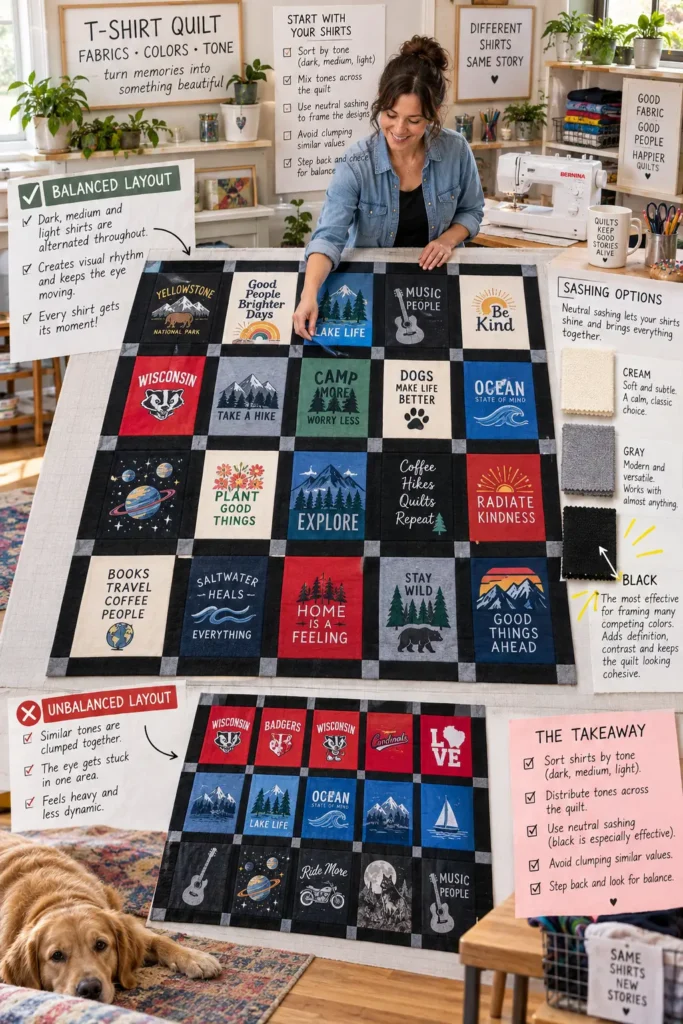
On color, t-shirt quilts often resist planning because the shirts already have their colors. The most effective approach is to sort by tone rather than by color family – separating the dark shirts from the medium ones and the light ones, and distributing them across the layout so nothing clumps. Alternating dark and light panels throughout gives the quilt visual rhythm even when the colors themselves are all over the place. For sashing, a neutral – cream, gray, or black – tends to frame the graphics without competing with them. Black sashing is particularly effective when the shirts are many different colors, since black reads as the absence of color competition rather than as another color to fight.
Common Mistakes to Avoid When Sewing
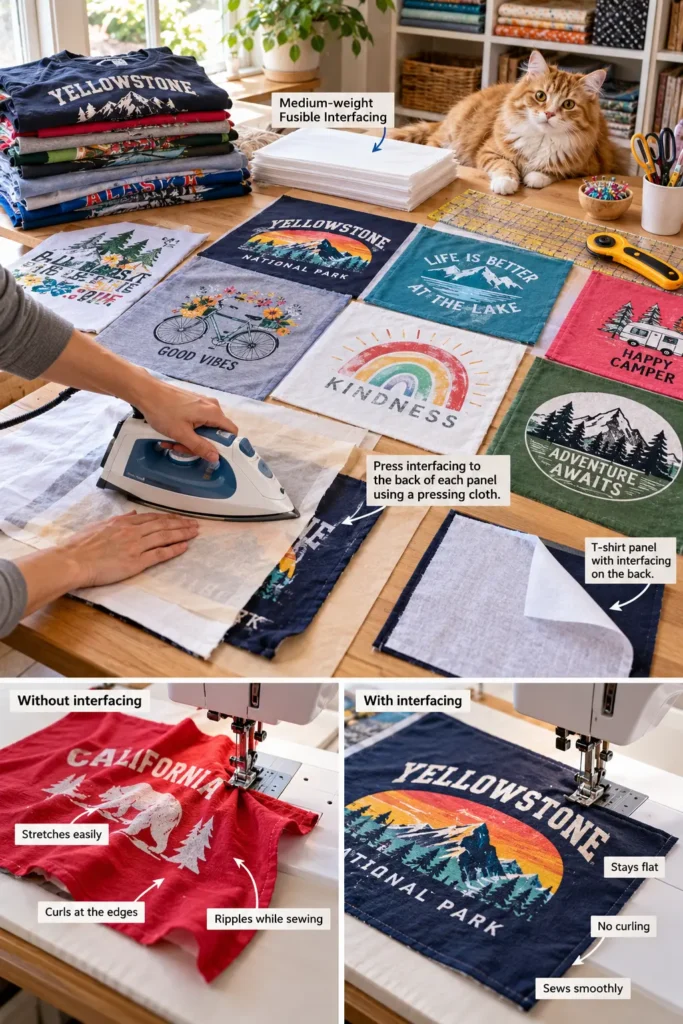
Not using interfacing is the first and most consequential mistake. The second is cutting panels too small– T-shirt graphics need breathing room, and a panel cropped right to the edge of a graphic looks unfinished. Leave at least an inch of plain fabric around every image where possible. Third is using a regular presser foot on the knit fabric – even with interfacing, a walking foot or a roller foot keeps the layers feeding evenly and prevents the slight wavy distortion that a standard foot can introduce.
Fourth: not accounting for seam allowances in the layout. A grid of twelve-inch finished squares needs twelve-and-a-half-inch cut panels, and if you cut to the finished size and then sew a quarter-inch seam, your squares will come out at eleven-and-a-half inches, and the grid won’t line up. Decide on your finished block size first, then add half an inch all round before cutting. Fifth: wash the shirts before making the quilt, but not the backing or sashing. Mixing prewashed knit with unwashed woven fabric will cause the quilt to pucker and pull unevenly after its first wash. Everything going into the quilt should be in the same state – all prewashed, or all unwashed – before a stitch is sewn.
1. Classic Grid T-Shirt Quilt for a Clean, Timeless Memory Layout
Design Inspirations – Digitally Modified Images. Texture and color may vary from the actual product.
Other Design Inspirations – Digitally Modified Images. Texture and color may vary from the actual product.
2. Graduation T-Shirt Quilt for School and College Keepsakes
Design Inspirations – Digitally Modified Images. Texture and color may vary from the actual product.
Other Design Inspirations – Digitally Modified Images. Texture and color may vary from the actual product.
3. Sports T-Shirt Quilt for Team, Race, and Athletic Memories
Design Inspirations – Digitally Modified Images. Texture and color may vary from the actual product.
Other Design Inspirations – Digitally Modified Images. Texture and color may vary from the actual product.
4. Baby and Kids’ T-Shirt Quilt for Preserving Childhood Memories
Design Inspirations – Digitally Modified Images. Texture and color may vary from the actual product.
Other Design Inspirations – Digitally Modified Images. Texture and color may vary from the actual product.
5. Travel T-Shirt Quilt Using Shirts from Memorable Trips and Adventures
Design Inspirations – Digitally Modified Images. Texture and color may vary from the actual product.
Other Design Inspirations – Digitally Modified Images. Texture and color may vary from the actual product.
6. Family Memory T-Shirt Quilt for Meaningful Handmade Keepsakes
Design Inspirations – Digitally Modified Images. Texture and color may vary from the actual product.
Other Design Inspirations – Digitally Modified Images. Texture and color may vary from the actual product.
7. Puzzle-Style T-Shirt Quilt for Mixed Shirt Sizes and Graphics
Design Inspirations – Digitally Modified Images. Texture and color may vary from the actual product.
Other Design Inspirations – Digitally Modified Images. Texture and color may vary from the actual product.
8. Modern T-Shirt Quilt with Sashing for a Polished Custom Look
Design Inspirations – Digitally Modified Images. Texture and color may vary from the actual product.
Other Design Inspirations – Digitally Modified Images. Texture and color may vary from the actual product.
9. Color-Coordinated T-Shirt Quilt for Stylish Home Décor
Design Inspirations – Digitally Modified Images. Texture and color may vary from the actual product.
Other Design Inspirations – Digitally Modified Images. Texture and color may vary from the actual product.
10. Reversible T-Shirt Quilt for Double the Upcycled Memories
Design Inspirations – Digitally Modified Images. Texture and color may vary from the actual product.
Other Design Inspirations – Digitally Modified Images. Texture and color may vary from the actual product.
11. Flannel-Backed T-Shirt Quilt for Extra Warmth and Cozy Comfort
Design Inspirations – Digitally Modified Images. Texture and color may vary from the actual product.
Other Design Inspirations – Digitally Modified Images. Texture and color may vary from the actual product.
12. Sustainable Scrap-Busting T-Shirt Quilt Using Old and Outgrown Shirts
Design Inspirations – Digitally Modified Images. Texture and color may vary from the actual product.
Other Design Inspirations – Digitally Modified Images. Texture and color may vary from the actual product.
Conclusion
A t-shirt quilt is the most personal quilt most people will ever own, because it was already personal before it was a quilt. The craft is in the making; the meaning was there from the start. And unlike most sentimental objects, which sit in boxes and are discovered at house moves, a quilt gets used. It goes on the sofa, the bed, or the chair in the corner, and the shirts it’s made from are seen and handled, not stored. That’s what makes it worth the time.
T-Shirt Quilt Ideas
The best T-Shirt Quilt Ideas match the shirts you actually have. A drawer full of college shirts calls for the graduation layout. A decade of race bibs and athletic tees calls for the sports version. Baby clothes that have been sitting in a bin since a child started school are ready for the kids’ memory quilt. And if the shirts are simply miscellaneous – a lifetime of accumulated fabric with no single theme – the puzzle layout and the color-coordinated version are both built for exactly that. Whatever the starting point, the process is the same: stabilize, cut, piece, and quilt. The shirts do the rest.

