
Heart Quilted Tote Bag Ideas With Appliqué Hearts and Pieced Blocks in Floral Fabrics
These Heart Quilted Tote Bag Ideas start with a familiar shape that can be stitched onto fabric or built directly into patchwork. A heart might sit on a quilted panel as an appliqué, or emerge from carefully joined squares and triangles. Floral cotton brings softness and detail, but its scale and contrast matter: a busy rose print can blur a heart’s outline, while a neighboring solid, gingham, linen, canvas, or denim gives the shape room to show.
Quilting adds another layer of character, from lines that follow the seams to stitching that traces a motif. Batting and stabilizers help determine how firmly the finished tote holds its form, while a properly constructed lining, base, and handles turn the decorative panel into something useful.
Heart Quilted Tote Bag Ideas
The designs here explore several approaches to making a heart the focus of a tote without treating every bag as the same project. Square-based layouts include distinct Nine Patch blocks, a continuous Checkerboard, and a Pixel Heart built from small squares. Strip constructions range from the rounds of Log Cabin to the angled, light-to-dark movement of French Braid. Triangle-based work brings another rhythm through Half-Square Triangle units and Flying Geese, while reverse appliqué in black denim and functional patch pockets shift attention to the surface and everyday details.
The collection includes totes for laundry, laptops, books, market trips, and daily use, each with its own size, shape, fabric choices, and structural requirements. Every design section includes an illustrated 18-step sewing guide with calculated measurements for that particular bag.
See also: – Chic Jelly Roll Quilt Tote Bag – Elegant Boho Quilt Tote Bag – Jelly Roll Christmas Quilt Jacket and Vest – Japanese Quilted Bag – Chic Jelly Roll Quilt Tote Bag Ideas – Stylish Quilted Tote Bag
Why Make Heart Quilted Tote Bags?
A heart gives a bag panel a focal point that’s easy to recognize, even when the surrounding fabric is full of tiny flowers or geometric seams. It can look gentle in blush prints or graphic against dark denim, depending on the contrast around it. Tote bags also let you explore quilt blocks on a smaller surface than a bed quilt, with a practical result at the end. The design decision isn’t only decorative: a bag meant for books needs to handle concentrated weight, while one intended for laundry or a laptop calls for different kinds of support.
That range makes heart-themed totes useful as handmade gifts, too, because the fabric and function can be chosen with a particular recipient in mind. Growing up in Dhaka, I watched artisans stitch motifs across layers of reused cloth for Nakshi Kantha, and a heart set on a quilted tote panel works in a similar way: one stitched motif carried by layered fabric. The sewing demands vary, though. Small squares may be straightforward to piece, whereas reverse appliqué on denim, carefully padded compartments, and reinforced pockets call for more planning.
What Makes These Designs Different?
The difference starts with how the fabric pieces relate to the heart. Nine Patch uses separate three-by-three blocks, while Checkerboard is one continuous field of alternating squares; Pixel Heart arranges small squares to make the heart itself. Strip-based designs behave differently again: Log Cabin builds around a center, Rail Fence turns neighboring strip blocks at right angles, French Braid uses angled strips that shift from pale to deep lavender, and Strip-Pieced keeps the strips straight. Among triangle-based designs, Half-Square Triangle units form diagonal geometry, Flying Geese create directional rows, and Churn Dash combines corner triangles and side rectangles around a center square.
The black-denim market tote reveals red floral fabric through a reverse-appliqué opening, whereas the Pixel Heart is pieced, not appliquéd. The plum Rail Fence and peach-and-gray Flying Geese laundry totes both need sturdy, oversized construction, but their patchwork rhythms differ sharply. Likewise, the teal-and-linen Churn Dash and berry-floral Pixel Heart laptop totes ask for structured, padded compartments despite their contrasting surfaces. The Patch-Pocket everyday tote makes working exterior pockets the feature rather than leaving decoration to the patchwork alone. These distinctions affect more than appearance: each intended use changes the planning for volume, weight, stability, and the finished feel.
Choosing Floral Fabrics and Building a Color Palette
Start by considering how clearly the heart reads from a few steps away. Small or medium floral prints tend to preserve its outline, while a large, busy print may need a quieter surrounding fabric or a larger uninterrupted area. Contrast is as important as color: red florals against black denim feel crisp, teal floral pieces beside linen define Churn Dash geometry, and sage floral pockets stand out against navy. Gingham can break up a field of florals without competing with it, while canvas and linen provide calmer space.
The lavender French Braid takes a different approach, grading floral strips from light to dark so the progression becomes part of the design. Fabric weight needs attention alongside the palette. Quilting cotton, linen, canvas, and denim do not behave identically at seams; interfacing or another appropriate stabilizer may help keep unlike materials working together. Prewash and test colors, especially red, berry, plum, navy, and black denim beside pale fabric. Also plan separately for lining, handles, padding, pockets, and any reinforced base.
Planning Tote Size, Shape, and Everyday Use
Choose the bag’s purpose before planning its panels, because these twelve designs do not share a standard set of dimensions. The oversized laundry totes need sturdy walls, a broad opening, anchored handles, and a round or square base that can stand on the floor. Laptop totes require a smooth, padded compartment sized for the device, with support under its weight and whatever secure closure the individual design specifies. A book tote must carry concentrated weight without stressing its handle attachments; a market tote should allow easy access while supporting groceries at the base.
The patch-pocket everyday tote needs its working pockets located and reinforced before the main panel is closed up. Handle length depends on whether the bag is carried by hand or on the shoulder, rather than on one universal measurement. Think about where the heart sits relative to seams and base construction, too, so an important motif doesn’t disappear around an edge. Batting adds softness; foam, fleece, and interfacing can lend more structure when a design calls for it.
Appliqué, Quilting, Durable Details, and Common Mistakes
Heart edges deserve care because the inner V, rounded lobes, and bottom point each respond differently to stitching. Turned-edge appliqué needs small relief snips and careful folding at the V and curves; raw-edge work avoids turning but still needs secure edge stitches. Reverse appliqué exposes the fabric beneath a cut opening, and denim’s bulky, fray-prone edge needs particular attention. These treatments are separate from piecing the patchwork and from quilting the layers together. Depending on the design, quilting might echo a heart, follow a block seam, or run in restrained straight lines. Reinforce handle ends, pocket corners, top edges, and bases where pulling and abrasion concentrate, and avoid excessive thickness where canvas or denim seams meet.
Common problems often start before the bag is assembled: a rounded inner V can make a heart look misshapen, weak value contrast can hide it, and appliquéing onto linen or stitching through fusible web can pucker the panel. Bias edges on Half-Square Triangle and Flying Geese units or angled French Braid strips can stretch, while mismatched points spoil the precision of triangle-based blocks. Poorly aligned squares interrupt a Pixel Heart’s outline; an incorrect turn changes a Rail Fence arrangement. Dark fabrics that have not been color-tested may bleed onto light florals. Checking alignment, fabric behavior, and reinforcement as separate tasks prevents decorative choices from undermining the bag’s function.
About the Design Inspiration Images and Sewing Guides
The images in this article illustrate possible bag designs and may be AI-generated or digitally modified. Several ideas draw on traditional quilt-block constructions, including Log Cabin, Nine Patch, and Churn Dash. These images are not photographs of bags that have been physically sewn and tested, so small visual details may differ from the written instructions. Each illustrated 18-step sewing guide presents a proposed construction method with calculated measurements for that specific tote, not a tested sewing pattern. Use the written steps as the reference, and check the dimensions, seam allowances, and material choices for your chosen bag before cutting fabric.
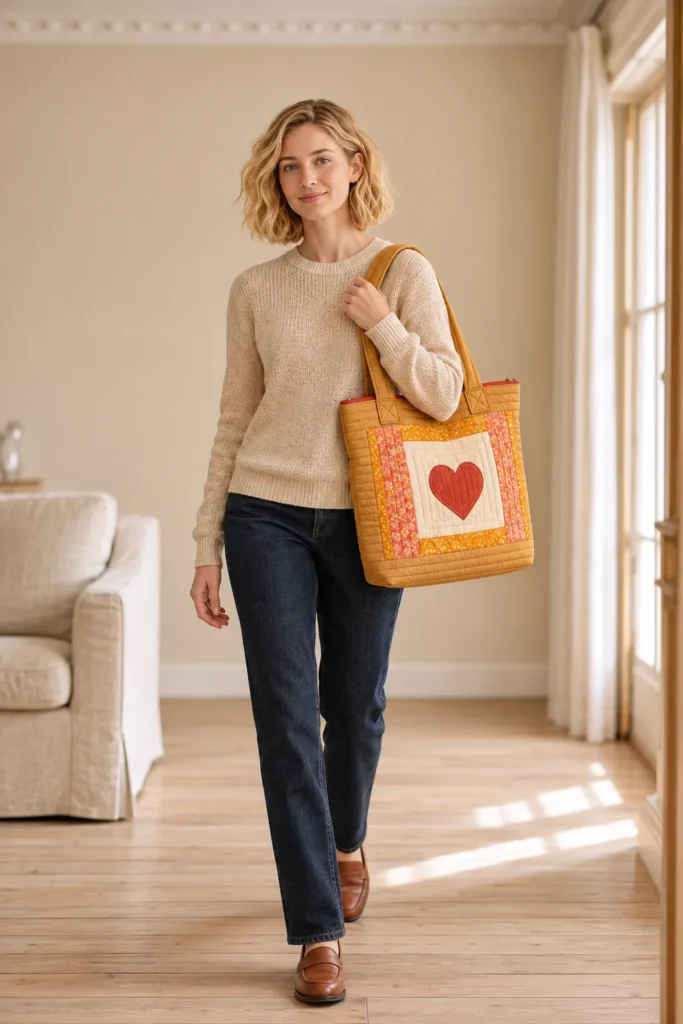
1. Log Cabin Heart Quilted Everyday Tote in Mustard and Coral Florals
This roomy zip-top tote takes one of the most familiar quilt blocks and gives it a clear focal point. On each face, a 12″ Log Cabin block grows outward from a cream center square in two rounds of narrow logs. Light and deep coral florals build the right and top sides, and light and deep mustard florals fill the left and bottom, so the block splits along its diagonal into a coral half and a mustard half. Mustard solid bands frame the block, and a mustard base strip runs underneath.
A 4½” deep coral floral heart is fused to the cream square on both faces and finished with a machine blanket stitch. At 20″ wide, 14″ tall, and 5″ deep, the bag is wider than it is tall, sized for everyday essentials. Low-loft batting, a muslin backing, and an interfaced coral lining give it moderate structure. A full-width zipper closes the top, an interior slip pocket holds small items, and two 1¼” mustard handles sit comfortably on the shoulder.
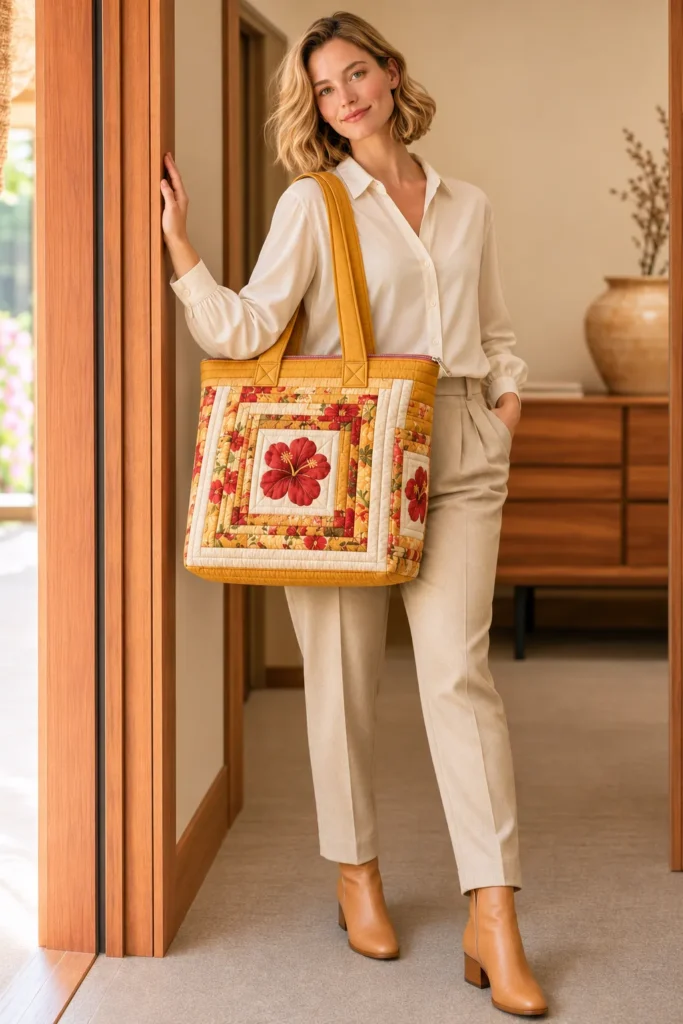
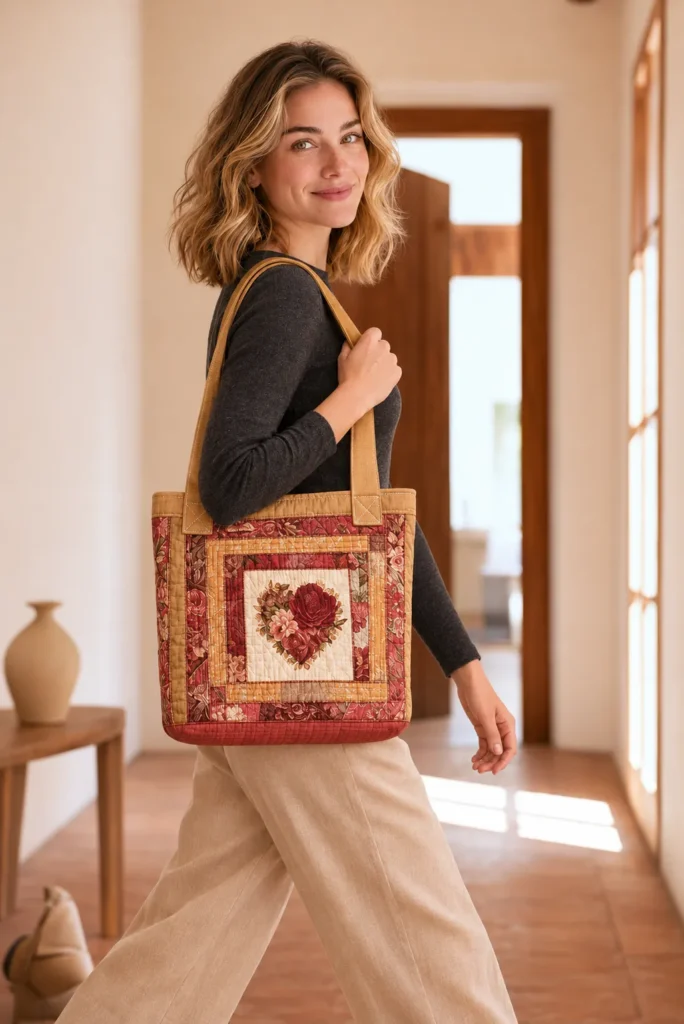
Design Inspirations – Digitally Modified Images. Texture and color may vary from the actual product.
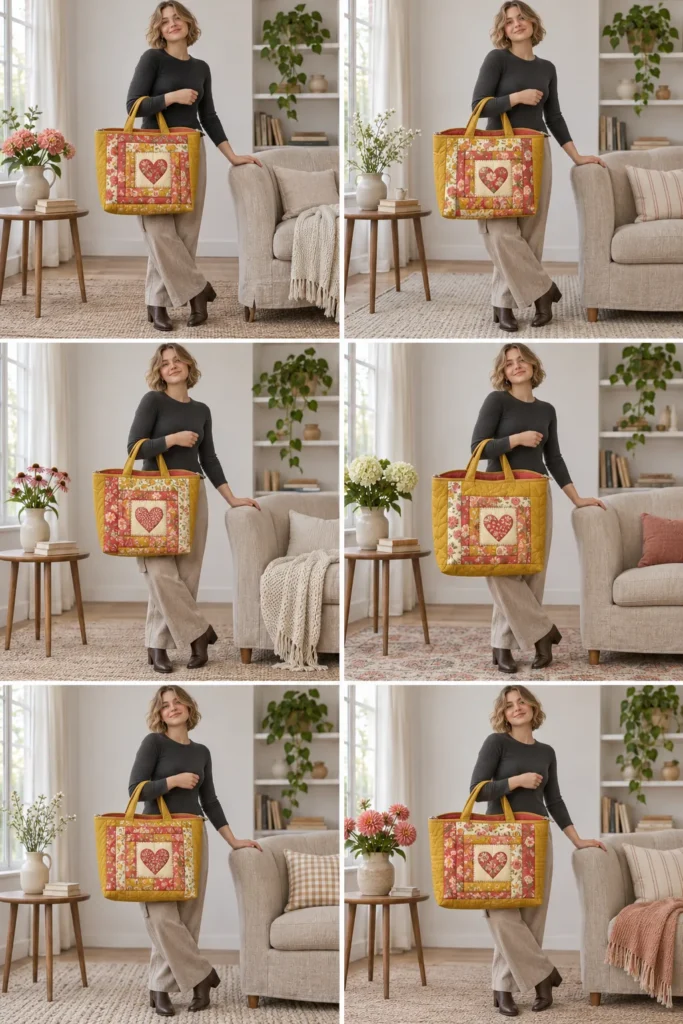
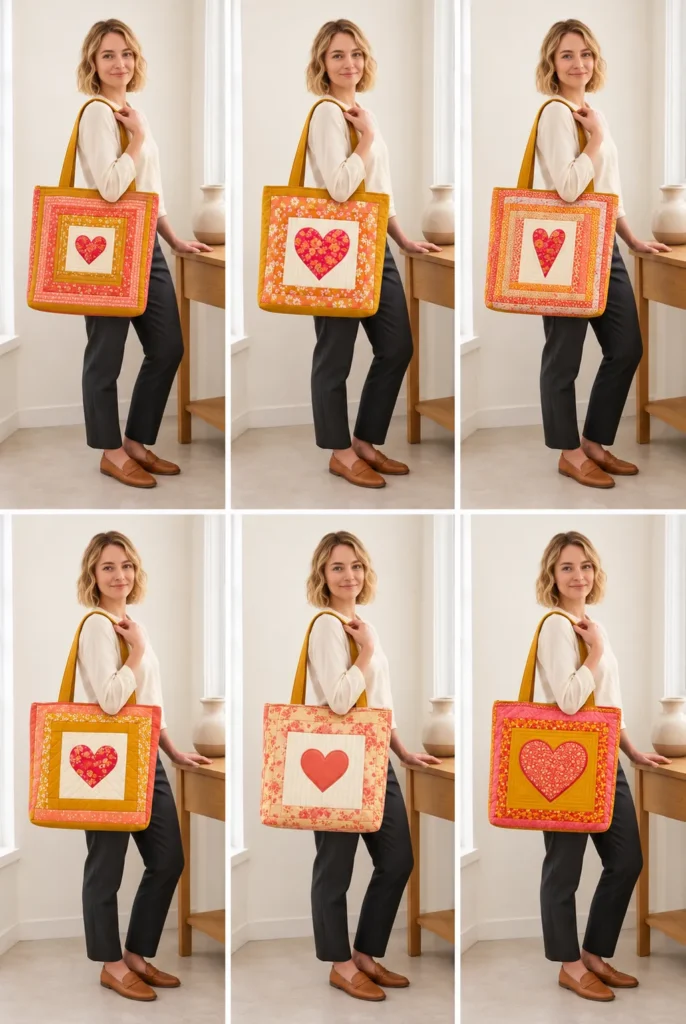
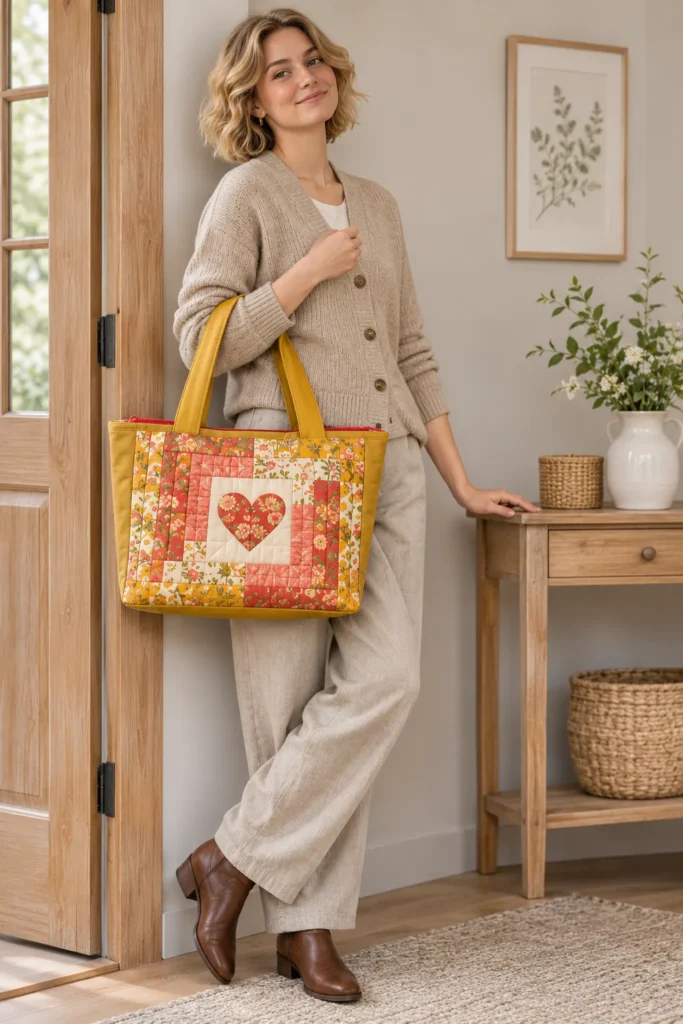
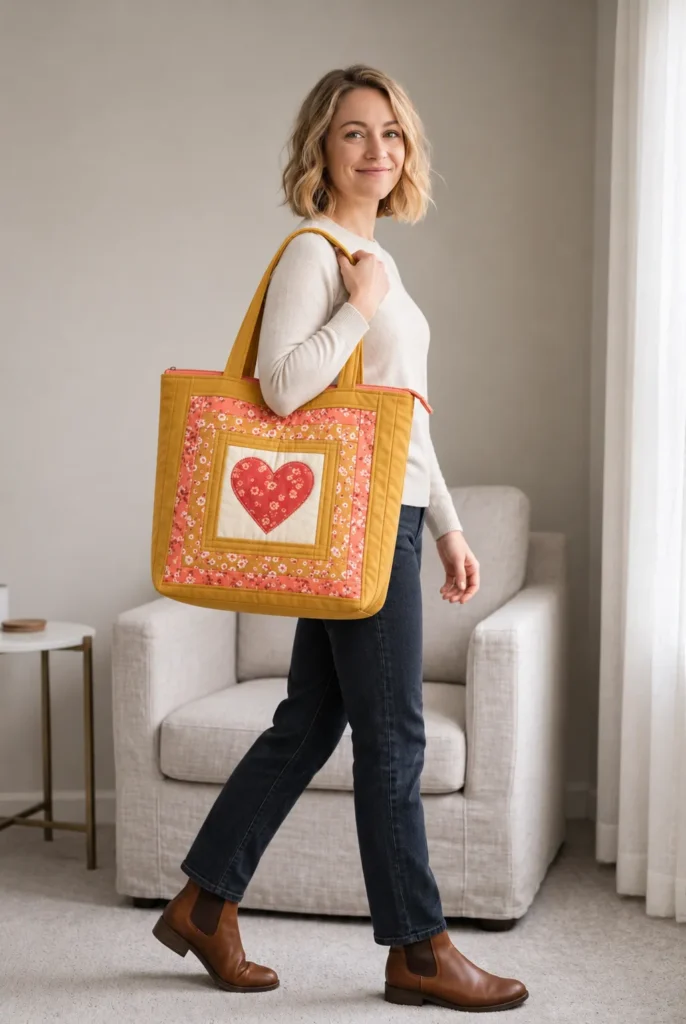
How the Log Cabin Rounds Frame the Heart
A Log Cabin block is built in rotation, each log sewn to the next side of the growing unit. Here the order is right, top, left, bottom, repeated for two rounds. Because coral always lands on the right and top and mustard on the left and bottom, the block reads as two triangles of color meeting at the cream square.
The first round uses the lighter florals and the second the deeper ones, so the softest colors sit beside the cream and the strongest at the block’s edge. That draws the eye inward to the heart, which sits in the cream square with at least ¾” of clear space on every side.
Keeping a Floral Heart Readable Among Floral Logs
The heart never touches a floral log. It sits on solid cream, which gives the deep coral print strong value contrast, and its small-scale floral keeps the outline crisp, including the soft V at the top that makes the shape read as a heart. A large print would blur that cleft.
The blanket stitch adds a fine outline, its straight stitches on the cream and its bites holding the fused edge. Stitch-in-the-ditch quilting keeps the log lines sharp, one echo line ⅜” outside the heart sets it slightly forward, and the plain mustard bands give the eye a resting place around the block.
Materials and Tools Needed
- Mustard solid quilting cotton: 1¼ yards (bands, base strip, handles, zipper tabs)
- Cream solid: ¼ yard
- Light coral, deep coral, light mustard, and deep mustard florals: ¼ yard each
- Deep coral small-scale floral (hearts): 1 fat eighth
- Coral cotton lining: 1¼ yards
- Muslin: 1¼ yards; low-loft cotton batting: 23″ × 36″
- Medium woven fusible interfacing: 1 yard of 20″-wide
- Paper-backed fusible web: ¼ yard; tear-away stabilizer: two 7″ squares
- Coil zipper, at least 18″ long
- Deep coral thread (blanket stitch), mustard thread (handles and topstitching), neutral thread (piecing and quilting)
- 80/12 needle; 90/14 topstitch needle
- Open-toe embroidery foot, walking foot, zipper foot
- Paper, fabric marker, small sharp appliqué scissors, point turner, rotary cutter, ruler, mat, pins or clips, iron
Finished Tote Bag Size
- Width: 20″, measured flat across the top from side seam to side seam
- Height: 14″, measured from the base line to the zipper seam
- Depth: 5″, measured across the boxed base
- Base: 15″ × 5″
- Handles: 1¼” wide, 26″ visible length, approximate drop 10″ (measured from the top edge to the top of the handle loop)
- Zipper: 18″ including the end tabs
- Interior slip pocket: 9″ × 6″
Cutting Measurements
All measurements include seam allowances. Prewash every fabric before cutting.
| Piece | Quantity | Cut Size (W × H) | Purpose |
|---|---|---|---|
| Center square, cream solid | 2 | 6½” × 6½” | Log Cabin centers |
| Log 1, light coral floral | 2 | 2″ × 6½” | Round 1, right |
| Log 2, light coral floral | 2 | 8″ × 2″ | Round 1, top |
| Log 3, light mustard floral | 2 | 2″ × 8″ | Round 1, left |
| Log 4, light mustard floral | 2 | 9½” × 2″ | Round 1, bottom |
| Log 5, deep coral floral | 2 | 2″ × 9½” | Round 2, right |
| Log 6, deep coral floral | 2 | 11″ × 2″ | Round 2, top |
| Log 7, deep mustard floral | 2 | 2″ × 11″ | Round 2, left |
| Log 8, deep mustard floral | 2 | 12½” × 2¼” | Round 2, bottom (block’s bottom edge) |
| Side band, mustard solid | 4 | 4¾” × 12¾” | Left and right of each block |
| Top band, mustard solid | 2 | 21″ × 2¾” | Top of each face |
| Base strip, mustard solid | 1 | 21″ × 6″ | Bag base |
| Heart fabric, deep coral small-scale floral | 2 | 5½” × 5¼” | Hearts (cut to shape in Step 2) |
| Fusible web | 2 | 5½” × 5¼” | Heart backing |
| Tear-away stabilizer | 2 | 7″ × 7″ | Behind each heart while stitching |
| Low-loft cotton batting | 1 | 23″ × 36″ | Outer panel |
| Muslin | 1 | 23″ × 36″ | Quilt backing |
| Lining, coral cotton | 1 | 21″ × 34″ | One-piece lining |
| Medium woven fusible interfacing | 1 | 20″ × 33″ | Lining structure |
| Slip pocket, coral cotton | 1 | 10″ × 13″ | Interior pocket |
| Handle, mustard solid | 2 | 5″ × 27″ | Folded shoulder handles |
| Zipper tab, mustard solid | 2 | 2″ × 3″ | Zipper end tabs |
| Coil zipper | 1 | 16″ between tabs | Top closure |
Assembly at a Glance
- Cut and Sort the Fabrics
- Prepare the Heart Appliqués
- Build the Two Log Cabin Blocks (Round by Round)
- Add the Bands to Complete Both Faces
- Join the Back Face, Base Strip, and Front Face
- Fuse and Blanket-Stitch the Hearts
- Layer and Quilt the Outer Panel
- Trim the Outer Panel and Cut the Boxing Notches
- Make the Two Handles
- Baste the Handles to the Outer Panel
- Make the Interior Slip Pocket
- Prepare the Lining
- Add the End Tabs to the Zipper
- Sew the Zipper Between the Outer and Lining at the Front Top Edge
- Sew the Zipper Between the Outer and Lining at the Back Top Edge
- Sew the Outer and Lining Side Seams, Leaving a Turning Gap
- Box the Outer and Lining Corners
- Turn Through the Gap, Close It, and Topstitch Beside the Zipper
Step-by-Step Sewing Tutorial
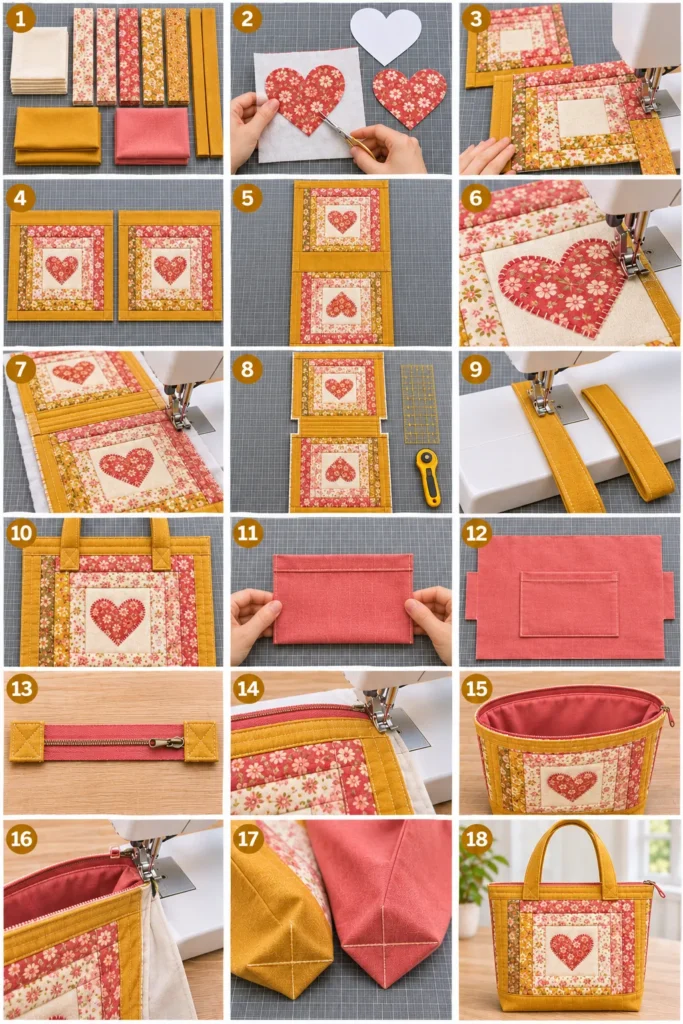
Step-by-Step Illustration – Digitally Created Image. Follow the written steps for measurements and details.
Piecing seams are ¼” and bag seams are ½”, sewn right sides together unless a step says otherwise.
Step 1 – Cut and Sort the Fabrics
Prewash and press every fabric, then cut all pieces from the table. Lay out two identical log sets in build order, 1 through 8, beside each cream square, and label log 8, the only 2¼” log. Stack the mustard bands, base strip, handles, and tabs separately from the lining, pocket, batting, muslin, and interfacing.
Result: Every piece is cut and sorted into two Log Cabin sets plus the band and lining stacks.
Step 2 – Prepare the Heart Appliqués
Fold paper in half and draw half a heart against the fold, 2¼” wide and 4¼” tall, with a rounded lobe, a cleft about ⅞” deep, and a bottom point of about 90 degrees. Cut and unfold it for a 4½” × 4¼” template. Trace it twice on the paper side of the fusible web (no mirroring needed, since the heart is symmetrical), fuse each piece to the wrong side of a heart rectangle, and cut on the line with small sharp scissors. Leave the paper on.
Result: Two deep coral floral hearts, 4½” × 4¼”, backed with fusible web.
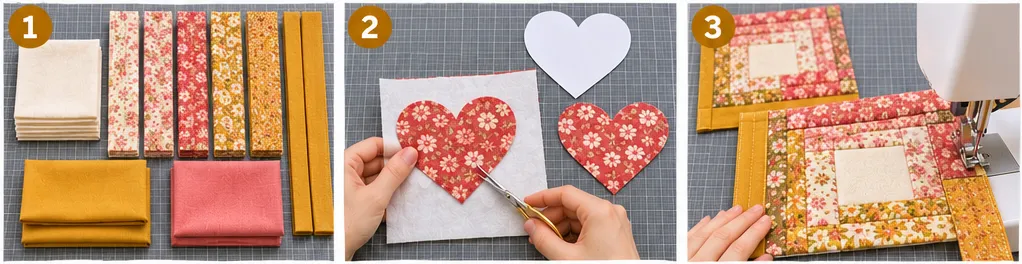
Step 3 – Build the Two Log Cabin Blocks (Round by Round)
Sew each log with a ¼” seam and press toward the new log, keeping the block’s bottom at the bottom:
- Log 1 to the right of the cream square (unit 8″ × 6½”), then log 2 across the top (8″ × 8″).
- Log 3 to the left (9½” × 8″), then log 4 across the bottom (9½” × 9½”).
- Log 5 to the right (11″ × 9½”), then log 6 across the top (11″ × 11″).
- Log 7 to the left (12½” × 11″), then log 8 across the bottom, joining one long edge so the extra width stays on the outer edge (12½” × 12¾”).
Measure after every log and square up before adding the next. Build the second block the same way.
Result: Two blocks, each 12½” × 12¾”, coral on the right and top, mustard on the left and bottom.
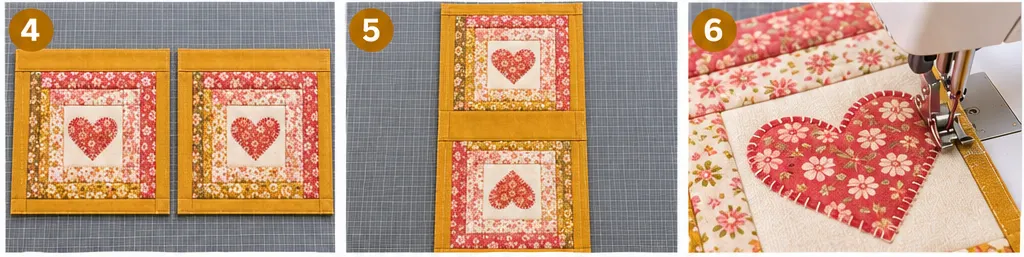
Step 4 – Add the Bands to Complete Both Faces
Sew a 4¾” × 12¾” side band to the left and right of each block, matching top and bottom edges, then a 21″ × 2¾” top band across the top. Use ¼” seams and press toward the bands. The log 8 edge stays at the bottom.
Result: Two faces, each 21″ × 15″, with the block at the bottom center.
Step 5 – Join the Back Face, Base Strip, and Front Face
Lay the front face right side up, top band at the top, and sew the 21″ × 6″ base strip to its bottom edge with a ½” seam. Turn the back face upside down and sew its bottom edge to the other side of the base strip. Press both seams toward the base strip.
Result: One 21″ × 34″ outer panel with the front face upright, the base strip in the middle, and the back face upside down.
Step 6 – Fuse and Blanket-Stitch the Hearts
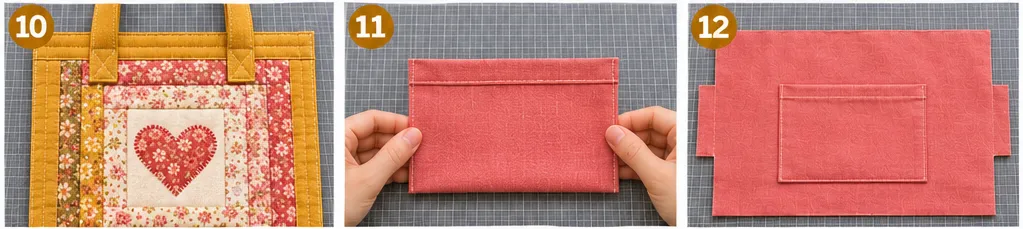
Peel the paper and center a heart on each cream square, point toward the base strip on both faces, so the back heart looks inverted in the flat panel. Fuse. Pin tear-away stabilizer behind each square. With the open-toe foot and deep coral thread, blanket-stitch about 2.5 mm wide and 2.5 mm long, straight stitches on the cream just outside the edge and bites into the heart, pivoting with the needle down outside the heart at the cleft and point. Test on a scrap first, then tear away the stabilizer.
Result: A blanket-stitched deep coral heart on each cream square.
Step 7 – Layer and Quilt the Outer Panel
Lay the 23″ × 36″ muslin wrong side up, add the batting, and center the panel right side up on top, about 1″ of batting showing all around. Baste. With a walking foot, stitch in the ditch along every log, band, and base strip seam, then stitch one echo line ⅜” outside each heart without crossing it.
Result: A quilted three-layer outer panel.
Step 8 – Trim the Outer Panel and Cut the Boxing Notches
Trim the batting and muslin even with the panel, squaring it to 21″ × 34″. Mark the base strip’s center line, 17″ from each end. At both side edges, cut a notch centered on that line, 2½” wide and 4″ tall (2″ above and below the line), through all layers.
Result: A 21″ × 34″ quilted panel with a notch at each side of the base center line.
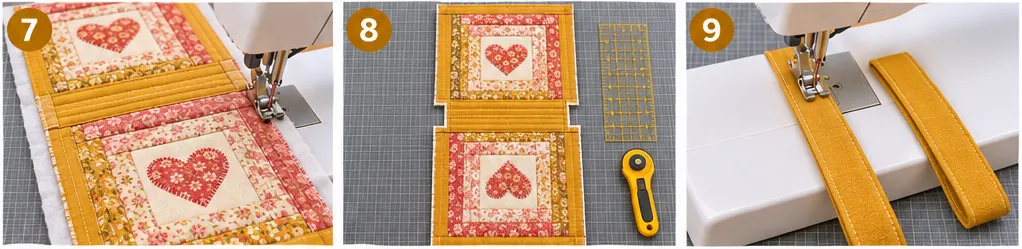
Step 9 – Make the Two Handles
Fold each 5″ × 27″ strip in half lengthwise, wrong sides together, and press. Open, fold both raw edges to the center crease, refold, and press. Edgestitch both long edges ⅛” in mustard thread.
Result: Two 1¼” × 27″ mustard handles.
Step 10 – Baste the Handles to the Outer Panel
With the panel right side up, pin a handle at the front top edge, its ends centered 7½” and 13½” from the left raw edge (6″ apart center to center), raw ends even with the top edge, and the loop lying down toward the base strip, untwisted. Repeat at the back top edge. Baste ⅜” from the edge.
Result: One handle basted at each top edge, loops pointing toward the center.
Step 11 – Make the Interior Slip Pocket
Fold the 10″ × 13″ pocket in half, right sides together, to 10″ × 6½” with the fold at the top. Sew both sides at ½”, clip the corners, turn, and push out the corners with a point turner. Press, turning the bottom raw edges ½” inside.
Result: A 9″ × 6″ slip pocket with a folded top.
Step 12 – Prepare the Lining
Fuse the 20″ × 33″ interfacing to the wrong side of the 21″ × 34″ lining, ½” in from every edge. Mark the center line 17″ from each end and the base lines 2½” above and below it, then cut the same 2½” × 4″ notches as the outer. On the half that will join the back face, center the pocket side to side (6″ from each raw edge), right side up, fold at the top, bottom 3″ above the base line. Stitch the sides and bottom ⅛” from the edges, backtacking at the top corners.
Result: A flat, interfaced, notched lining with the pocket on its back half.
Step 13 – Add the End Tabs to the Zipper
Slide the pull to the middle. Press both 2″ ends of each tab ½” to the wrong side and fold the tab in half. Edgestitch one tab over the zipper’s bottom end, measure 16″ of tape from its fold, edgestitch the second tab there, and cut off the excess. Trim the tab sides even with the tape.
Result: An 18″ tabbed zipper with 16″ of tape between the tabs.
Step 14 – Sew the Zipper Between the Outer and Lining at the Front Top Edge
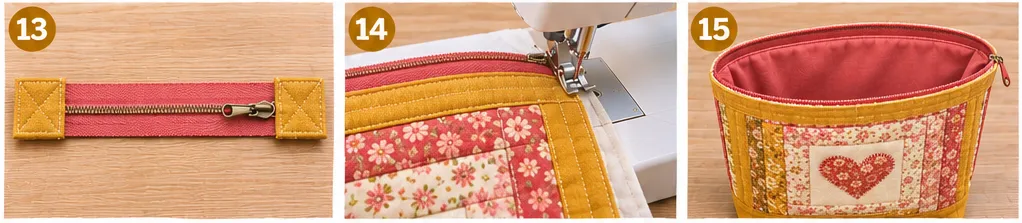
Lay the outer right side up, front top edge toward you, handle loops pointing away from the edge. Place the zipper face down along the edge, centered with each tab 1½” from the raw side edge. Lay the lining’s front half face down on top, edges aligned. Sew a ½” seam with the zipper foot, trim the batting and muslin from the allowance, then fold outer and lining away from the zipper, wrong sides together, and press the allowance toward the lining.
Result: The first zipper tape sewn between the outer and lining front edges, handle ends caught in the seam.
Step 15 – Sew the Zipper Between the Outer and Lining at the Back Top Edge
Bring the outer’s back top edge, right side up, to the free zipper tape lying face down, and lay the lining’s back half (with the pocket) face down on top. Sew a ½” seam, trim the batting and muslin, and press toward the lining.
Result: A closed loop of quilted outer and lining joined at both zipper tapes.
Step 16 – Sew the Outer and Lining Side Seams, Leaving a Turning Gap
Open the zipper halfway. Refold the loop so the outer is right sides together at its base center line and the lining right sides together at its center line, the zipper in the middle with its allowances toward the lining. Match the edges, seams, and notches. Sew each side at ½” in one pass from the outer notch to the lining notch, leaving an 8″ gap in one lining side, backtacked at both ends. The seams pass outside the zipper tabs. Trim the batting and muslin from the outer side allowances.
Result: Both side seams sewn, with an 8″ gap in one lining side.
Step 17 – Box the Outer and Lining Corners
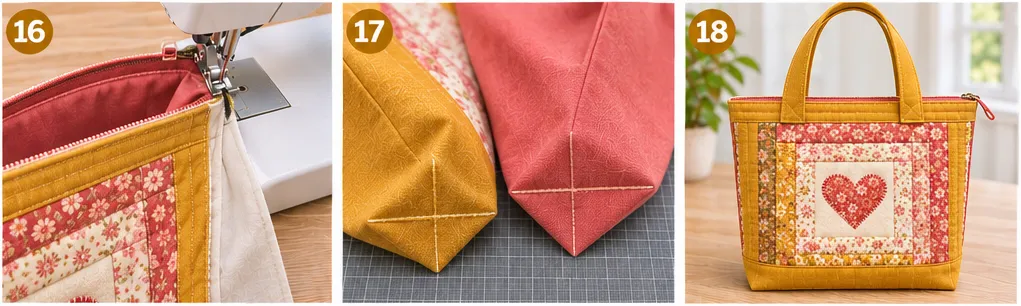
Open each outer notch, align the side seam with the base strip center line so the raw edges form a straight line, and sew across at ½”, backtacking. Trim the batting and muslin. Box both lining corners the same way, side seam on the lining center line.
Result: Four boxed corners giving the outer and the lining each a 15″ × 5″ base.
Step 18 – Turn Through the Gap, Close It, and Topstitch Beside the Zipper
Turn the bag right side out through the gap and ease out the corners with a point turner. Edgestitch the gap closed ⅛” from the fold and push the lining into the bag. Smooth the outer and lining away from the zipper, handles standing up, and topstitch ¼” from each zipper seam in mustard thread, stitching across the handle bases.
Result: A finished 20″ × 14″ × 5″ Log Cabin heart tote with a blanket-stitched heart on each face, a topstitched zip top, mustard handles with an approximate 10″ drop, and a coral lining with a slip pocket.
Troubleshooting the Log Cabin Heart Tote
- The block skews out of square. Errors build round by round. Check each unit against the sizes in Step 3 and square it before the next log, pressing rather than sliding the iron.
- The face is short at the base seam. Log 8 is the only 2¼” log. Swapping it for a 2″ strip loses the ½” allowance at the base strip.
- Blanket stitches bunch at the cleft or point. Slow down, pivot with the needle down outside the heart, and keep the bite angle even.
- The cleft looks rounded. Cut into the V with one clean snip rather than nibbling.
- The cream square puckers. Fuse the heart fully and keep the stabilizer behind it while stitching.
- Bulk at the zipper ends. Trim the batting and muslin from the seam allowances, and keep the tabs 1″ inside the side seam lines.
- Color bleeding onto the cream. Prewash the deep coral and mustard prints and test them against the cream before cutting.
Care: Spot-clean or hand wash gently in cold water and air dry.
Design Inspiration and Tutorial Note: The images in this section may be AI-generated or digitally developed to show the design idea. The written instructions describe a proposed construction method with calculated measurements, not a physically tested pattern. Before cutting, check the panel, block, and lining sizes against your own fabric, seam allowances, and equipment.
Other Design Inspirations – Digitally Modified Images. Texture and color may vary from the actual product.
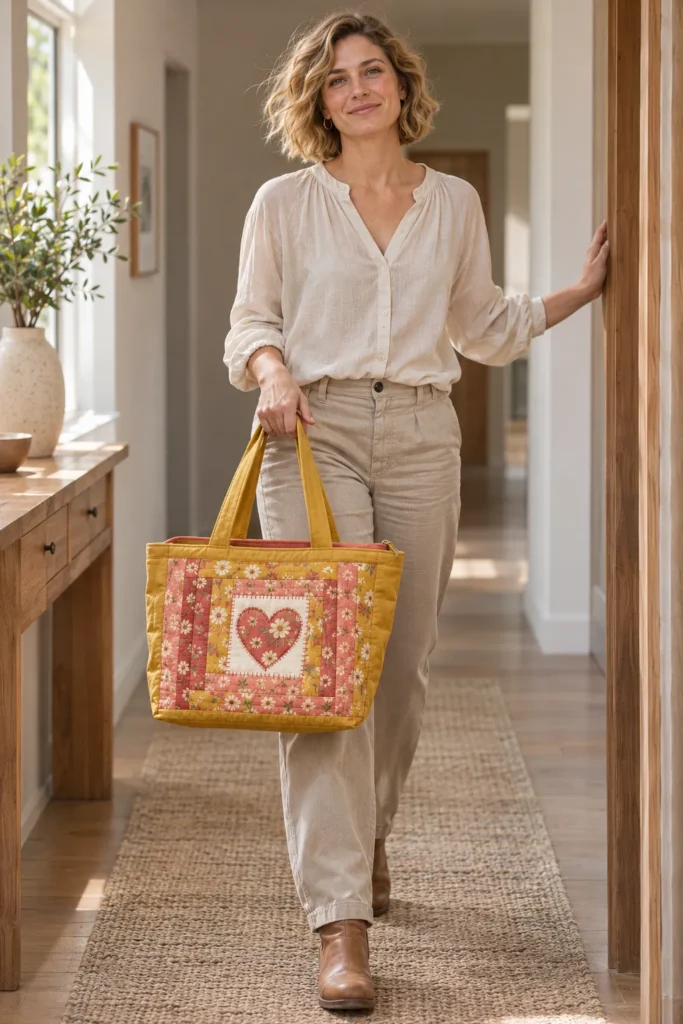
2. Half-Square Triangle Heart Quilted Book Tote in Red and Pink Florals
Design Inspirations – Digitally Modified Images. Texture and color may vary from the actual product.
Other Design Inspirations – Digitally Modified Images. Texture and color may vary from the actual product.
3. Nine Patch Heart Quilted Everyday Tote in Blush Florals and Gingham
Design Inspirations – Digitally Modified Images. Texture and color may vary from the actual product.
Other Design Inspirations – Digitally Modified Images. Texture and color may vary from the actual product.
4. Oversized Rail Fence Heart Quilted Laundry Tote in Plum Florals
Design Inspirations – Digitally Modified Images. Texture and color may vary from the actual product.
Other Design Inspirations – Digitally Modified Images. Texture and color may vary from the actual product.
5. Black Denim Reverse Appliqué Heart Quilted Market Tote in Red Florals
Design Inspirations – Digitally Modified Images. Texture and color may vary from the actual product.
Other Design Inspirations – Digitally Modified Images. Texture and color may vary from the actual product.
6. Churn Dash Heart Quilted Laptop Tote in Teal Florals and Linen
Design Inspirations – Digitally Modified Images. Texture and color may vary from the actual product.
Other Design Inspirations – Digitally Modified Images. Texture and color may vary from the actual product.
More to come …
7. Checkerboard Heart Quilted Book Tote in Teal and Pink Florals
8. Pixel Heart Quilted Laptop Tote in Berry Florals and Canvas
9. Flying Geese Heart Quilted Laundry Tote in Peach Florals and Gray
10. French Braid Heart Quilted Everyday Tote in Ombré Lavender Florals
11. Patch-Pocket Heart Quilted Everyday Tote in Sage Florals and Navy
12. Strip-Pieced Heart Quilted Market Tote in Yellow and Green Florals
Final Thoughts on Heart Quilted Tote Bag Ideas
The most interesting heart quilted tote bags let the motif belong to the bag rather than feel added at the last moment. Sometimes the heart is made through piecing; elsewhere, appliqué creates the focal point against a patchwork or calmer fabric. Florals bring variation in scale and movement, while gingham, linen, canvas, denim, and solids help define the design. Familiar blocks offer a readable structure, but reverse appliqué and practical patch pockets show how much can change when the surface technique changes. A heart that is clear in a close-up still needs to read across the whole bag, so contrast, quilting texture, and the bag’s intended use should be considered together rather than as separate decorative decisions.
Choose your starting point by what you intend to carry and by the techniques you are comfortable handling. Straight strips and simple squares can make good first explorations; precise triangles, bias-heavy braids, reverse appliqué, padded compartments, and large reinforced laundry panels demand more deliberate preparation. Decide whether you want a softer bag or one that stays upright, then match the fabric weight, batting or stabilizer, and quilting density to that goal.
Plan the handles, base, lining, and any pockets before preparing the decorative panel, because their attachment points may affect its layout. Follow the measurements in the guide for the bag you choose, not another tote’s. Before cutting, mark the seam allowances, base, and handle positions on the panel, and check that the heart clears them.

