
Star Quilt Wall Hanging Ideas Featuring Classic Patchwork and Bold Geometric Designs
Star Quilt Wall Hanging Ideas bring one of quilting’s most recognizable motifs into the home as decorative textile art. Built from diamonds, triangles, squares, and carefully arranged contrasts, star blocks create striking geometric focal points that can suit everything from a cozy farmhouse entryway to a contemporary living room. Traditional designs introduce the character of heritage patchwork, while modern interpretations experiment with asymmetry, generous negative space, and bold color blocking. Layered fabrics, batting, and quilting stitches add tactile depth, making these pieces as interesting up close as they are from across a room. Because wall hangings are generally smaller than bed quilts, they also offer a manageable format for exploring distinctive star patterns, fabric combinations, and decorative finishing techniques.
Star Quilt Wall Hanging Ideas
The designs in this collection demonstrate how dramatically a familiar star motif can change through construction, color placement, and presentation. Some feature radiating diamonds and finely pieced points, while others build geometric shapes from rectangular strips, tiny squares, or intentionally irregular patches. Fabric choices range from faded floral calico and reclaimed indigo denim to crisp solids, natural linen, and richly colored jewel-tone patchwork.
Quilting texture adds another dimension, whether through closely spaced straight lines, delicate stitching around traditional points, or softly frayed rag-quilt seams. The collection also explores different ways to display these textiles, from individual statement pieces to dowel-mounted hangings and coordinated miniature quilt gallery walls. Together, these approaches offer inspiration for choosing star patterns, fabrics, and finishes that complement different interior styles.
Explore More Quilt Wall Hanging Ideas: How to Hang a Quilt Wall Hanging – Christmas Quilt Wall Hanging Ideas – Jelly Roll Quilt Wall Hanging Ideas – Farmhouse Quilt Wall Hanging Ideas
Why Make Star Quilt Wall Hangings?
Star quilt wall hangings offer a way to display the beauty of patchwork without committing to a full-sized bed quilt. Their recognizable geometry makes them effective decorative focal points, while the smaller format provides opportunities to explore traditional blocks, modern compositions, and fabric combinations on a more manageable scale. A single carefully pieced star can add structure to an otherwise plain wall, while repeated blocks or several coordinated mini quilts introduce rhythm and color. Wall hangings also provide a practical use for suitable fabric remnants, vintage-inspired prints, and reclaimed textiles that might not be available in quantities sufficient for a larger quilt.
Techniques such as English paper piecing, Log Cabin construction, and improvisational piecing can be explored in decorative formats, although intricate designs may still require considerable precision. Beyond the patchwork itself, quilting stitches, batting, and layered fabrics create surface texture that changes how light falls across the finished piece. These qualities make star quilt wall hangings appealing for everyday decorating, seasonal displays, and thoughtful handmade gifts.
What Makes These Designs Different?
The most important differences among these star quilt wall hangings lie in their underlying geometry and construction methods. A Lone Star develops its radiating appearance from diamond-shaped patches arranged around a central point, while a Feathered Star uses small, precisely pieced triangles to create intricate serrated details along larger star shapes. Mariner’s Compass designs also rely on radial geometry, but their sharply angled points form a distinctive circular medallion composition.
Traditional Ohio Star blocks follow a nine-patch structure with characteristic triangular star-point units, and checkerboard sashing can introduce a secondary geometric pattern between repeated blocks. Other designs create stars through less conventional arrangements: contrasting light-and-dark Log Cabin blocks combine to reveal a larger star, while numerous small squares form the stepped silhouette of a pixelated design.
Six-point English paper-pieced stars use diamond-shaped fabric pieces folded around removable templates and stitched together, with hexagons providing complementary patchwork. Modern Wonky Stars take a different approach, using intentionally irregular points, off-center placement, and open negative space to create an informal composition. Texture and presentation introduce further distinctions. Exposed, clipped seams give denim-and-flannel rag quilts their soft, frayed character, while wooden dowels and knotted macramé fringe add a bohemian finish to conventional patchwork. A miniature quilt gallery wall changes the presentation altogether by arranging several separate star quilts into one coordinated display.
Choosing Fabrics and Building a Balanced Color Palette
Fabric selection plays a major role in determining whether a star quilt appears traditional, contemporary, rustic, or refined. Stable quilting cotton is particularly useful for precise diamond, square, and triangle piecing because it presses neatly and helps maintain accurate seams. Small-scale floral calicos and vintage-inspired prints complement traditional Ohio Star arrangements, while solids and subtle tone-on-tone fabrics allow modern geometric shapes and negative space to remain visually clear. Color value—the relative lightness or darkness of a fabric—is just as important as hue.
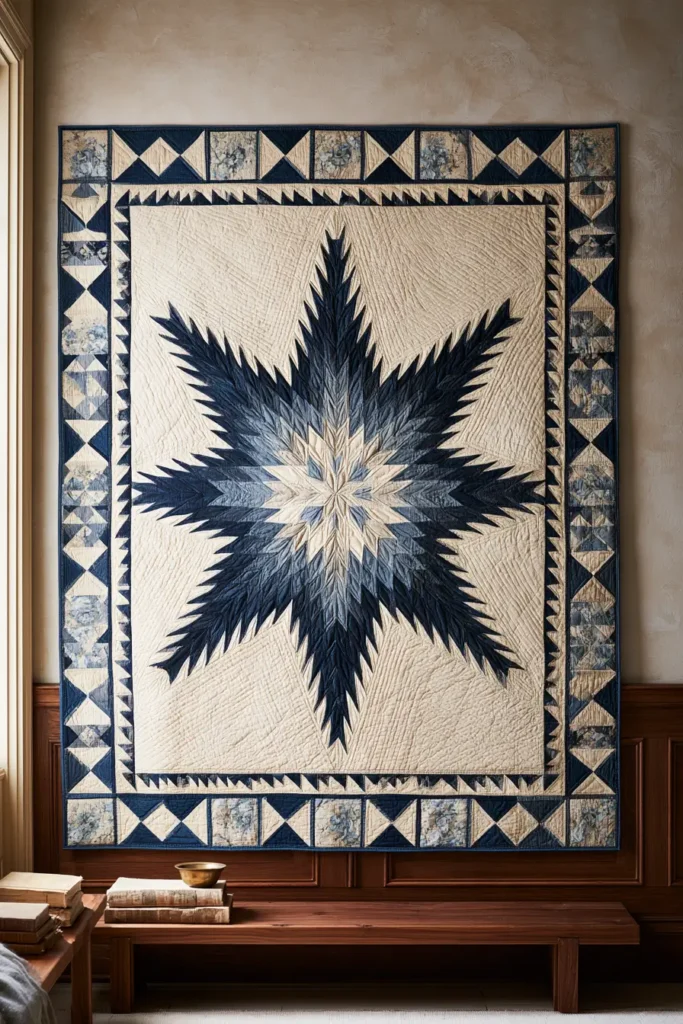
Strong value contrast helps Log Cabin stars emerge from rectangular patchwork and allows pixelated designs to retain their stepped outlines when viewed from a distance. In contrast, a Lone Star with an ombré effect benefits from carefully graduated shades that move smoothly from lighter to darker tones. Natural linen and warm brass-gold fabric accents can soften a navy Mariner’s Compass, while jewel-tone fabrics create a cohesive palette across separate miniature quilts. Denim and flannel introduce appealing differences in texture and weight, but their shrinkage, stability, and laundering requirements should be considered before combining them.
Print scale deserves equal attention: oversized florals may overwhelm tiny geometric pieces, while very small prints can lose their detail from across a room. The most effective palette is not necessarily the most colorful one, but the combination that preserves the star’s structure and complements its intended setting.
Planning Size, Shape, and Wall Display
The proportions of a star quilt wall hanging should reflect both its patchwork design and the space where it will be displayed. Square formats work especially well for centered stars and medallion-style compositions, allowing the geometry to radiate outward without feeling crowded. Rectangular layouts provide more flexibility for repeated blocks, directional patchwork, and modern off-center designs that rely on additional negative space. A Mariner’s Compass may feature a circular central motif while retaining a conventional square or rectangular outer shape.
Compact wall hangings can brighten entryways, hallways, and reading corners, while larger geometric compositions may serve as focal points above a console table or other suitable furniture. Several miniature star quilts can also be arranged together, with consistent spacing and a shared color palette creating visual unity. Structural stability is particularly important for vertical displays. Appropriate batting, stable backing fabrics, secure binding, and properly attached hanging sleeves or tabs help a quilt retain its shape without excessive sagging. Heavier denim-and-flannel constructions or decorative macramé fringe may require additional support, while a visible wooden dowel can become part of the intended design.
Mounting hardware should suit the wall surface and textile weight, and important star details should remain recognizable from the normal viewing distance. Seasonal pieces can be stored flat or loosely rolled where practical to reduce permanent creases and protect delicate stitching or decorative finishes.
Quilting Texture, Decorative Details, and Common Mistakes
Quilting stitches and finishing details can strengthen a star wall hanging’s visual character, but they should complement the patchwork rather than overwhelm it. Straight-line quilting works particularly well with modern geometric designs, creating subtle directional texture across solid backgrounds and negative space. Echo quilting can emphasize the radiating geometry of a large star, while restrained stitching helps preserve the visibility of intricate Feathered Star points and other finely pieced details.
Quilting density also affects how a piece hangs: closely spaced stitches can produce an attractive textured surface, but excessive density may introduce stiffness or distortion, particularly in smaller wall hangings. Common design problems include insufficient contrast between star points and background fabrics, overly busy prints that obscure small geometric units, and uneven color placement that weakens the intended pattern. Accurate seam alignment matters in traditional star construction, whereas intentionally irregular Wonky Star points should appear deliberate rather than resembling accidental piecing errors. Rag quilting requires a different kind of care, with exposed seam allowances clipped and frayed without weakening the stitching that holds the pieces together.
Decorative elements such as dowels, hanging tabs, and macramé fringe should be securely attached and proportionate to the quilt. Before finalizing a design, it is useful to consider how the patchwork looks from several feet away, since details that appear prominent on a worktable may become difficult to distinguish once the quilt is hanging on a wall.
About the Design Inspiration Images
The images in this article are intended as design inspiration for star quilt wall hangings. Some may be AI-generated, digitally edited, or developed as visual concepts, and certain ideas draw on established quilting traditions or existing designs encountered in other sources. They should not be assumed to show physically completed or tested quilts. An image may not have a matching downloadable pattern, verified cutting plan, or step-by-step tutorial. Use the colors, patchwork layouts, textures, and display ideas as starting points for your own original interpretations, while respecting the work and rights of other designers.
1. Lone Star Quilt Wall Hanging with Radiating Ombré Diamond Patchwork
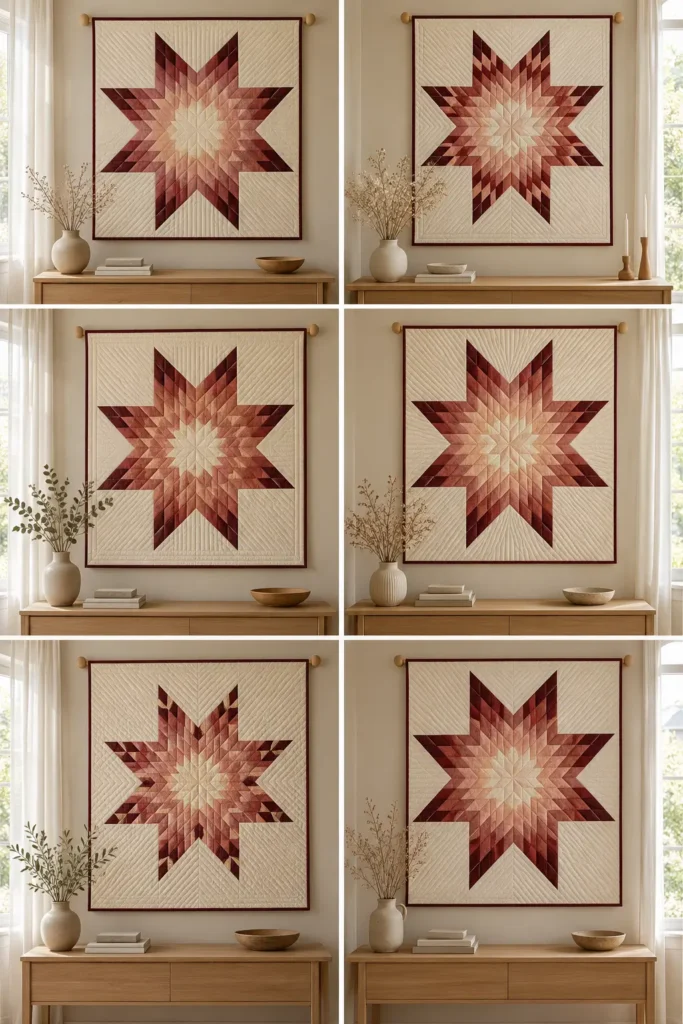
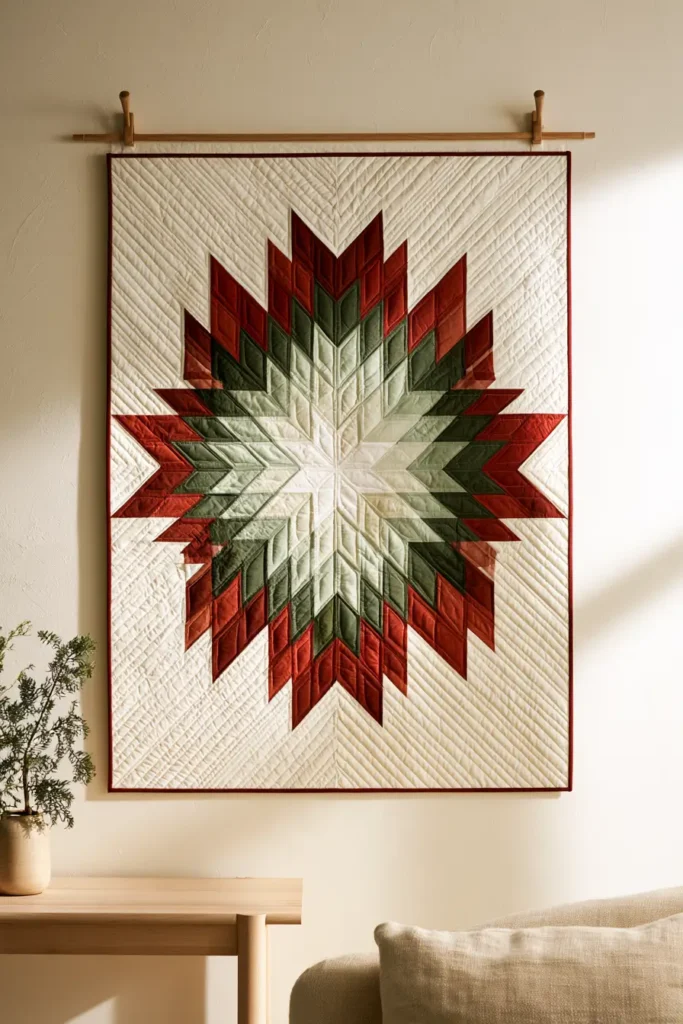
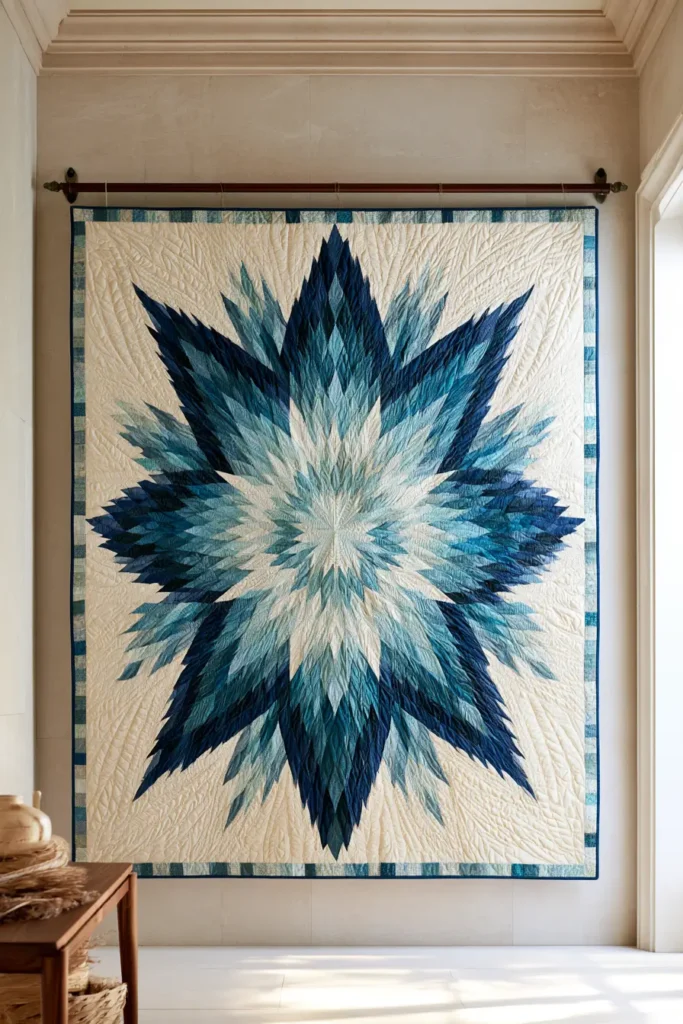
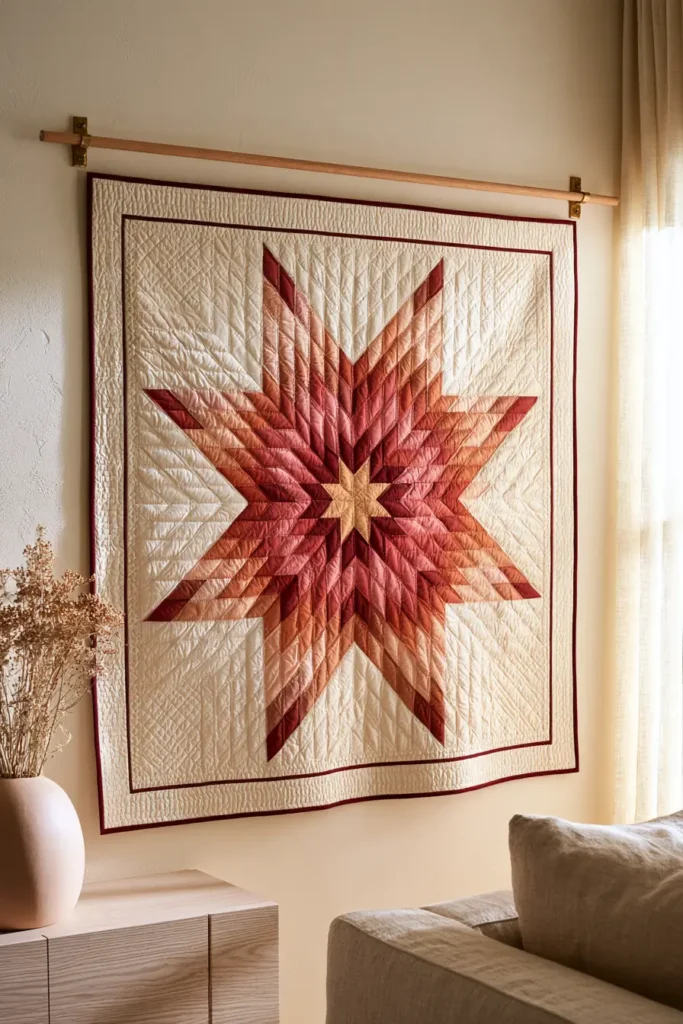
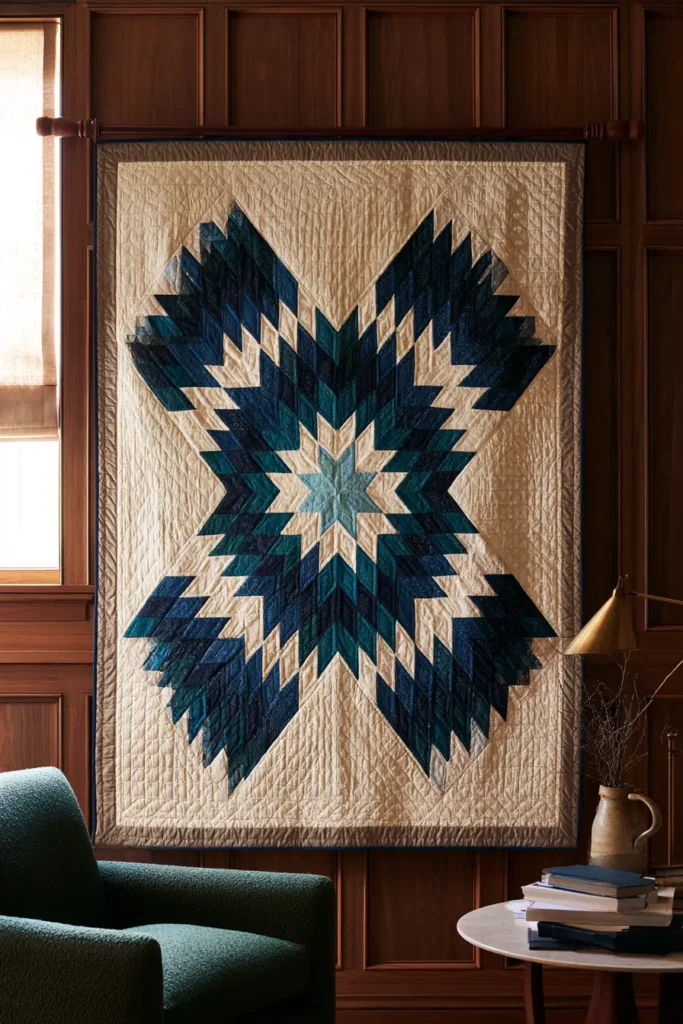
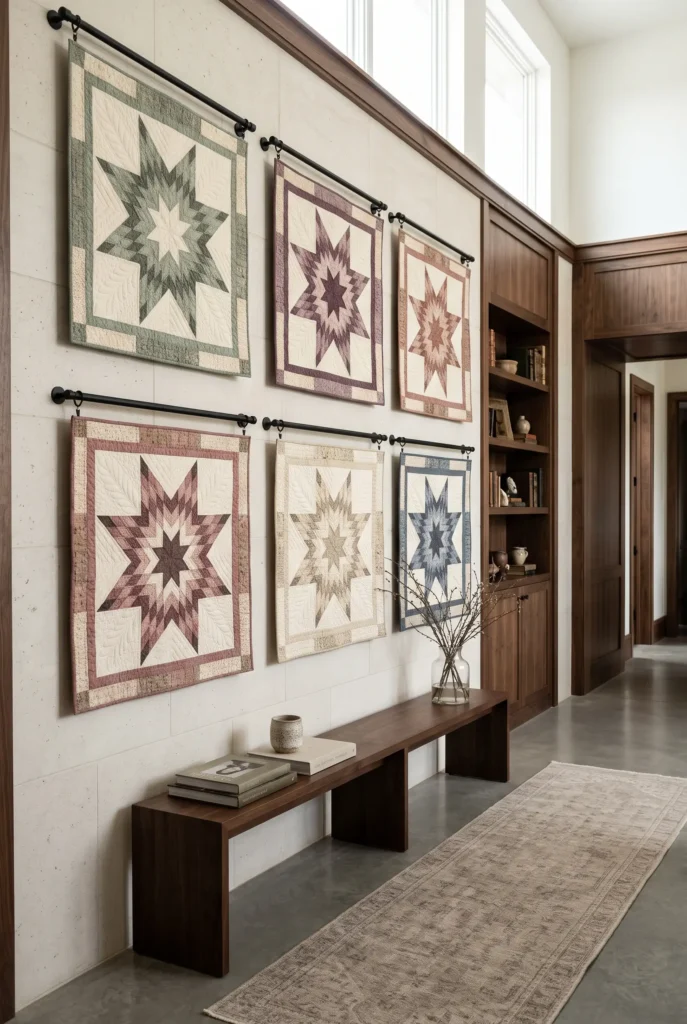
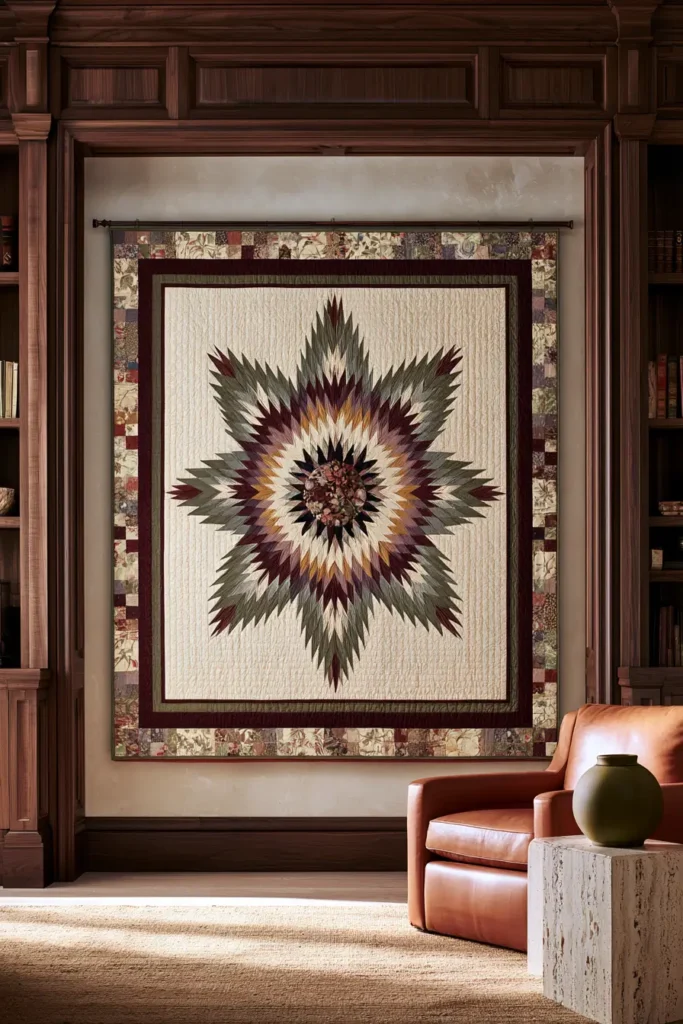
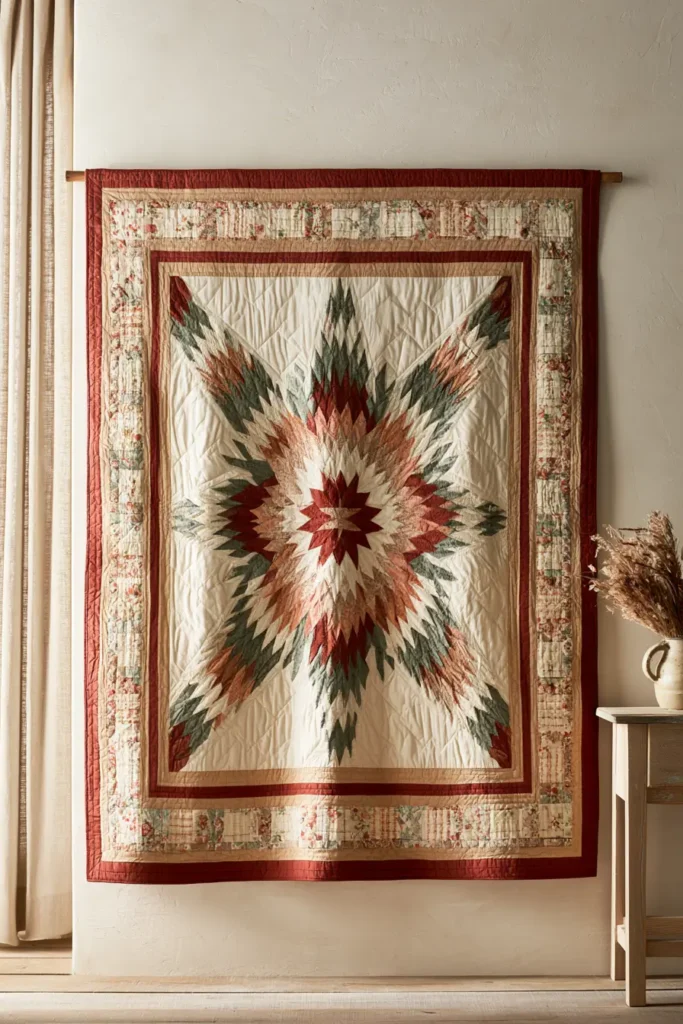
A Lone Star Quilt Wall Hanging with Radiating Ombré Diamond Patchwork brings one of quilting’s most recognizable geometric patterns into a decorative format. The design is built around a large eight-point star, with diamond-shaped fabric pieces arranged in repeating sections that radiate from the center. Unlike simpler star blocks formed from squares and triangular corner units, the Lone Star develops its distinctive appearance through continuous diamond geometry. Carefully graduated colors introduce another visual dimension, allowing lighter and darker fabrics to form flowing bands across the star without disrupting its sharp, symmetrical structure.
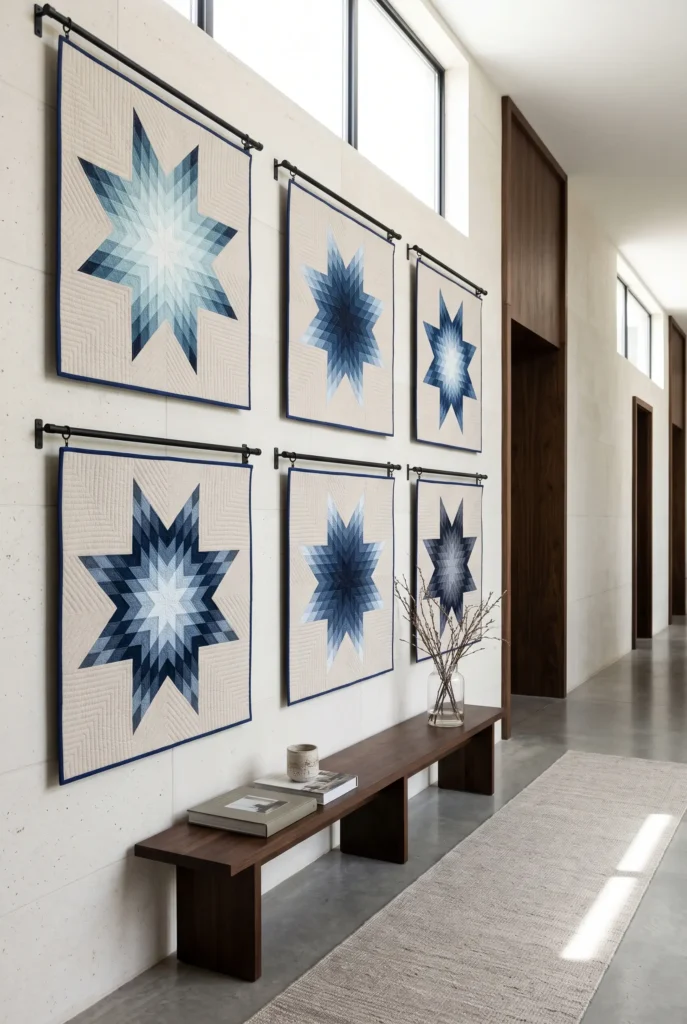
The appeal of this design lies in the balance between traditional craftsmanship and contemporary color styling. A warm arrangement of champagne, blush, dusty rose, terracotta, and burgundy can create a soft, inviting focal point, while sea-glass blue, teal, sapphire, and deep indigo offer a cooler interpretation. Both approaches work particularly well against a restrained neutral background that leaves the eight star points clearly visible. Although Lone Star quilts have a long-established place in patchwork traditions, their precise diamond construction and flexible color treatments make them equally suitable for modern interiors. The smooth radiating geometry also distinguishes them from Feathered Stars with finely serrated triangle details and Mariner’s Compass designs with pointed directional rays arranged around circular medallions.
Design Inspirations – Digitally Modified Images. Texture and color may vary from the actual product.
Creating a Smooth Ombré Across Radiating Diamonds
Color placement is the defining feature of an ombré Lone Star. Rather than scattering light and dark fabrics randomly, the design relies on a controlled progression across successive rows of diamonds. One attractive approach begins with pale cream or blush near the center, gradually introducing muted rose, coral, terracotta, and deeper burgundy toward the outer points. Repeating this sequence consistently across the eight sections creates visual continuity and reinforces the star’s symmetrical movement.
The reverse arrangement can also work, with a darker center transitioning toward lighter outer points. What matters most is the relationship between neighboring fabric values. Abrupt changes can interrupt the ombré effect, while colors that are too similar may flatten the diamond pattern. Before settling on a palette, arranging fabric samples from lightest to darkest can reveal whether the transitions feel smooth and balanced.
Print scale deserves attention as well. Solids, subtle batiks, and low-contrast tone-on-tone quilting cottons are particularly suitable because they allow the individual diamond shapes to remain recognizable. Large floral prints or strong directional patterns may compete with the geometry, especially when the diamonds are relatively small. A quiet ivory, cream, or natural linen-colored background can provide useful negative space, separating the outer star points from the surrounding quilt.
Choosing Fabrics and Maintaining Accurate Diamond Geometry
Stable quilting cotton is a practical choice for this style because it presses neatly and provides a relatively consistent surface for precise patchwork. The diamonds may be assembled through different established piecing methods, including approaches using accurately prepared strip-pieced sections. Regardless of the method, the important consideration is keeping the diamond angles, rows, and intersections consistent.
Lone Star construction can be demanding because diagonal fabric edges may stretch during handling. Gentle pressing, careful pinning or another suitable alignment method, and avoiding unnecessary pulling help preserve the intended geometry. Even small alignment errors can become more noticeable as the diamond rows expand outward from the center.
Fabric weight should remain reasonably consistent across the star. Combining very lightweight cotton with heavy upholstery fabric, for example, may introduce uneven seam bulk and make accurate piecing more difficult. If using a cotton-linen blend or another fabric with different handling characteristics, consider whether stabilization or separate testing would be appropriate.
The surrounding background panels also influence the overall result. They should support the star’s angular silhouette without introducing distracting seams or competing patterns. A narrow contrasting border can frame the color progression, while a broader neutral outer border gives the star additional breathing room.
Quilting Texture, Borders, and Wall Display
Quilting should complement the Lone Star’s radial structure rather than obscure its carefully arranged diamonds. Subtle stitching along selected patchwork seams can reinforce the geometry, while angular echo quilting around the star creates additional texture within the neutral background. Straight-line quilting may also work in the surrounding sections, provided its direction does not compete with the central motif.
For a decorative wall hanging, relatively low-loft batting can help preserve a flatter appearance while still giving the stitched surface gentle dimension. The backing, batting, quilting density, and finishing should work together to support the textile without excessive stiffness or distortion.
A square format is particularly suitable for an eight-point Lone Star because it allows the points to radiate evenly within the surrounding background. The completed design can be displayed using a securely attached hanging sleeve and an appropriately supported wooden or metal rod. Neat binding and a stable upper edge help maintain the quilt’s proportions when suspended vertically.
In a bright living room, a warm rose-and-terracotta Lone Star can complement pale oak furniture and natural linen upholstery. A sapphire-and-teal variation may suit a refined reading room with walnut furniture and warm neutral walls. In either setting, the star itself should remain the central decorative feature.
Common Mistakes That Can Weaken the Design
One of the most common problems with an ombré Lone Star is selecting colors that look attractive individually but do not create a convincing progression when arranged together. Testing fabric placement before piecing helps identify unexpected jumps in value or overly similar adjacent shades.
Inaccurate diamond intersections can also interrupt the star’s symmetry. This is particularly noticeable near the center, where multiple angled sections converge. Maintaining consistent seam allowances and handling diagonal fabric edges carefully can reduce distortion.
Another mistake is allowing the background or border fabrics to compete with the central geometry. Busy prints, excessively wide contrasting borders, or unrelated decorative motifs may draw attention away from the star’s color movement.
Finally, remember that a wall hanging is viewed from a distance. A diamond arrangement that looks beautifully detailed on a worktable may lose definition once displayed. Strong overall contrast, controlled color gradation, and appropriate patch scale help preserve the recognizable eight-point silhouette.
Helpful Note: Before choosing the final fabrics, photograph the proposed color arrangement in grayscale. This makes it easier to evaluate the progression of light and dark values independently of hue, helping identify sections where the ombré transition may appear uneven.
Other Design Inspirations – Digitally Modified Images. Texture and color may vary from the actual product.
2. Traditional Feathered Star Quilt Wall Hanging with Serrated Points and Vintage Patchwork Borders
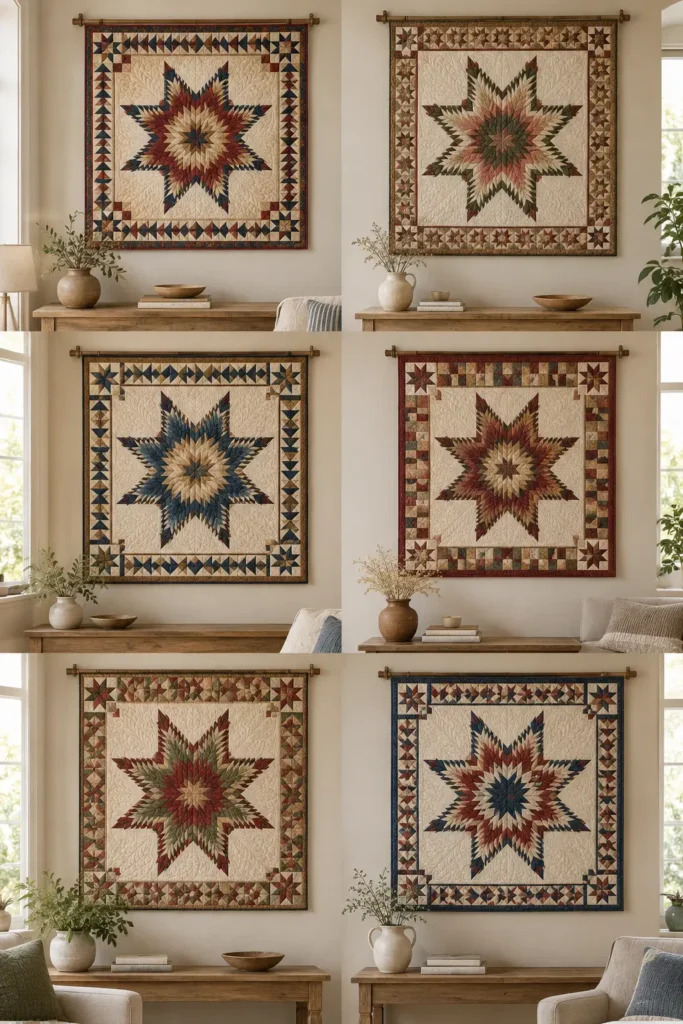
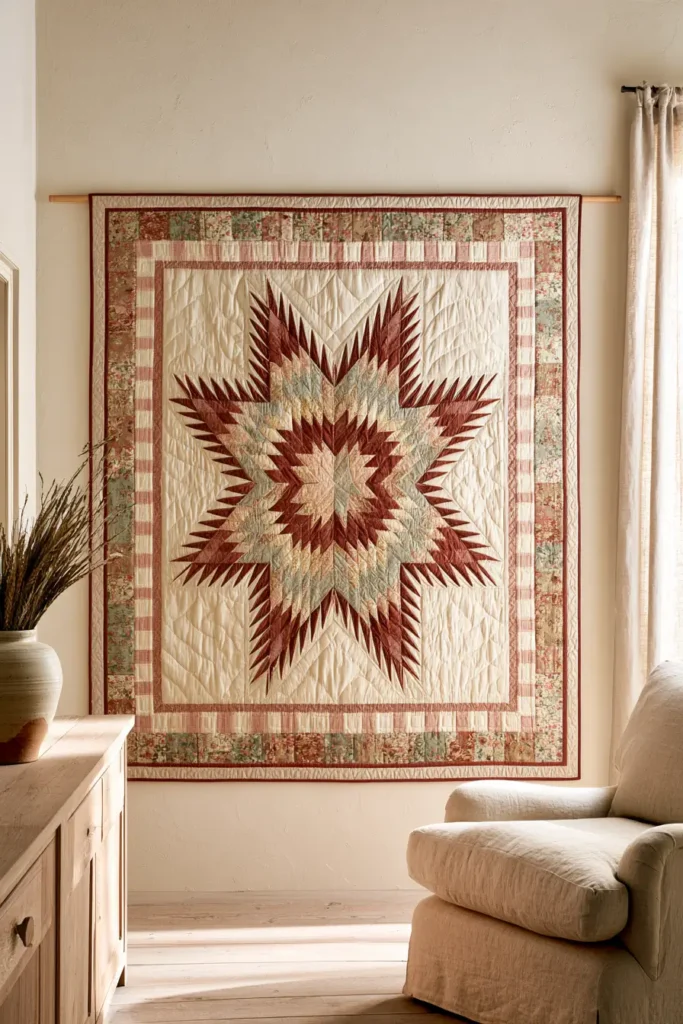
A Traditional Feathered Star Quilt Wall Hanging with Serrated Points and Vintage Patchwork Borders celebrates the intricate geometry of heritage-inspired quilting. Its most distinctive feature is the series of small, precisely pieced triangles that create feather-like, serrated edges along the larger star points. These delicate triangular details introduce a rhythmic, almost lace-like appearance while preserving the strong symmetry of a traditional eight-point star. Unlike the broad radiating diamonds of a Lone Star or the comparatively simple triangular units of an Ohio Star, the Feathered Star draws much of its visual character from the careful arrangement of numerous smaller patchwork pieces.
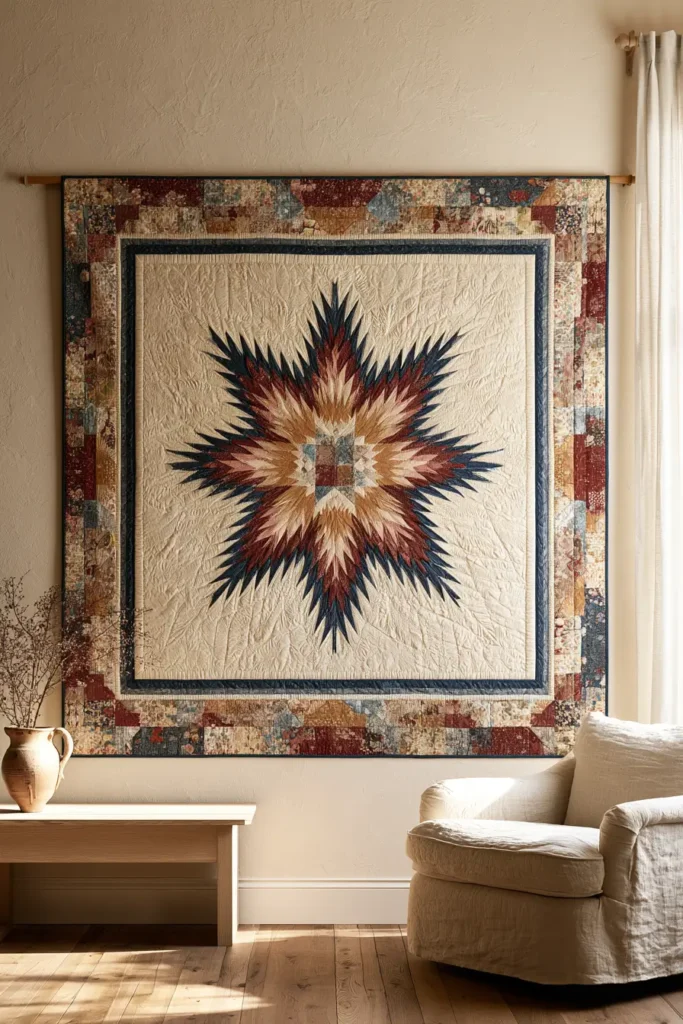
Vintage-inspired fabrics bring warmth and depth to this detailed construction. Antique indigo, faded dusty rose, muted burgundy, soft mustard gold, and creamy ivory create a collected appearance reminiscent of traditional patchwork textiles. A central star framed by carefully arranged patchwork borders can look particularly striking against a quiet cream background, where its serrated edges remain clearly visible. Small floral calicos, reproduction-style prints, and subtly aged color combinations reinforce the traditional aesthetic without requiring genuinely fragile antique fabrics. The result is a decorative quilt that rewards close inspection while retaining enough geometric contrast to be appreciated from across a room.
Design Inspirations – Digitally Modified Images. Texture and color may vary from the actual product.
Understanding the Serrated Feathered Star Construction
The Feathered Star differs from simpler star blocks through the additional triangular units placed along the edges of its major points. These small pieces form repeated serrations, creating the impression of delicate feathers extending outward from the larger star structure. Maintaining a consistent rhythm between these units is essential because uneven spacing or poorly aligned intersections can interrupt the characteristic feathered outline.
For a wall hanging, the scale of the feathered details deserves particular consideration. If the triangles are extremely small, their individual shapes may become difficult to recognize once the quilt is displayed vertically. Conversely, oversized feathering can make the star appear heavier and less intricate. A balanced design preserves the relationship between the large star points, the smaller surrounding triangles, and the central patchwork area.
Many traditional Feathered Star arrangements incorporate a central square or decorative patchwork section. This provides an opportunity to introduce a contrasting fabric or a restrained floral print without overwhelming the surrounding geometry. Cream or ivory background sections can help separate the delicate triangular edges, allowing their alternating colors to remain visually distinct.
Precise piecing is especially important where multiple small units meet. Consistent seam allowances, careful pressing, and controlled handling of diagonal fabric edges help preserve the intended shapes. The technique demands patience, but the fine geometric detail is also what distinguishes the design from more straightforward star blocks.
Choosing Vintage Fabrics and Coordinating Patchwork Borders
Fabric selection should reinforce the traditional character while keeping the intricate star geometry readable. Stable quilting cotton is particularly suitable for the small triangular units because it presses neatly and is generally easier to control than loosely woven or stretchy textiles.
A palette of antique indigo, dusty rose, faded burgundy, warm ochre, and ivory offers a rich vintage appearance. For a softer interpretation, muted sage, antique plum, aged lavender, and cream can create a similarly traditional effect. The strongest contrast should appear where it helps define the feathered edges, rather than being distributed randomly throughout the quilt.
Small-scale floral calicos, delicate botanical prints, and subtle tone-on-tone fabrics work well with the detailed piecing. Large, high-contrast prints may obscure the small triangles, making the serrated edges appear visually fragmented. Consider reserving more noticeable prints for the central patchwork or selected border sections, where the fabric design has room to remain recognizable.
The borders provide another opportunity to establish the quilt’s vintage identity. Individually pieced squares, narrow fabric strips, small geometric units, or a carefully coordinated scrappy arrangement can frame the central star without competing with it. Repeating a few colors from the star within the border creates continuity, while a narrow solid inner border can provide a useful visual separation.
Avoid making every border equally busy. A detailed Feathered Star already contains substantial geometric activity, so alternating decorative patchwork with quieter fabric sections can produce a more balanced composition.
Quilting Texture and Decorative Wall Display
Quilting stitches should enhance the Feathered Star’s intricate construction rather than conceal it beneath heavy surface patterns. Fine echo quilting around the larger star outline can emphasize its geometry, while restrained stitching within the background adds texture without overwhelming the small serrated points. Subtle straight-line or crosshatch quilting may complement the vintage character, particularly in areas of open background fabric.
Low-loft batting can be a practical choice for a wall hanging because it provides gentle stitched relief without creating unnecessary bulk. However, the appropriate batting and quilting density should be chosen together, taking into account the fabric weight and the desired hanging behavior.
A square composition generally suits a centered Feathered Star, providing balanced space around its eight main points. The surrounding borders should be wide enough to frame the design while allowing the star to remain the dominant feature.
For display, a securely attached hanging sleeve and a suitable wooden or metal rod can help support the quilt evenly. Stable backing, neatly finished binding, and a straight upper edge contribute to a tidy presentation. The textile should hang relatively flat so the small triangular details remain visible.
This style pairs naturally with vintage-inspired rooms, traditional farmhouse interiors, and reading spaces featuring wooden furniture, linen upholstery, or muted botanical accents. The decorative setting should remain restrained enough for the intricate patchwork to receive the attention it deserves.
Practical Tips for Accurate Points and Visual Balance
One of the most common challenges in Feathered Star construction is maintaining consistent alignment across numerous small triangular units. Even minor inaccuracies can accumulate, affecting the rhythm of the serrated edges. Careful preparation, checking unit dimensions against a reliable pattern, and avoiding excessive stretching during pressing can help reduce distortion.
Color contrast is another important consideration. When the feathered triangles and adjacent fabrics are too similar in value, the detailed edges may disappear into the surrounding patchwork. Testing the fabric arrangement in grayscale can reveal whether the small units remain distinct.
Excessively busy border fabrics can also weaken the composition. If the outer patchwork attracts more attention than the central star, consider reducing the print contrast or introducing a narrow neutral separating border.
Finally, avoid excessive quilting density around the smallest pieced sections. Closely spaced stitching may introduce unwanted stiffness or distortion, particularly in a compact wall hanging. The goal is to secure and texture the quilt while allowing its carefully constructed geometry to remain clear.
Helpful Note: Before selecting fabrics for the smallest feathered triangles, place several candidate prints beside a contrasting background and view them from a few feet away. Fabrics that appear beautifully detailed up close may blend together at normal wall-viewing distance. Strong value separation and restrained prints often preserve the feathered effect more effectively than additional colors.
Other Design Inspirations – Digitally Modified Images. Texture and color may vary from the actual product.
Design Inspirations – Digitally Modified Images. Texture and color may vary from the actual product.
Other Design Inspirations – Digitally Modified Images. Texture and color may vary from the actual product.
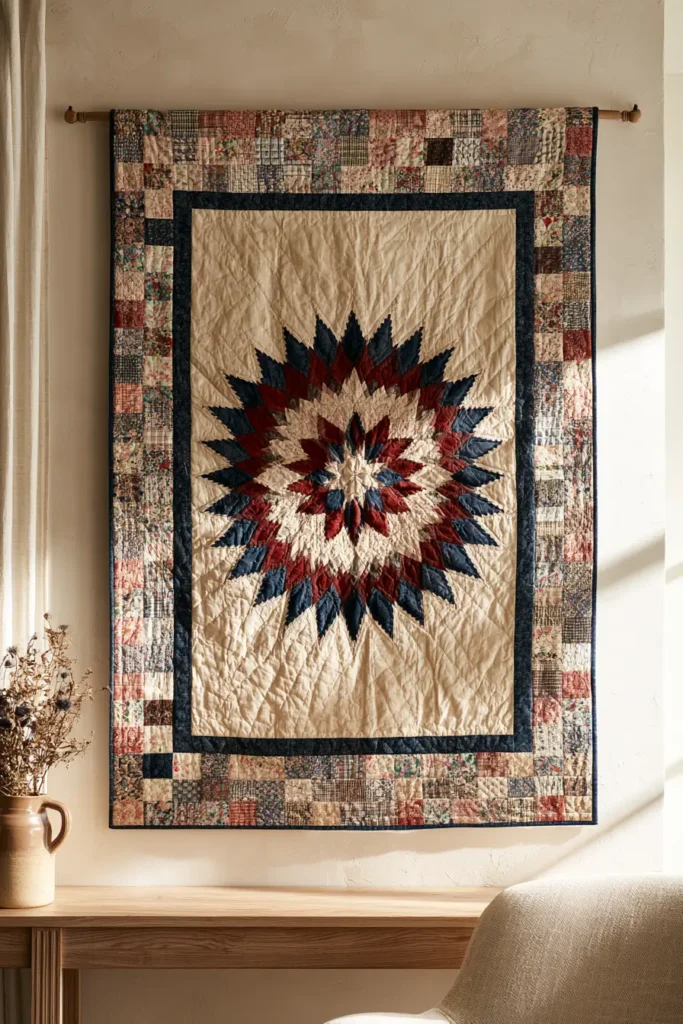
4. Vintage Ohio Star Quilt Wall Hanging with Scrappy Floral Calico Prints and Checkerboard Sashing
Design Inspirations – Digitally Modified Images. Texture and color may vary from the actual product.
Other Design Inspirations – Digitally Modified Images. Texture and color may vary from the actual product.
5. Six-Point English Paper-Pieced Star Quilt Wall Hanging with Diamond Rosettes and Hexagon Accents
Design Inspirations – Digitally Modified Images. Texture and color may vary from the actual product.
Other Design Inspirations – Digitally Modified Images. Texture and color may vary from the actual product.
6. Modern Off-Center Wonky Star Quilt Wall Hanging with Negative Space and Linear Quilting
Design Inspirations – Digitally Modified Images. Texture and color may vary from the actual product.
Other Design Inspirations – Digitally Modified Images. Texture and color may vary from the actual product.
More to come …
7. Log Cabin Star Quilt Wall Hanging with Light-and-Dark Strips Forming Bold Geometric Points
8. Mini Star Quilt Wall Hangings for a Coordinated Jewel-Tone Patchwork Gallery Wall
9. Christmas Star Quilt Wall Hanging in Evergreen, Barn Red, and Plaid Flannel
10. Pixelated Star Quilt Wall Hanging with Tiny Patchwork Squares and Bold Color Contrast
11. Boho Patchwork Star Quilt Wall Hanging with a Wooden Dowel and Macramé Fringe
12. Upcycled Indigo Denim and Flannel Star Rag Quilt Wall Hanging with Exposed Frayed Seams
Final Thoughts on Star Quilt Wall Hanging Ideas
Star quilt wall hangings demonstrate how a familiar geometric motif can take on remarkably different personalities through fabric selection, construction, and presentation. Precisely pieced diamonds and triangular points create intricate traditional compositions, while irregular patchwork, strong value contrast, and open negative space introduce a more contemporary character. Small squares, rectangular fabric strips, vintage florals, and softly frayed seams each contribute their own visual rhythm and surface texture.
Even the way a quilt is displayed can change its decorative effect, from a neatly bound individual hanging to a relaxed dowel-mounted piece or a carefully arranged miniature gallery wall. The most successful designs balance recognizable star geometry with fabric choices and finishing details that enhance rather than compete with the central motif.
When choosing a design to explore, consider the available wall space, the scale of the patchwork, your preferred sewing techniques, and the fabrics you want to use. A detailed star medallion may reward close viewing, while a simpler, high-contrast composition can make a stronger impression from across a room. Pay attention to color value, print scale, fabric compatibility, quilting density, and the support needed to keep the finished piece hanging neatly. A single star can provide a striking focal point, while several smaller quilts can introduce a more collected, layered appearance. Choosing the right combination of geometry, texture, color, and display method allows a star quilt wall hanging to feel thoughtfully integrated into the surrounding home.

