
Christmas Quilt Wall Hanging Ideas in Red, Green, and Winter White
Christmas Quilt Wall Hanging Ideas bring seasonal color, handmade texture, and festive character into a home without the space requirements of a full-sized quilt. Deep cranberry and crimson reds introduce warmth and strong focal points, while forest, pine, and evergreen greens recall Christmas trees and winter foliage. Winter white provides a snowy background that separates colorful motifs and gives intricate patchwork room to breathe. Quilting stitches and layered fabrics add texture and subtle dimension, transforming even a small textile into an attractive seasonal decoration. From traditional patchwork blocks and appliquéd botanical motifs to contemporary geometric arrangements and dimensional folded-fabric designs, these wall hangings offer many ways to interpret a familiar Christmas palette.
Christmas Quilt Wall Hanging Ideas
The designs in this collection explore how different quilting techniques, fabric arrangements, and decorative proportions influence the appearance of Christmas wall hangings. Traditional Log Cabin blocks and detailed Feathered Star medallions emphasize precise geometric piecing, while holly wreaths, poinsettias, and miniature winter villages introduce recognizable seasonal imagery. Scandinavian-inspired reindeer, farmhouse flannel textures, and flowing Bargello waves offer contrasting interpretations of holiday style. Some designs work best as compact square or rectangular pieces, while tall compositions featuring geometric ornaments create stronger vertical statements. A quilted Advent calendar adds a functional element through individually numbered pockets. Together, these ideas demonstrate how fabric selection, color balance, quilting texture, and display format can shape a distinctive piece of Christmas wall décor.
Explore More Quilt Wall Hanging Ideas: How to Hang a Quilt Wall Hanging – Jelly Roll Quilt Wall Hanging Ideas – Farmhouse Quilt Wall Hanging Ideas
Why Make Christmas Quilt Wall Hangings?
Christmas quilt wall hangings offer a practical way to introduce handmade decorations without committing to a large bed quilt. Their smaller scale makes them useful for exploring traditional blocks, appliqué, foundation paper piecing, or dimensional fabric techniques, although the difficulty still depends on the design. They can also make thoughtful seasonal gifts or provide a creative use for suitable fabric remnants and leftover holiday yardage.
Unlike disposable decorations, a well-constructed wall hanging can be stored carefully and displayed again in subsequent years. Different styles complement different interiors: farmhouse plaid and frayed flannel suit relaxed rustic spaces, while Scandinavian motifs and geometric ornaments work particularly well in simpler contemporary settings. Beyond their decorative appeal, quilted layers introduce texture and gentle dimension, while an Advent calendar can provide a practical element for seasonal traditions.
What Makes These Designs Different?
The main differences lie in how the motifs are constructed and how the finished surfaces develop texture. Traditional patchwork uses joined fabric pieces, as seen in triangular Christmas trees, Log Cabin blocks, and precisely pieced Feathered Star medallions. Wool appliqué takes a different approach, attaching shaped holly leaves and berries to a background, while foundation paper piecing helps create the sharp geometric petals of a poinsettia.
Miniature winter villages combine pictorial composition with suitable piecing or appliqué techniques. Strip piecing produces another visual effect: Scandinavian-inspired designs may combine pieced bands with separate decorative motifs, while Bargello uses staggered strip arrangements and graduated colors to suggest flowing ribbons. Cathedral Window construction creates dimensional folded frames rather than conventional flat patchwork. Farmhouse rag quilts emphasize exposed, clipped, and frayed seams, while geometric baubles rely on simplified shapes and negative space. An Advent calendar differs through its functional arrangement of 24 accessible, securely attached pockets.
Choosing Fabrics and Building a Festive Color Palette
Fabric selection affects both the appearance and construction of a Christmas wall hanging. Stable quilting cotton works well for traditional patchwork, Log Cabin blocks, precise geometric piecing, and Bargello strips, while wool or wool-blend fabrics suit softly textured holly appliqué. Cotton flannel creates the cozy surface associated with farmhouse rag quilts, particularly where controlled fraying is part of the design. Color value is as important as hue: saturated cranberry, ruby, and crimson reds need sufficient contrast against forest, pine, or emerald greens to keep individual motifs recognizable.
Winter white, ivory, and soft cream provide useful negative space, especially around detailed stars, wreaths, and poinsettias. A green-dominant composition feels woodland-inspired, while generous winter-white areas produce a lighter, more restrained appearance. Favor solids and subtle tone-on-tone fabrics where precision matters, and consider compatible fabric weights, shrinkage, and colorfastness before combining materials.
Planning Size, Shape, and Wall Display
The shape of a Christmas wall hanging should complement both its design and its intended location. Small square pieces suit wreaths, star medallions, and compact geometric arrangements, while horizontal rectangles provide room for snowy village scenes or repeated quilt blocks. Tall, narrow formats work especially well for vertically arranged Christmas ornaments and other designs intended for limited wall space. Motif scale matters because details that look attractive up close may become difficult to distinguish across a room.
A suitable hanging sleeve and dowel, fabric tabs, or another securely supported method can help distribute the textile’s weight and reduce distortion. Backing, quilting density, and neatly finished edges also influence how flat the piece hangs. Choose mounting hardware appropriate for the wall surface and textile weight. For seasonal storage, keep the quilt clean and dry, avoiding tight folds that could damage dimensional embellishments.
Quilting Texture, Decorative Details, and Common Mistakes
Quilting stitches should support the design rather than compete with its decorative motifs. Straight-line quilting complements Log Cabin blocks, geometric baubles, and Bargello strip arrangements, while carefully positioned echo quilting can emphasize appliquéd wreaths or botanical shapes. Pictorial winter villages benefit from restrained stitching that preserves small architectural details, and dimensional Cathedral Window frames require finishing methods appropriate to their folded construction.
Lightweight batting often helps decorative pieces hang flatter, although the appropriate layering depends on the technique. Common mistakes include insufficient contrast between red and green fabrics, overly busy prints, distorted seams, and excessive quilting density that makes the hanging stiff. Accurate points are particularly important in Feathered Star and foundation paper-pieced designs. Rag quilts require controlled seam clipping, while Advent calendars need secure pocket attachments and readable numbers. Above all, the finished composition should remain recognizable at its intended viewing distance.
About the Design Inspiration Images
The accompanying images illustrate Christmas quilt wall hanging design possibilities and are intended primarily as visual inspiration. Some images may be AI-generated, digitally modified, or developed as conceptual designs. Certain ideas may also draw inspiration from existing quilting traditions, techniques, motifs, or designs found in other sources. These visuals should not automatically be interpreted as photographs of physically completed or tested quilts, and a pictured design may not have a corresponding downloadable pattern or verified construction instructions. Readers can use the concepts to explore original fabric arrangements, seasonal color combinations, quilting methods, and decorative interpretations suited to their own projects.
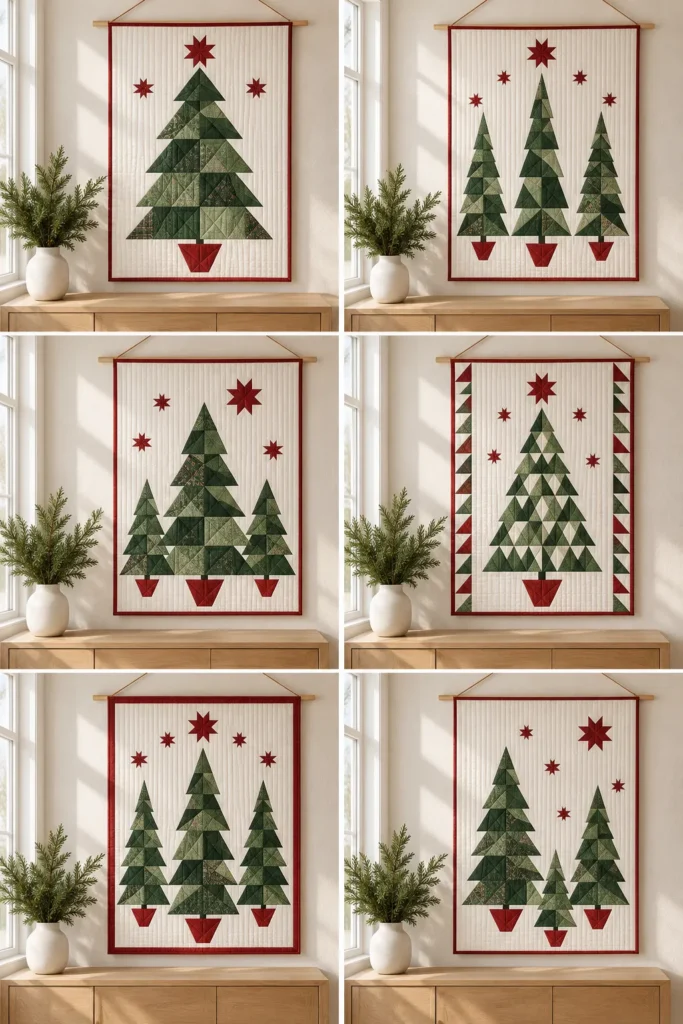
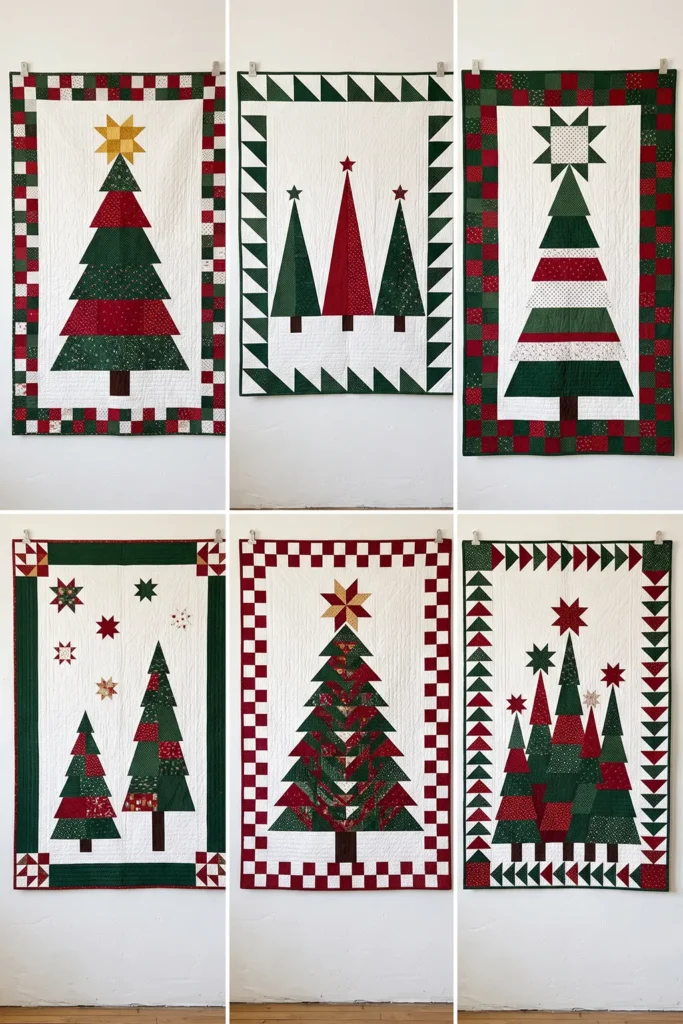
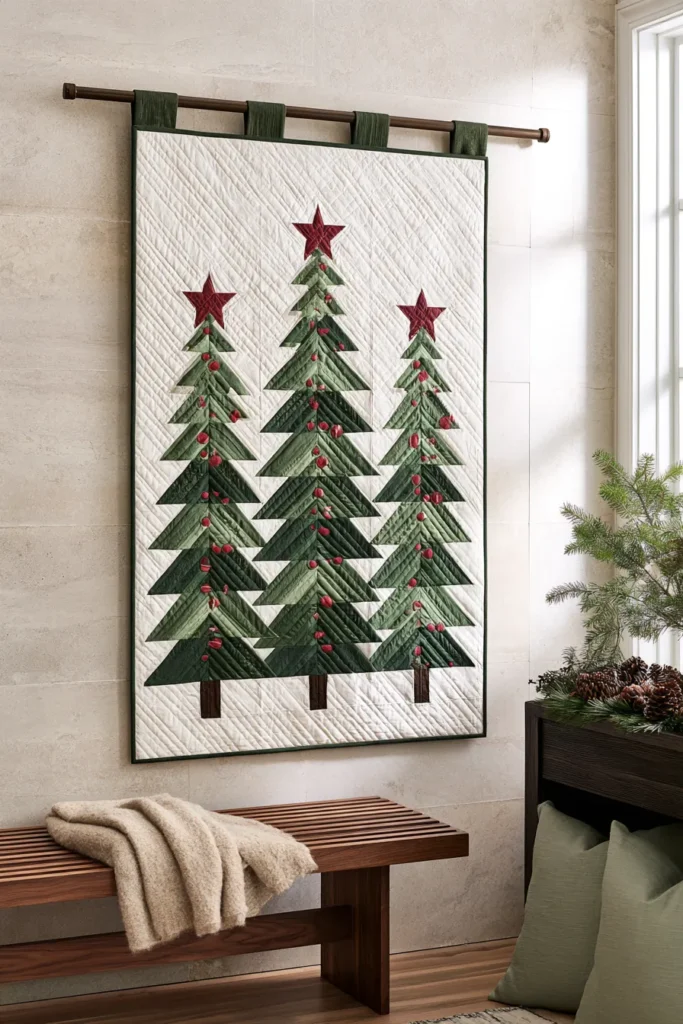
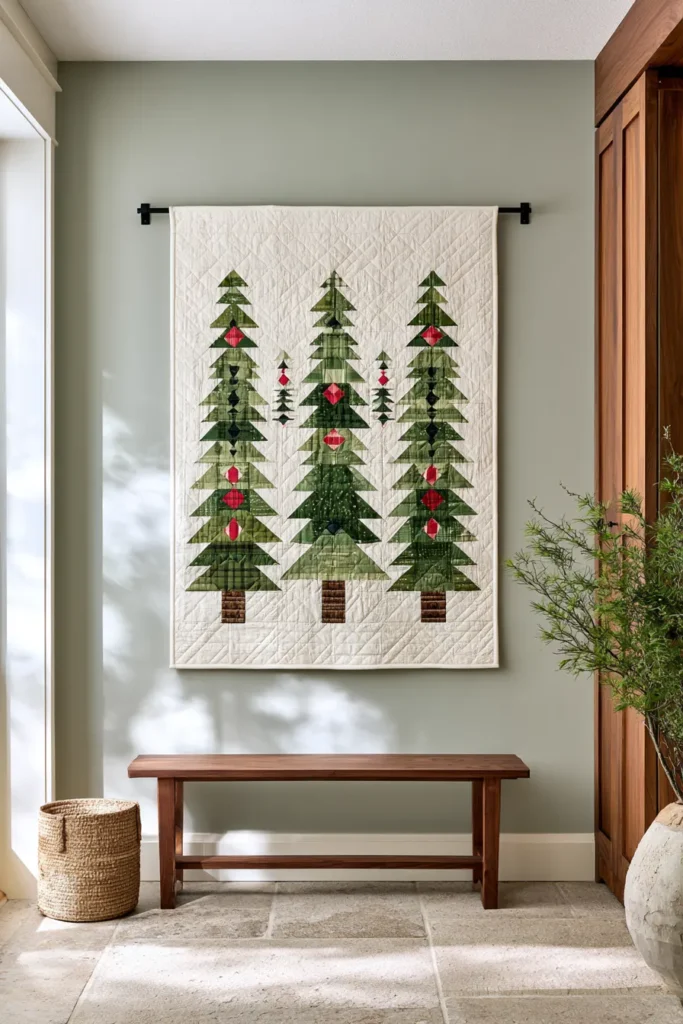
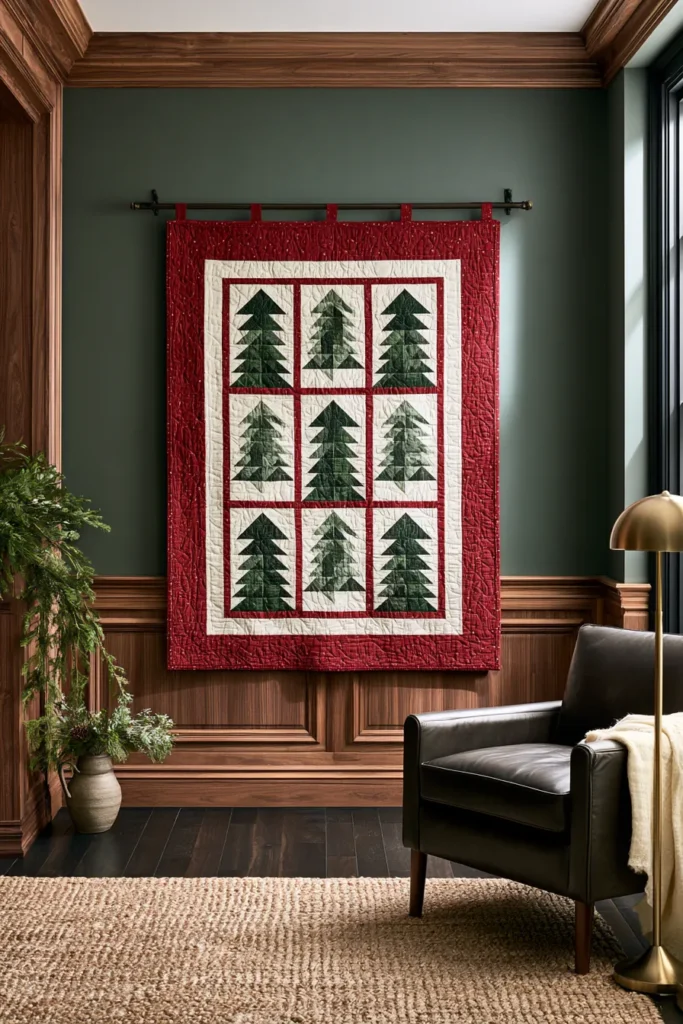
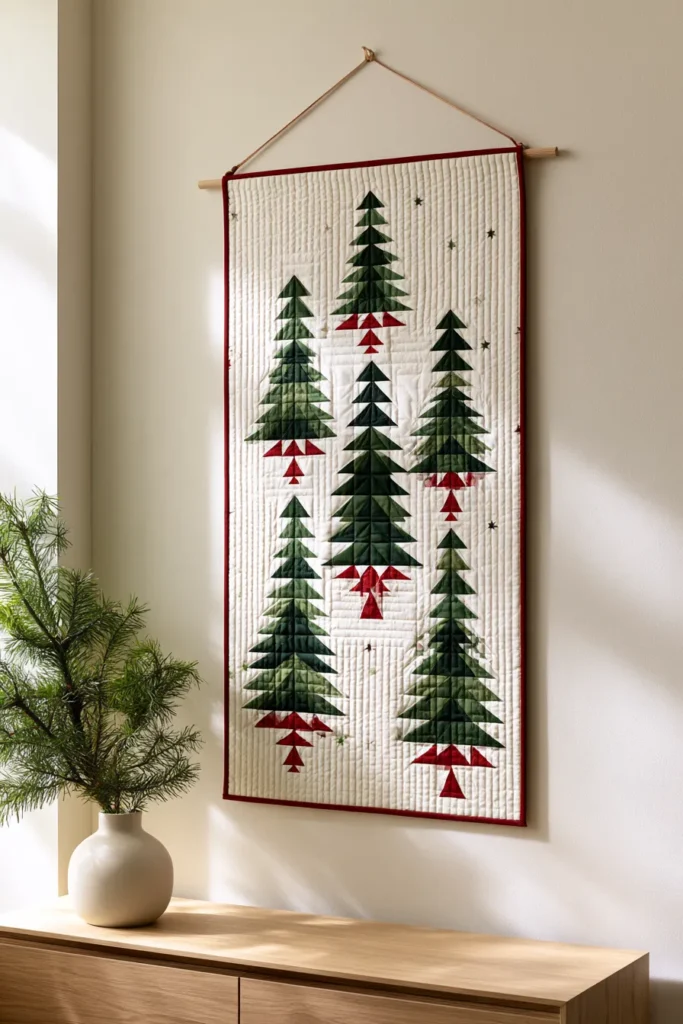
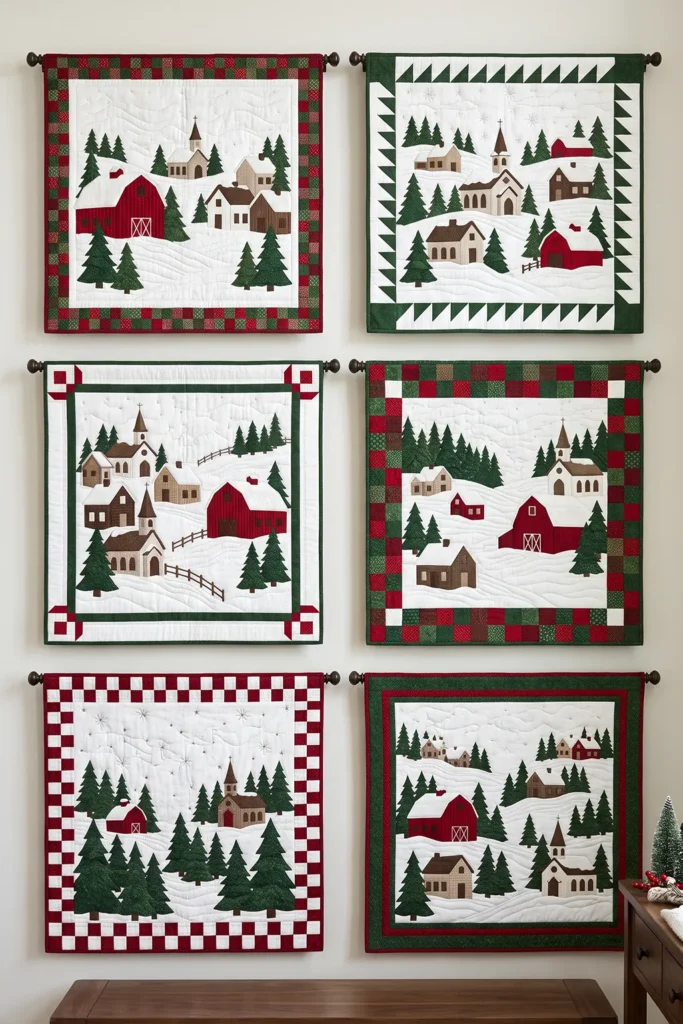
1. Layered Triangle Patchwork Pine Tree Christmas Quilt Wall Hanging in Forest Green, Cranberry, and Winter White
A layered triangle patchwork pine tree Christmas quilt wall hanging brings the familiar silhouette of evergreen trees into a clean, geometric textile design. Forest-green and pine-green fabric triangles form overlapping-looking tiers of branches, while cranberry-red accents introduce festive warmth against a bright winter-white background. The triangular shapes create a natural rhythm, widening toward the lower branches and narrowing toward pointed treetops. A larger central tree can serve as the focal point, accompanied by smaller trees that give the composition the appearance of a miniature winter forest. The result combines traditional Christmas imagery with the crisp geometry of patchwork quilting.
What distinguishes this wall hanging from an ordinary Christmas tree appliqué quilt is the emphasis on individually arranged triangular fabric sections. Rather than relying on a single tree-shaped silhouette, the design uses repeated triangles to suggest overlapping evergreen branches and create depth through differences in color and fabric value. Traditional triangle piecing can produce this effect through joined fabric units, while carefully arranged layered appliqué offers another interpretation. These approaches should not be confused: piecing joins shapes to construct the quilt surface, whereas appliqué attaches fabric shapes to an existing background. Both can inspire the tiered appearance, although their seams, thickness, and finishing requirements differ.
Design Inspirations – Digitally Modified Images. Texture and color may vary from the actual product.
Choosing Forest-Green Fabrics and Cranberry Accents
Stable quilting cotton works particularly well for this design because it supports accurate triangular shapes and clearly defined seams. A combination of solid and subtle tone-on-tone fabrics can give the evergreen trees visual depth without making their geometric structure difficult to recognize.
Forest green should establish the principal foliage color, supported by variations of pine, deep evergreen, and muted sage. Darker greens can emphasize the lower or recessed-looking branch sections, while medium greens help distinguish individual triangular tiers.
Cranberry red provides a useful contrast, but its placement should remain deliberate. Small cranberry triangles interspersed among the green branches can suggest festive ornaments without requiring additional decorative appliqué. A narrow cranberry border or occasional red fabric accent near the tree bases can reinforce the Christmas palette.
Winter-white quilting cotton creates a clean background that allows the tree silhouettes to stand out. A soft ivory or subtle white-on-white print can add texture while preserving the snowy appearance.
Avoid combining too many large Christmas prints within the tree shapes. Busy motifs may compete with the triangular geometry and obscure the layered branch effect. Fabrics with compatible weights and minimal stretch will also be easier to manage than an assortment of loosely woven or unusually heavy materials.
Arranging Triangles for Layered Evergreen Branches
The arrangement of the triangular patches is central to the design. A convincing pine tree silhouette generally becomes wider toward the base, with narrower sections and smaller shapes near the top.
The impression of overlapping branches can be achieved through alternating light and dark green triangular units, carefully aligned tiers, and the placement of contrasting fabric sections. Actual overlapping fabric layers are another possibility, but they introduce additional thickness and require appropriate edge finishing.
A composition featuring trees of different heights creates a more natural woodland appearance. One large central tree can establish a strong focal point, while two smaller trees positioned at different heights introduce variation without overwhelming the wall hanging.
The trees should remain clearly separated by winter-white background fabric. Without sufficient negative space, neighboring green triangles can merge into an indistinct mass, particularly when viewed from across a room.
Triangle scale also matters. Larger units produce a simpler, more graphic appearance, while smaller triangles create finer detail and more opportunities for color variation. However, excessively small pieces may introduce unnecessary seam intersections and make the patchwork difficult to read.
A useful design principle is to maintain recognizable tree silhouettes first, then introduce variation through fabric values, selective cranberry accents, and subtle changes in triangular proportions.
Quilting Texture, Batting, and Wall-Hanging Finish
Lightweight batting is generally appropriate for a decorative quilt wall hanging because it adds gentle dimension without creating unnecessary bulk. Low-loft cotton or suitable lightweight polyester batting can support subtle quilting texture while allowing the finished textile to hang relatively flat.
Straight-line quilting complements the triangular construction. Stitching parallel to selected diagonal seams can reinforce the geometric branch arrangement, while restrained vertical or diagonal quilting across the winter-white background can suggest the quiet texture of a snowy landscape.
The quilting should remain balanced rather than overly dense. Excessive stitching may stiffen the surface, while insufficient quilting may allow uneven movement between the layers. Follow the selected batting’s quilting-distance recommendations.
A narrow forest-green or cranberry-red binding can frame the composition without competing with the trees. A simple inner border may also help separate the main design from the outer edge.
For display, a fabric hanging sleeve along the upper back can accommodate a suitably supported wooden dowel or quilt rod. The hanging method should distribute the textile’s weight evenly and allow the full composition to remain visible.
Beginner Tips and Common Design Mistakes
One of the most common problems with triangular patchwork is losing the clarity of the intended shape. Inaccurate seam alignment or inconsistent handling can interrupt the pointed treetops and make the branch tiers appear uneven.
Bias edges on some triangular pieces may also stretch during handling, creating distorted seams or rippled sections. Stable cotton fabric, careful pressing, and suitable piecing methods help preserve the intended geometry.
Color balance deserves equal attention. Using only one dark green can make the trees appear visually flat, while too many contrasting green prints can obscure the branch structure. A controlled range of dark, medium, and lighter greens provides more convincing depth.
Cranberry accents should enhance the trees rather than dominate them. Concentrating too much red in one area can disrupt the visual rhythm, while scattering tiny red pieces everywhere may produce an unnecessarily busy surface.
Finally, consider the hanging’s intended viewing distance. A design that looks intricate close up may lose definition on a wall if its trees are too small or its background lacks sufficient contrast.
Helpful Note: Before planning a larger wall hanging, arrange a few representative green and cranberry triangles against the intended winter-white background. Viewing the arrangement from several feet away can reveal whether the layered branches remain recognizable and whether the color contrast is strong enough.
Other Design Inspirations – Digitally Modified Images. Texture and color may vary from the actual product.
2. Wool Appliqué Holly and Berry Wreath Christmas Quilt Wall Hanging on a Winter White Background
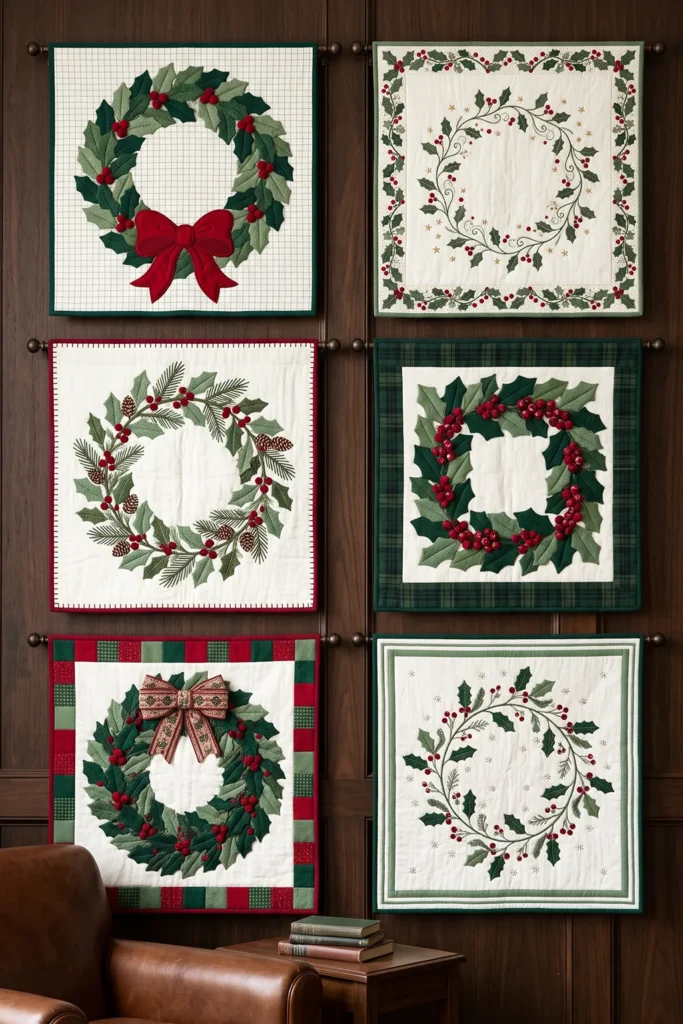
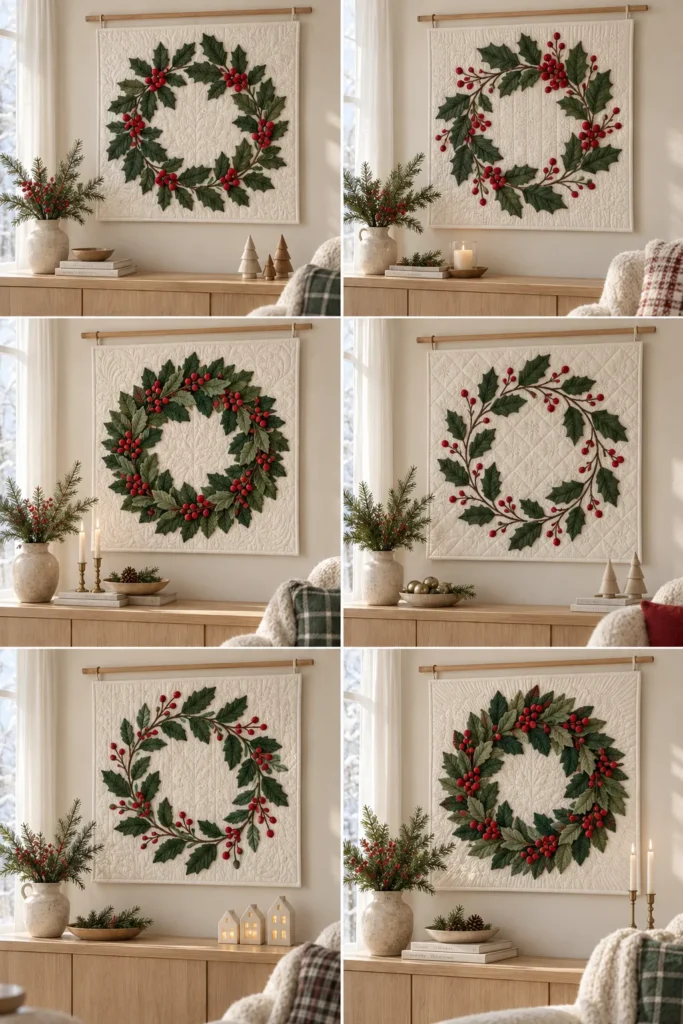
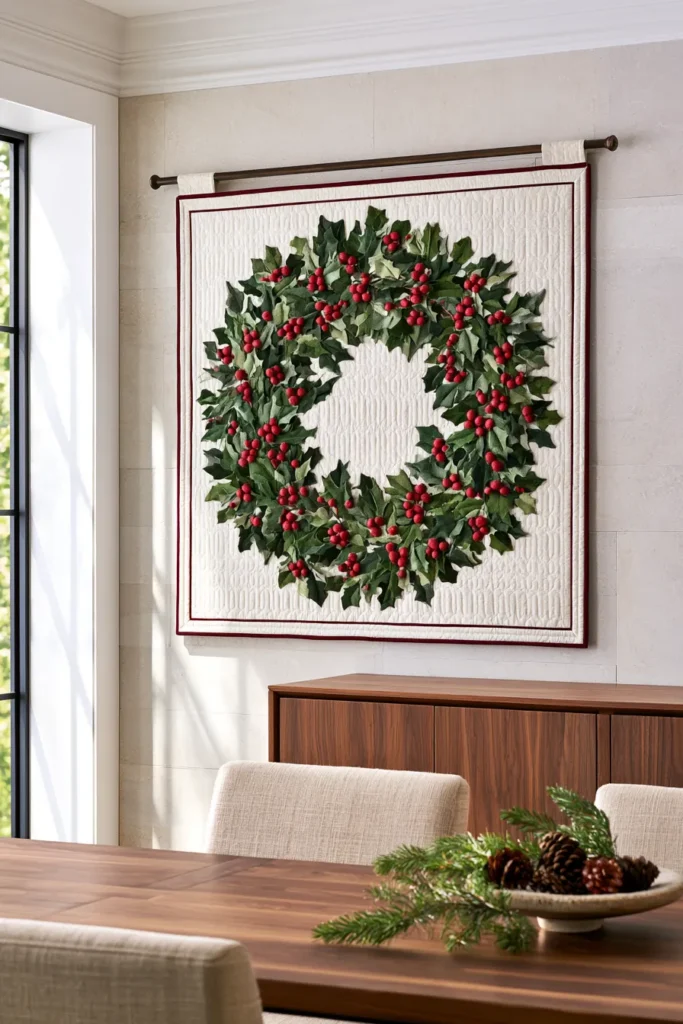
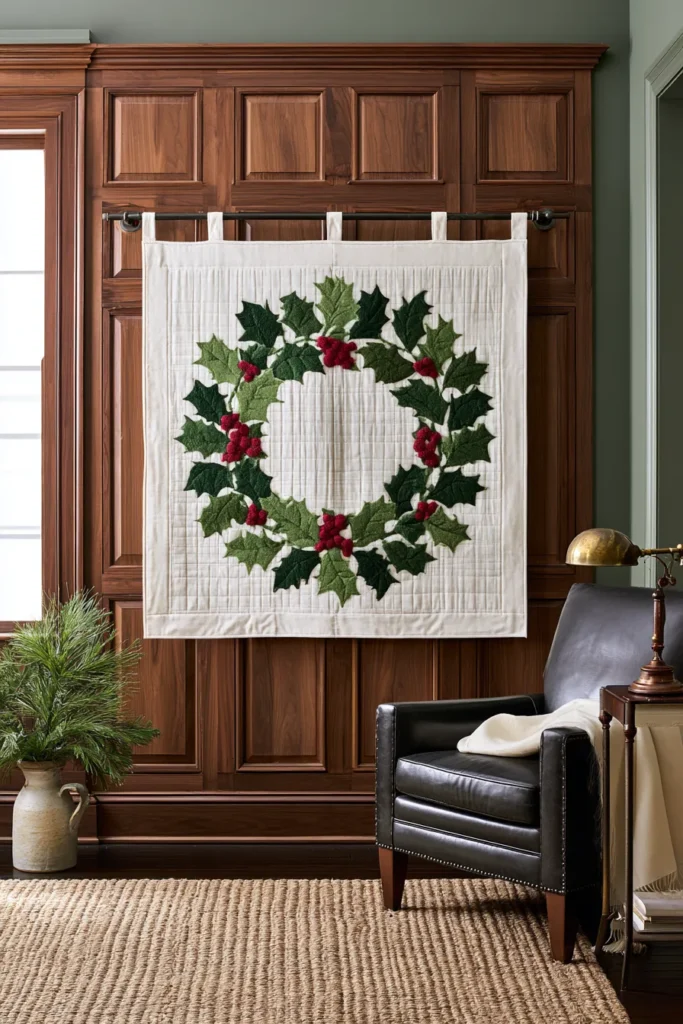
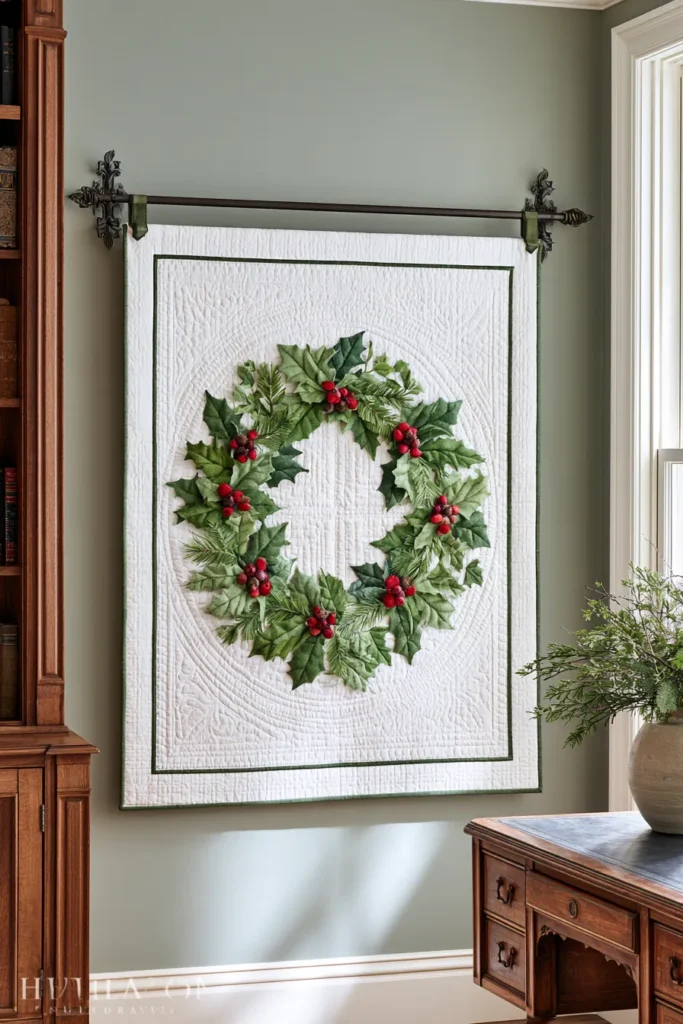
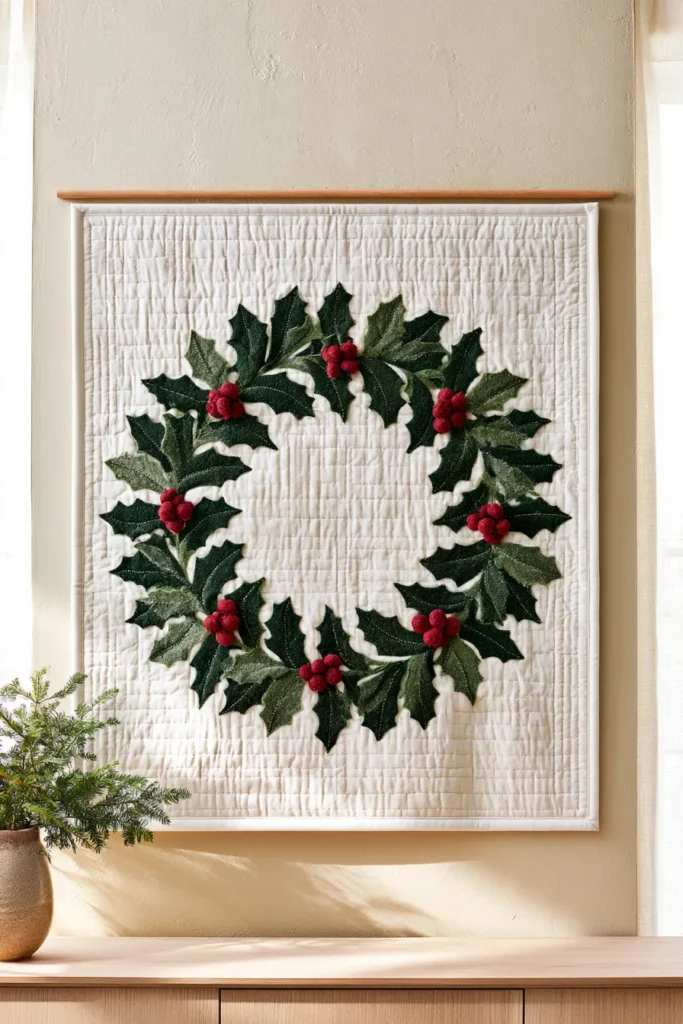
A wool appliqué holly and berry wreath Christmas quilt wall hanging brings the rich colors and natural shapes of traditional holiday greenery into a softly textured textile design. A generous circular wreath of deep forest-green holly leaves surrounds an open winter-white center, while clusters of cranberry-red berries provide bright seasonal accents. The leaves have recognizable pointed tips and gently serrated edges, with overlapping arrangements that create the appearance of a full evergreen wreath. Against a luminous winter-white cotton background, the dark green wool and red berries become the focal point. The square or nearly square format gives the composition a balanced, framed appearance suitable for a Christmas living room, entryway, or seasonal display.
Unlike traditionally pieced Christmas quilts, this design uses wool appliqué to create the decorative foliage. Individual wool shapes are placed on a background fabric and secured with suitable appliqué stitching, allowing leaves, stems, and berries to follow natural curves rather than the straight seams associated with geometric patchwork. Wool introduces a distinctive matte surface and softly raised texture, particularly when felted or fulled wool is used. The wreath can feel traditional through its recognizable Christmas symbolism while remaining visually restrained through a simple background, carefully selected colors, and delicate quilting. Its character comes from the relationship between botanical shapes, layered fabric, and visible stitching rather than complex quilt-block construction.
Design Inspirations – Digitally Modified Images. Texture and color may vary from the actual product.
Choosing Wool Fabrics for Holly Leaves and Red Berries
Felted or fulled wool is particularly suitable for this design because its compact fibers help cut edges resist fraying. This allows the pointed holly leaves to retain their distinctive shapes without the same edge-turning requirements as many woven cotton appliqué techniques.
A combination of deep forest green, pine green, and muted evergreen wool adds natural variation to the wreath. Darker leaves create visual depth, while slightly lighter green pieces help individual shapes remain distinguishable. Small amounts of sage or olive green can soften the overall appearance, provided they do not weaken the traditional Christmas palette.
For the berries, cranberry red and rich ruby wool create strong contrast against the foliage. Using slightly different red values can make clustered berries more interesting without introducing unrelated colors.
The background works particularly well in winter-white quilting cotton. A smooth solid fabric keeps the appliqué clearly visible, while a subtle white-on-white woven or tone-on-tone texture can provide additional interest.
Avoid heavily patterned backgrounds that compete with the wreath. Large floral prints or prominent geometric motifs can make the holly shapes difficult to distinguish, especially from across a room.
Fabric compatibility also matters. Wool and cotton can respond differently to moisture, heat, and laundering. Check the care requirements of both materials and consider preparing compatible fabrics appropriately before combining them.
Arranging Holly Leaves into a Balanced Circular Wreath
The wreath should form a recognizable ring with enough open space at its center to preserve the circular composition. Leaves can radiate outward from an implied central stem, with their pointed tips extending naturally in different directions.
Overlapping leaf shapes create depth, but excessive layering can make the wreath bulky. A useful design approach is to combine larger holly leaves that establish the main outline with smaller leaves that fill selected spaces.
The composition does not need to be perfectly symmetrical. Slight differences in leaf size, direction, and spacing help suggest natural foliage. However, the wreath should still maintain a visually balanced circular shape.
Berry placement is equally important. Small clusters distributed around the ring create festive rhythm, while a more prominent grouping near the lower portion can establish a subtle focal point.
A common mistake is placing too many berries close together. Large, continuous areas of red can overpower the green foliage and weaken the recognizable holly wreath appearance.
The winter-white background provides essential negative space. Leaving generous margins around the wreath helps its individual leaves remain visible and prevents the composition from feeling crowded.
For a restrained Scandinavian-inspired interpretation, use fewer leaves, clearly defined silhouettes, and small red berry clusters. A fuller traditional version can incorporate more overlapping foliage while preserving the open center and balanced outline.
Appliqué Stitching, Quilting Texture, and Wall-Hanging Finish
Blanket stitching is a natural choice for securing wool holly leaves and berries because it provides a decorative edge while helping hold the appliqué in place. Matching green thread creates a subtle finish, while slightly contrasting thread can emphasize the outline of selected leaves.
Small running stitches can suggest central leaf veins, although these details should remain understated. The wool shapes themselves should provide most of the botanical character rather than relying on extensive embroidery.
Berry pieces require careful attachment, particularly when they are small or layered. Secure stitching helps prevent raised edges from catching during handling and seasonal storage.
If the design uses a conventional quilt sandwich, lightweight low-loft batting can add gentle dimension without making the wall hanging excessively thick. Echo quilting around the outer wreath shape can emphasize the circular composition, while restrained straight-line or background quilting provides subtle texture across the winter-white surface.
Avoid excessively dense quilting through thick wool appliqué. Heavy stitching can compress the raised foliage and reduce the soft dimensional appearance that makes this design distinctive.
A narrow forest-green or cranberry-red binding can frame the textile without distracting from the wreath. Alternatively, winter-white binding offers a quieter finish that allows the appliqué to remain the strongest element.
For display, a suitable hanging sleeve attached to the upper back can accommodate a securely supported dowel or quilt rod. The hanging should remain relatively flat, with its full circular wreath clearly visible.
Common Mistakes with Wool Appliqué Wreath Designs
The most important consideration is maintaining recognizable holly foliage. Leaves that are too rounded may resemble ordinary oval foliage, while excessively narrow points can become difficult to handle and secure.
Using only one green fabric can also make the wreath appear visually flat. A controlled selection of dark and medium greens adds depth without making the arrangement overly busy.
Another potential problem is combining fabrics that behave differently during washing or pressing. Some wool materials may shrink, distort, or change texture under unsuitable care conditions.
Excessive layering is also worth avoiding. Although overlapping wool creates appealing dimension, too many layers can introduce bulk that interferes with the wall hanging’s ability to lie relatively flat.
Finally, ensure the background quilting complements the wreath rather than competing with it. The eye should be drawn first to the green holly leaves and red berry clusters, then to the quieter texture of the winter-white fabric.
Helpful Note: Test a small wool leaf and berry appliqué sample on the intended background fabric before working on a larger composition. This can help evaluate stitching visibility, fabric thickness, edge stability, and the contrast between the wool and winter-white cotton.
Other Design Inspirations – Digitally Modified Images. Texture and color may vary from the actual product.
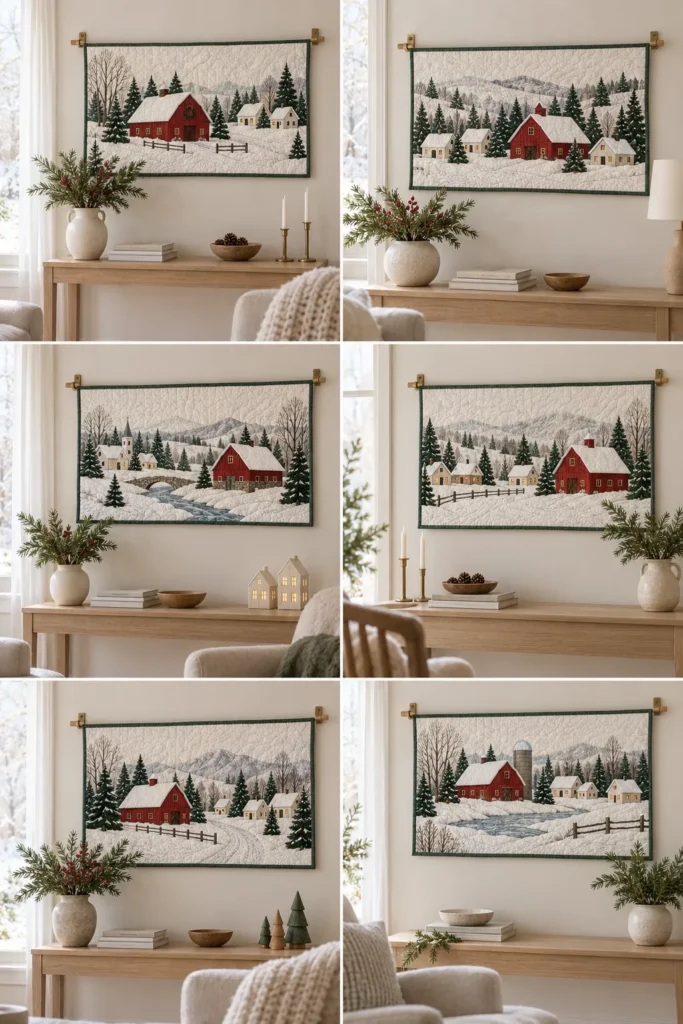
3. Mini Christmas Quilt Wall Hanging with a Snowy Winter Village, Red Barn, and Evergreen Trees
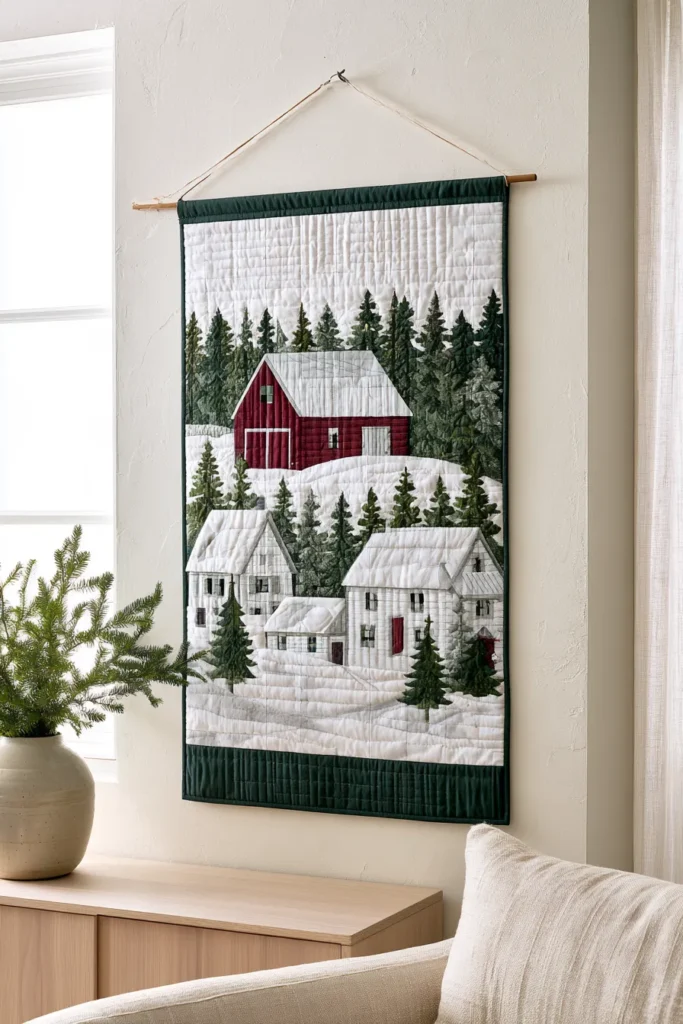
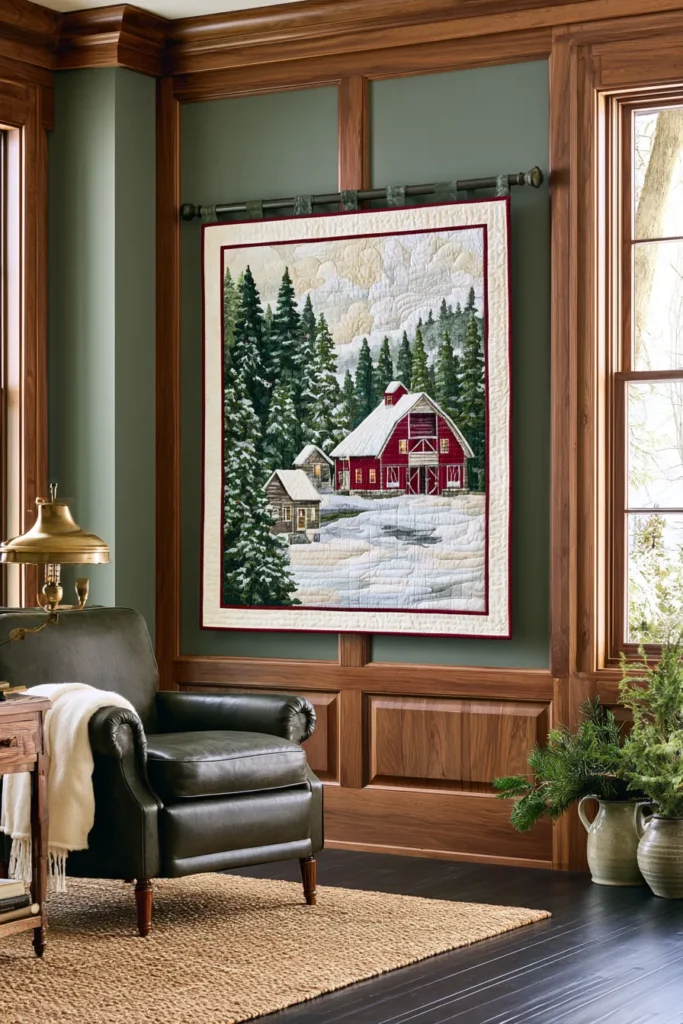
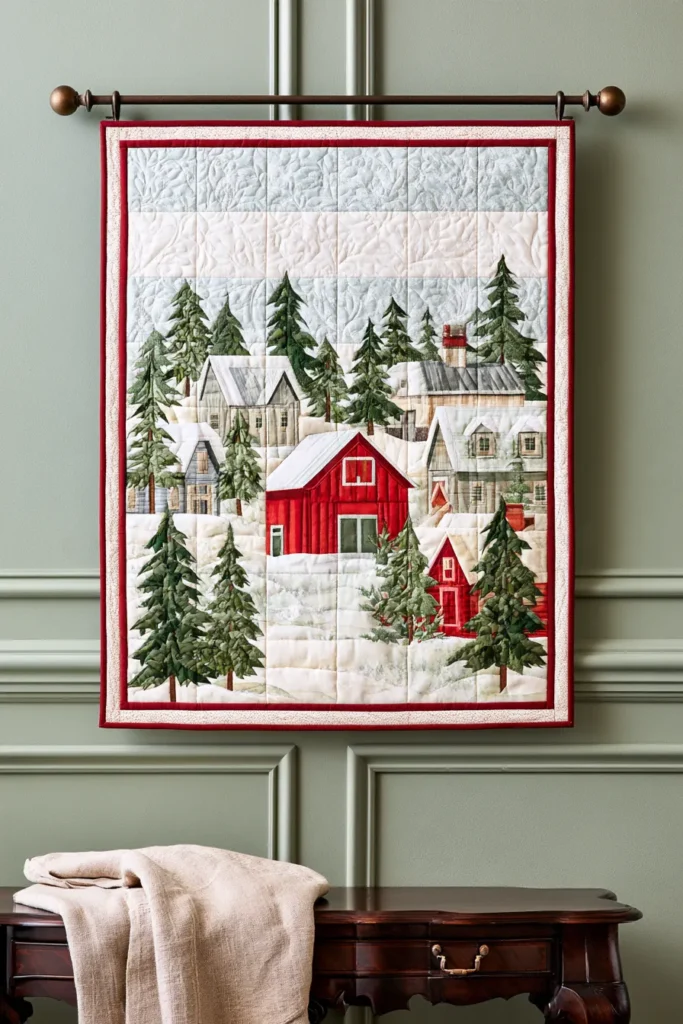
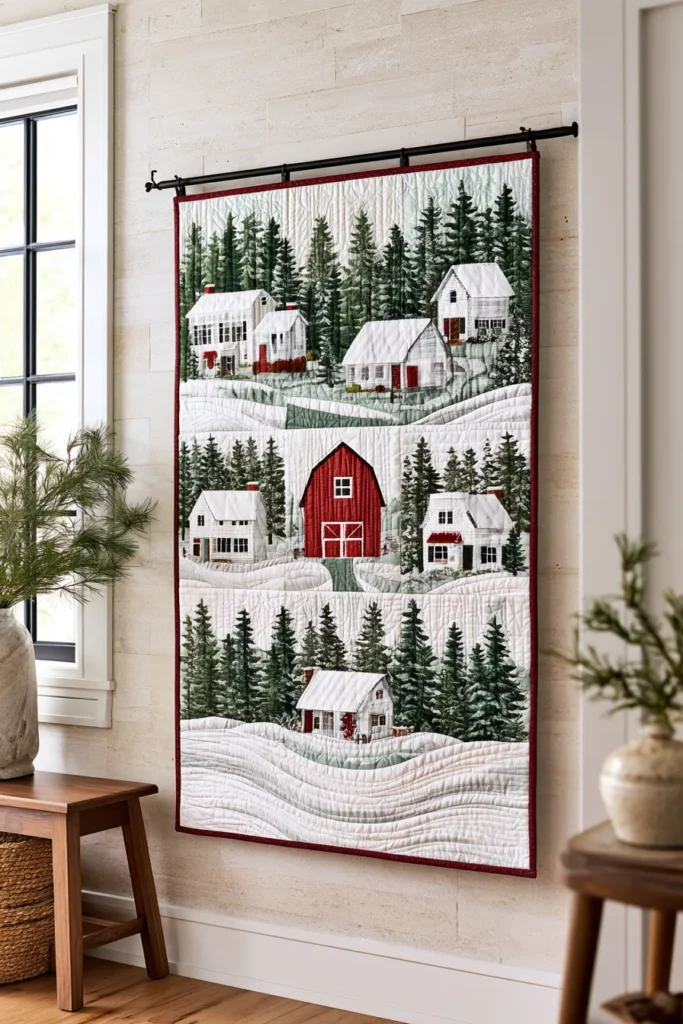
A mini Christmas quilt wall hanging featuring a snowy winter village captures the quiet charm of a countryside Christmas through carefully arranged fabric shapes and soft quilting texture. A prominent cranberry-red barn anchors the scene, surrounded by small winter-white cottages, snow-covered rooftops, and clusters of forest-green evergreen trees. Layered white fabric creates gently rolling snowdrifts, while a pale winter-white sky provides a calm background for the miniature buildings. The combination of red, green, and snowy white establishes a traditional Christmas palette without overwhelming the small landscape. Presented in a moderately horizontal rectangular format, the design resembles a miniature textile illustration, making it especially appealing for a farmhouse entryway, Scandinavian-inspired living room, or cozy seasonal display.
Unlike Christmas quilts built around repeated geometric blocks, this design uses pictorial quilting to create a recognizable winter landscape. Simple architectural shapes can be formed through conventional patchwork, while smaller details such as doors, windows, trees, and snow-covered roof edges may be added through appliqué. The distinction is important: piecing joins individual fabric sections to construct the quilt surface, whereas appliqué attaches shaped fabric elements to an existing background. Combining these approaches allows the village to retain its recognizable character without requiring every tiny detail to become a separate patchwork unit. Restrained quilting adds texture to the snow and buildings, creating a decorative textile scene rather than a flat printed illustration.
Design Inspirations – Digitally Modified Images. Texture and color may vary from the actual product.
Choosing Fabrics for Snowy Rooftops, Red Barns, and Evergreen Trees
Stable quilting cotton works particularly well for miniature pictorial designs because it supports accurate fabric shapes, crisp seams, and carefully defined architectural details. Small-scale solids and subtle tone-on-tone prints are especially useful when individual buildings occupy only a limited area.
The red barn should provide the strongest color accent. Cranberry, barn red, and muted ruby fabrics create a warm focal point against the winter-white surroundings. A small amount of deeper crimson can define the barn doors or other architectural features without requiring elaborate embellishment.
The neighboring cottages benefit from a quieter palette. Winter-white, cream, pale ivory, and soft stone-gray cotton can distinguish individual buildings while preserving the snowy atmosphere. Darker window or doorway details may be introduced sparingly to make the structures recognizable.
For the evergreen trees, combine forest green, pine green, and deep evergreen fabrics. Slight differences in value help separate neighboring trees and suggest depth within the miniature landscape.
The snow itself is most convincing when several compatible white fabrics are used. Bright winter white, soft ivory, and subtle white-on-white textures can create gentle differences between rooftops, snowbanks, and the sky.
Avoid large, busy Christmas prints in the buildings or background. A prominent printed motif may overwhelm a miniature house or make its shape difficult to recognize.
Arranging the Winter Village with a Clear Red Barn Focal Point
The red barn should remain unmistakable, with a recognizable pitched roof, clearly defined walls, and suitable door details. Positioning it near the center or slightly to one side allows it to anchor the composition without making the entire village feel rigidly symmetrical.
Smaller cottages can be arranged around the barn at different heights, suggesting a village spread across gently rolling terrain. Their rooftops should remain distinct, with enough winter-white fabric separating neighboring structures.
Evergreen trees provide a useful transition between the buildings and the surrounding landscape. Taller trees can frame the outer edges of the scene, while smaller trees introduce variation near the cottages.
The snowy foreground is equally important. Broad, gently overlapping-looking white fabric sections can suggest rolling hills or snowdrifts, helping connect the different buildings into one continuous landscape.
The sky should remain relatively quiet. Too many tiny snowflakes, stars, or decorative motifs may make the miniature scene look crowded. A generous winter-white background provides negative space and helps the buildings stand out.
A moderately horizontal composition is particularly suitable because it gives the village room to extend naturally across the landscape. The quilt can remain compact without forcing the buildings into an unnecessarily tall arrangement.
One useful approach is to establish the barn, rooftops, and tree silhouettes as the most recognizable shapes, then introduce smaller decorative details only where they improve the scene.
Combining Patchwork, Appliqué, and Subtle Quilting
This design lends itself to a combination of traditional piecing and appliqué. Rectangular fabric sections can form walls, while suitable triangular or other angular pieces can establish pitched rooftops. Appliqué offers additional flexibility for small windows, barn doors, evergreen silhouettes, and irregular snowbanks.
Because the scene is miniature, construction choices should account for the practical limitations of very small fabric pieces. Tiny windows or narrow roof details can introduce difficult seam intersections if every element is pieced individually. Carefully secured appliqué can often provide a more manageable alternative.
Straight-line quilting can emphasize rooflines and the horizontal layers of snow. Restrained echo quilting around selected buildings and trees may introduce additional dimension without distracting from the landscape.
The winter-white sky offers an opportunity for gentle background quilting. Widely spaced diagonal lines or subtle curved stitching can suggest snowfall or winter atmosphere without relying on numerous decorative snowflake motifs.
Lightweight low-loft cotton or suitable polyester batting can provide modest texture while helping the miniature quilt hang relatively flat. Excessively thick batting may obscure fine details or make the finished wall hanging unnecessarily bulky.
A narrow forest-green or cranberry-red binding can frame the village and reinforce its seasonal colors. A simple inner border may also help separate the pictorial scene from the outer edge.
For wall display, a fabric hanging sleeve attached to the upper back can accommodate a suitably supported dowel or quilt rod. The hanging method should keep the landscape level and allow the entire scene to remain visible.
Common Mistakes in Miniature Pictorial Christmas Quilts
One of the most common problems is including too many tiny details. Although miniature houses with intricate doors and windows may look appealing in an illustration, translating every feature into fabric can create excessive seams, unnecessary bulk, or shapes that become difficult to recognize.
A simplified barn with clear walls, a pitched snowy roof, and recognizable doors is generally more effective than a highly detailed structure whose individual fabric pieces become visually crowded.
Color contrast also deserves attention. White rooftops can disappear against a winter-white sky if their edges are not clearly defined. Subtle changes in fabric value, appropriate quilting lines, or restrained contrasting trim can help separate the architectural shapes.
The evergreen trees should remain distinguishable from one another. Using identical dark-green fabrics for every tree may create a continuous mass rather than a varied woodland arrangement.
Another common issue is placing all the strongest colors in one area. The barn can remain the dominant red feature, but a few restrained cranberry accents elsewhere may help connect it to the wider composition.
Finally, avoid overly dense quilting around small appliqué elements. Heavy stitching can compete with the miniature shapes, while poorly secured details may lift during handling or seasonal storage.
Helpful Note: Before choosing fabric sizes or finalizing a layout, consider how the village will look from the intended viewing distance. If the red barn, snowy rooftops, and evergreen trees remain recognizable without the smallest details, the composition is more likely to work as an attractive Christmas wall hanging.
Other Design Inspirations – Digitally Modified Images. Texture and color may vary from the actual product.
4. Mini Log Cabin Christmas Quilt Wall Hanging with Red Hearth Centers and Alternating Evergreen and Snowy White Strips
Design Inspirations – Digitally Modified Images. Texture and color may vary from the actual product.
Other Design Inspirations – Digitally Modified Images. Texture and color may vary from the actual product.
5. Feathered Star Medallion Christmas Quilt Wall Hanging in Deep Crimson, Pine Green, and Winter White
Design Inspirations – Digitally Modified Images. Texture and color may vary from the actual product.
Other Design Inspirations – Digitally Modified Images. Texture and color may vary from the actual product.
6. Advent Calendar Christmas Quilt Wall Hanging with 24 Numbered Patchwork Pockets in Red, Green, and Winter White
Design Inspirations – Digitally Modified Images. Texture and color may vary from the actual product.
Other Design Inspirations – Digitally Modified Images. Texture and color may vary from the actual product.
More to come …
7. Scandinavian Folk Art Reindeer and Snowflake Strip-Pieced Christmas Quilt Wall Hanging
8. Farmhouse Plaid Flannel Rag Quilt Christmas Wall Hanging with Exposed Fringed Seams
9. Foundation Paper-Pieced Poinsettia Blossom Christmas Quilt Wall Hanging in Ruby Red, Sage Green, and Winter White
10. Tall Vertical Christmas Quilt Wall Hanging with Mid-Century Geometric Baubles in Cranberry Red, Emerald Green, and Warm Winter White
11. Cathedral Window Christmas Quilt Wall Hanging with Dimensional Folded Winter White Frames and Red-and-Green Centers
12. Bargello Ribbon Wave Christmas Quilt Wall Hanging in Graduated Crimson, Evergreen, and Winter White
Final Thoughts on Christmas Quilt Wall Hanging Ideas
What makes these Christmas wall hangings distinctive is the relationship between traditional quilting techniques, festive motifs, and thoughtful color placement. Log Cabin blocks and Feathered Star medallions offer precise geometric structure, while wool appliqué and foundation paper-pieced poinsettias introduce botanical detail. Farmhouse flannel creates a softer, rustic appearance, and dimensional Cathedral Window construction adds depth through folded fabric. Meanwhile, Scandinavian-inspired motifs, modern geometric ornaments, and graduated Bargello waves demonstrate how familiar Christmas colors can produce dramatically different decorative styles.
When choosing a design, consider the techniques you enjoy, the fabrics available, and the space where the finished piece will hang. A compact wreath or winter village may suit a narrow entryway, while a larger medallion or vertical geometric arrangement can become a seasonal focal point. Pay attention to contrast, motif scale, quilting density, secure finishing, and suitable hanging support. Whether the goal is traditional holiday warmth or a cleaner contemporary appearance, thoughtful fabric combinations and practical construction choices can help create a Christmas wall hanging that complements the surrounding décor.

