
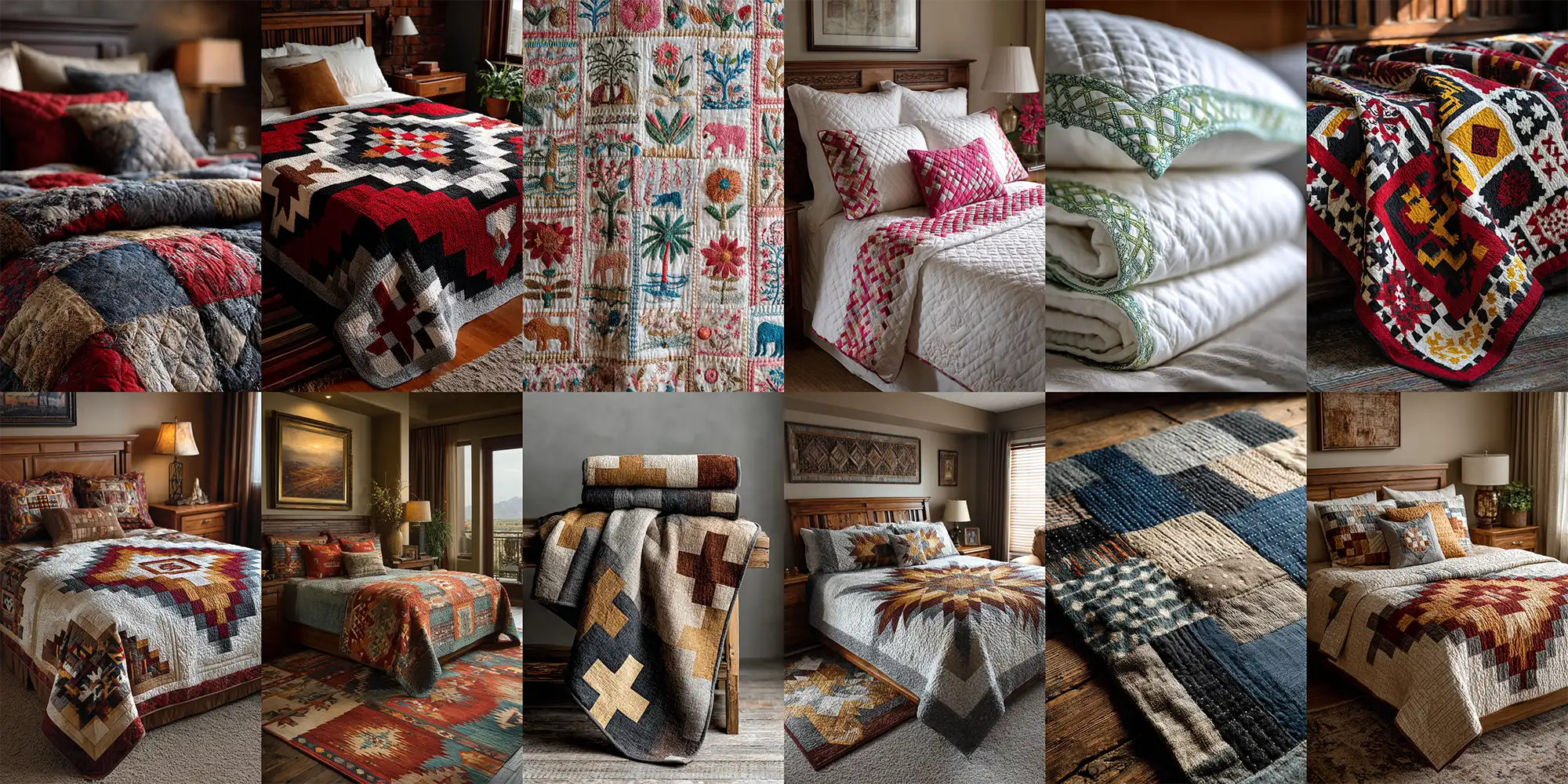
Heritage & Cultural Quilt Ideas: Patterns, Stories, and Handmade Traditions
There is a certain kind of quiet that comes when you sit with a handmade quilt. Not the silence of an empty room, but the stillness of something that has already lived a long life before you touched it. A quilt stitched by someone’s grandmother, or worked in the traditions of a community that sewed meaning into every seam, carries a weight you can feel even when the fabric is light.
This article is a guide to the many traditions that have shaped quilt-making across cultures and generations. It covers Indigenous textile storytelling, Bengali embroidered quilts, Japanese boro and sashiko, Hawaiian appliqué, Scandinavian simplicity, and more. Along the way, it offers ideas for using these quilts in modern homes, thoughts on cultural respect, and practical care advice.
Note: This guide focuses on both design inspiration and cultural context, with careful distinctions between authentic community-made textiles and designs that are only inspired by those traditions.
Whether you are drawn to heritage quilts for their visual richness, their history, or the feeling they bring to a room, you will find something worth knowing here.
What Makes a Quilt a Heritage & Cultural Quilt?
A heritage quilt is not simply an old quilt. And a cultural quilt is not simply a quilt with a pattern that comes from somewhere other than where you live. Both words ask us to look more carefully.
At its most basic, a quilt is a layered textile — typically a top fabric, a middle batting, and a backing, all held together by stitching. Quilted and layered textiles have appeared in many parts of the world, often because cloth wears out, scraps accumulate, and people find creative ways to reuse what remains.
What transforms a quilt into a heritage or cultural quilt is the layer of meaning woven into its making. These are quilts that carry memory. They record family events, mark seasons of life, preserve the visual language of a community, or document the specific hand of a maker whose name may no longer be known.
Quilts as functional comfort pieces. Heritage quilts began as practical objects. They kept people warm. They were made from worn clothing, salvaged fabric, and scraps too small for other uses. Their value was not primarily decorative. Understanding this origin matters because it means these textiles carry the evidence of real daily life. The uneven stitching, the faded patch, the slightly misaligned block — these are not flaws. They are the record of actual hands doing actual work.
Quilts as storytelling objects. Over time, quilts in many traditions took on a narrative role. Patterns were chosen for their symbolism. Motifs were passed from mother to daughter, from community elder to apprentice. In some cultures, the quilt itself was the document — a visual record of births, marriages, harvests, migrations, and loss. This is particularly true in the Bengali Nakshi Kantha tradition, in Lakota Star quilts made for ceremonies and gifts, and in the Japanese boro tradition, where the act of mending visible damage becomes its own kind of record-keeping.
The difference between “traditional,” “heritage,” “folk,” and “cultural.” These words are sometimes used interchangeably, but they have slightly different meanings in practice. A traditional quilt follows established patterns passed down within a community over time — the Irish Chain, the Log Cabin block, the Wedding Ring.
A heritage quilt is one that carries family or community history in a more personal way, often made from meaningful fabrics or given as a significant gift. A folk quilt is usually made outside formal training, by someone who learned through community or family rather than schools or publications. A cultural quilt is specifically rooted in the practices, symbols, and values of a particular community or ethnic tradition. All of these overlap, and most of the quilts in this article could honestly carry more than one of these labels.
Why heritage quilts work in modern homes. Contemporary interiors have moved steadily toward the handmade and the meaningful. People want rooms that feel specific to their own lives rather than assembled from a catalog. A heritage quilt, used thoughtfully, brings both visual texture and a sense of accumulated time into a space. It introduces something that cannot be manufactured to order. That irreproducible quality is exactly what makes it worth understanding.
Indigenous Quilt Patterns: Textile Art Rooted in Story and Tradition
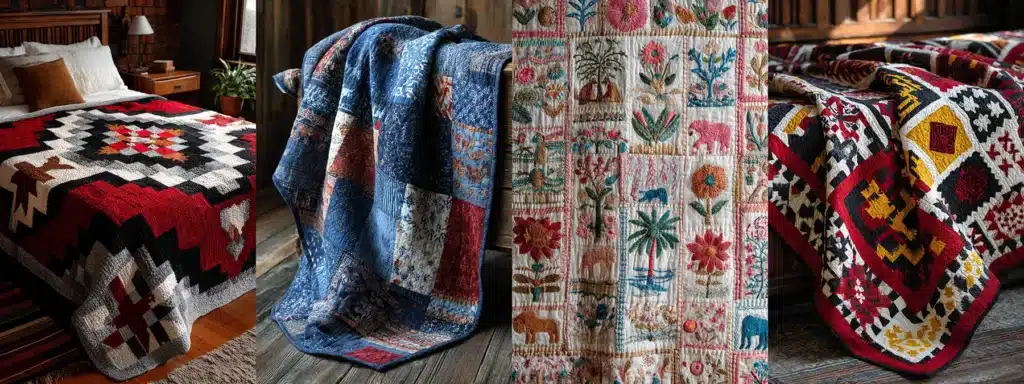
Across North America, textile-making has long been a form of cultural memory. Weaving, beading, embroidery, and stitching have all served as ways of recording knowledge, marking identity, and transmitting community values from one generation to the next. Quilting entered many Indigenous communities through contact with European and settler traditions, but it was not simply adopted wholesale. It was transformed. Specific patterns, colors, and construction methods were shaped by the aesthetic and symbolic frameworks already present in each community.
Today, many Indigenous quilts are recognized as significant artistic and cultural works. The eight-pointed star — central to Lakota quilt traditions — appears throughout Lakota ceremony and gift-giving. The bold geometry of Navajo-influenced textiles reflects the visual language of Diné weaving. These quilts are not decorative coincidences. They are deliberate artistic statements made within a living tradition.
Quilts as cultural memory. In many communities, the making of a quilt is as significant as the quilt itself. Communal quilting gatherings pass on both technique and tradition. The chosen patterns carry specific meanings that outsiders may not immediately grasp. A quilt given at a ceremony, a birth, or a graduation is not simply a gift — it is a statement of connection and belonging.
Symbolic geometry, repeated motifs, and community identity. Indigenous quilt-making traditions often rely on strong geometric forms that echo the visual language found in other traditional arts within the same community. Stars, diamonds, crosses, and concentric forms recur because they carry meaning within that symbolic system, not because they are universally “decorative.”
Handmade textiles as practical and ceremonial objects. Many Indigenous quilts serve dual roles. They provide warmth and comfort in everyday life and mark important events. The same quilt might be used on a bed and brought to a ceremony. This dual function is worth remembering when considering how to use heritage textiles in a modern home.
A note on language. When discussing quilts made by Indigenous artists and communities, the most respectful and accurate approach is to name the specific community whenever possible rather than using a broad or generic term. “Indigenous-inspired” is appropriate only when a design is created outside that community and draws on its aesthetic traditions, but is not an authentic product of the community itself.
Lakota Star Quilts: Radiating Geometry with Deep Cultural Presence
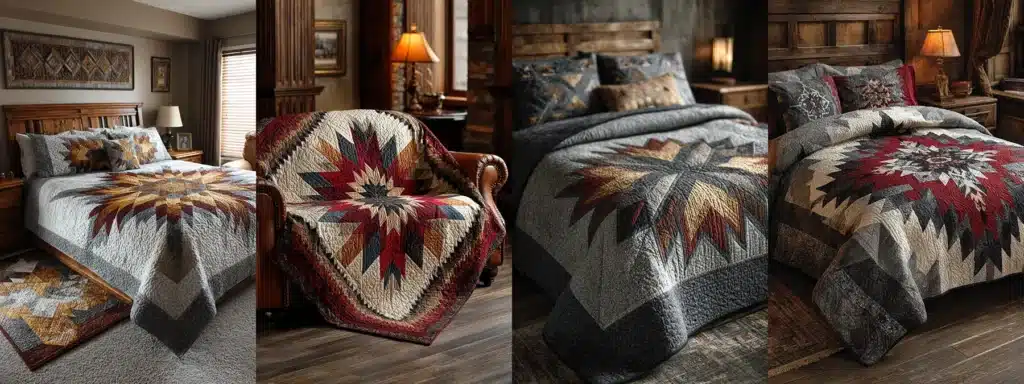
The Lakota Star quilt is often connected with the Morning Star, and its eight-pointed form is also related to star quilt patterns known in Euro-American quilting traditions, including Star of Bethlehem variations. Its design radiates outward from a central point in a pattern of eight diamond-shaped arms, each composed of dozens of small fabric pieces fitted together to create a continuous, glowing geometry.
Lakota women began making star quilts in the nineteenth century, adapting a European American quilt pattern to serve a purpose already embedded in Lakota culture: the tradition of giving beautiful handmade gifts to honor significant people and mark important moments. The star quilt replaced and extended the role previously played by painted buffalo robes. Today, it remains a deeply important cultural object, given at graduations, funerals, naming ceremonies, and other occasions when a community wishes to honor someone.
Eight-pointed star designs. The eight-pointed star is made from diamond shapes cut at precise angles and sewn together in eight long arms. Getting the angles to meet cleanly at the center requires careful cutting and experienced piecing. The result, when it works, is a form that seems almost to move — to pulse outward from the center like a radiating light source.
Strong central geometry. What makes the Lakota Star quilt so compelling as a room element is its absolute commitment to the center. The eye immediately finds that central point and then travels outward along the arms. This makes it an unusually effective focal piece, whether draped across a bed, hung on a wall, or folded over the arm of a chair.
Use in bedrooms, as wall decor, for throws, and as gifts. A Lakota Star quilt does not need much company. Used as the main covering on a bed, it creates a complete visual composition on its own. Paired with simple white or neutral bedding, it dominates the room in a way that feels intentional rather than overwhelming. As a wall hanging, it functions like a large-scale artwork. As a throw on a sofa or chair, it brings warmth and pattern to a neutral seating area without competing with other elements.
Why does it work as a focal point? Most patterns draw the eye in a distributed way — across a surface, through a grid, between repeating blocks. The Lakota Star draws the eye to a single central point and then releases it outward. This creates a different visual experience, one that is both active and settled at the same time.
Navajo-Inspired Quilt Patterns: Desert Colors, Geometry, and Warmth
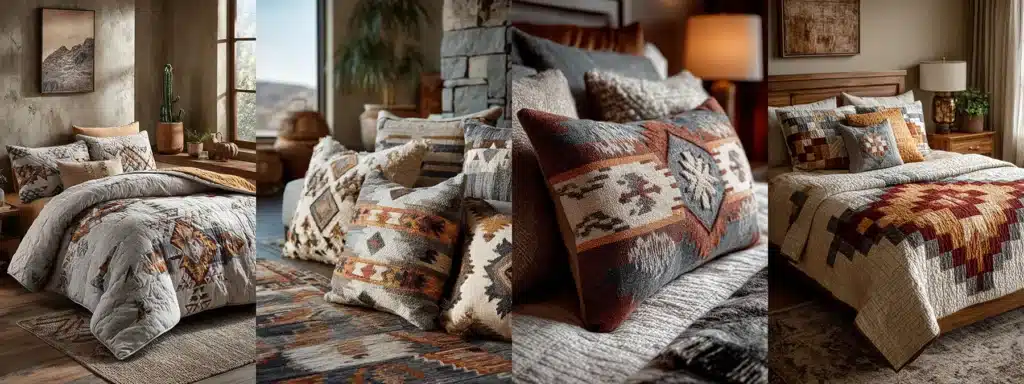
Navajo weaving is one of the most widely recognized and deeply respected textile traditions of the American Southwest. Developed over centuries by Diné weavers on vertical looms, Navajo rugs and blankets are characterized by bold geometric forms, strong horizontal organization, stepped motifs, and a command of color that has influenced textile design far beyond the American Southwest.
Quilt patterns described as Navajo-inspired draw on these visual elements — the stripes, the stepped diamonds, the strong contrast, the earthy palette — but it is important to be clear about what “inspired” means in practice. Authentic Navajo textiles are made by Diné weavers within a living tradition that carries both artistic and cultural weight. Quilts that reference these visual forms without being made by Diné makers are derivative works. They can be beautiful and made with genuine respect, but they should not be presented as the real thing.
Earth tones, desert palettes, stepped motifs, stripes, and diamonds. Navajo-inspired quilt patterns tend toward deep reds, terracotta, sandy neutrals, warm browns, and occasionally turquoise or dark navy. The forms are geometric: horizontal bands of alternating color, stepped diamond shapes, zigzag borders, and bold central medallions. These elements translate well into quilted form because the geometry of quilt piecing aligns naturally with the woven geometry of Navajo textile structure.
How these patterns bring warmth to bedrooms and living rooms. The color palette of Navajo-inspired quilts is particularly well-suited to rooms with natural materials. Wood tones, stone surfaces, linen textiles, and leather furniture all provide a supporting context that allows the quilt’s geometry to read clearly. In a bedroom with warm wood floors and a simple white wall, a Navajo-inspired quilt in deep red and sand serves as the room’s organizing element.
Pairing with natural materials. These quilts pair well with unfinished wood furniture, woven baskets, clay vessels, and other natural-material objects. They do not work as well in rooms that are already very pattern-heavy, or that lean toward cool, Nordic color palettes.
A short note on respect. If you are drawn to Navajo design, one meaningful step is to seek out authentic Diné-made textiles when making a purchase. Buying from Indigenous makers directly supports the community whose artistic tradition has inspired the broader aesthetic. Using the word “inspired” honestly — rather than claiming cultural authenticity — is the minimum standard of respect.
Nakshi Kantha Quilts: Bengali Embroidery, Memory, and Everyday Beauty
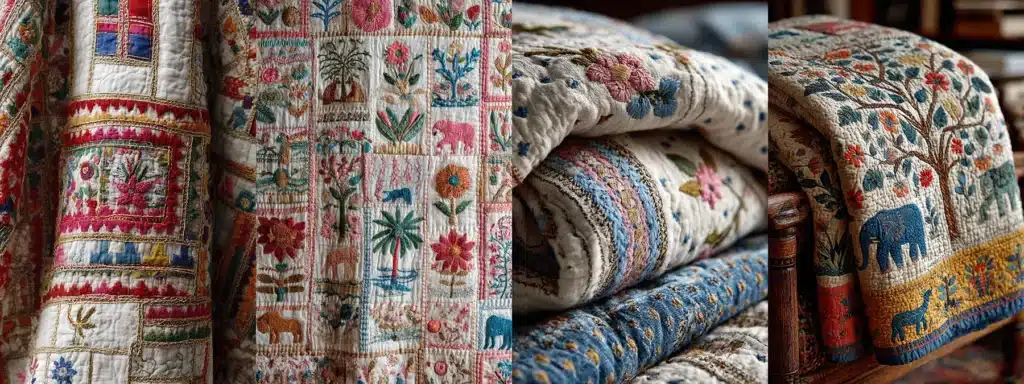
There is a form of quilt-making in Bengal — both Bangladesh and the Indian state of West Bengal — that is unlike almost anything else in the world. It is called Nakshi Kantha. The name comes from the word “naksha,” meaning pattern or design, and “kantha,” which refers to a simple running-stitch quilt made from layered old cloth. Together, the words describe something that is both humble in its materials and extraordinary in its execution.
Traditional Nakshi Kantha quilts were made by women working at home, using worn saris and old dhotis as their base fabric. The cloth was layered and then covered with dense running-stitch embroidery — the same kantha stitch used to hold the layers together also created the imagery. The patterns drawn in thread included flowers, vines, fish, birds, elephants, boats, trees, and scenes from daily rural life. Some quilts told specific stories. Others were organized around a central lotus or sun motif with smaller figures and patterns filling the surrounding space. Every quilt was different, because every maker brought her own hand to the work.
Reused cloth and layered fabric. The material basis of Nakshi Kantha is used cloth. Old saris, worn and washed until they are soft, form the layers. This gives traditional Kantha quilts a particular quality — a softness and suppleness that new fabric cannot replicate. The layers of worn cloth also create a subtle transparency and depth that shows through the embroidery in a way that factory-made fabric does not.
Running stitch embroidery. The kantha stitch is a simple running stitch worked across the entire surface of the quilt, not just at the seams. In a traditional Nakshi Kantha, thousands of individual stitches cover the cloth from edge to edge, creating both the imagery and the quilted texture. The stitching also causes the fabric to pucker slightly, creating a gentle rippled surface that catches light differently than a flat textile.
Rural life, floral, vine, and symbolic motifs. The imagery of Nakshi Kantha is drawn from the world around the maker. Fish are a symbol of prosperity and good luck. The lotus represents beauty and spiritual elevation. Trees and vines suggest abundance. Birds suggest freedom and aspiration. Scenes of village life — women carrying water, children playing, boats on rivers — record the texture of daily existence in rural Bengal. A Nakshi Kantha quilt is always, at some level, a self-portrait of its maker’s world.
Why Nakshi Kantha feels personal, intimate, and lived-in. There is no industrial version of a traditional Nakshi Kantha that carries the same presence. The hand of the maker is visible in every stitch — in the slight variations of tension, in the way the thread density shifts from one area to another, in the choices made about which motif to place where. This made-by-one-person quality is exactly what makes Nakshi Kantha so well-suited to intimate spaces in a home.
How to use it. Nakshi Kantha quilts work beautifully on beds, particularly on top of simple linen bedding. They can be draped over sofas or chairs, used as wall hangings, or folded at the foot of a bed as an accent. Beyond the home, the embroidery tradition has also found expression in accessories — jackets, vests, bags, and other garments that carry the kantha stitch into everyday wear.
Japanese Boro and Sashiko Quilts: Visible Mending and Quiet Elegance
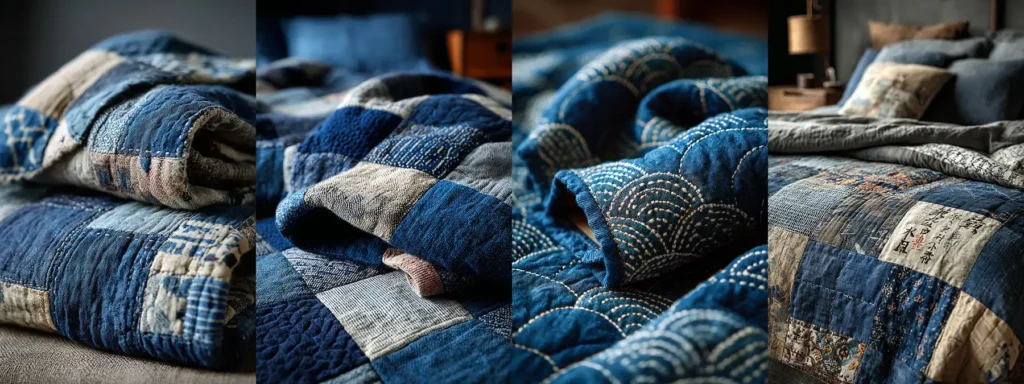
Japan has two distinct textile traditions that relate to quilt-making in both practical and philosophical ways. One is boro, a tradition of visible mending and repair. The other is sashiko, a form of rhythmic running-stitch embroidery that reinforces cloth while creating a geometric pattern. Both grew from necessity, and both have become recognized as significant art forms.
Boro as layered repair and reuse. Boro — the word means “rags” or “tattered cloth” in Japanese — refers to textiles that were repaired over and over again, with patches of fabric stitched onto worn areas to extend the life of garments, futon covers, and work clothing. In farming and fishing communities where fabric was precious and cold winters were long, no cloth was discarded as long as it could be used. Over many generations, a single garment might accumulate layer upon layer of patches, each one a small addition to the textile’s history. The result is an object that is simultaneously frugal and beautiful — a record of use, care, and the refusal to waste.
Boro pieces are deeply admired today because they embody a philosophy of making that modern culture has largely abandoned and now seeks to recover. The visible repair is not a failure. It is an act of attention. It says: ” This object is worth saving. This cloth still has value.
Sashiko as rhythmic running stitch. Sashiko is a more deliberate practice. Rather than arising from the accumulation of repairs, sashiko begins with design. The stitcher draws geometric patterns onto fabric — wave forms, overlapping circles, hemp leaf designs, interlocking diamonds — and then works through the pattern with a thick white thread on a dark ground, typically indigo. The repetitive rhythm of the stitch and the strong visual contrast of white thread on dark cloth create something that is both meditative in its making and striking in its result.
Sashiko was used to reinforce fabric that would be subject to heavy use — work jackets, protective garments, fishing nets — but the patterns chosen were always more than merely functional. They were chosen for beauty, and often for meaning. The hemp leaf pattern, for example, was used on baby clothing because hemp grows strong and fast, and that strength was wished for the child.
Indigo, cream, navy, and natural fabrics. Japanese quilt and textile traditions favor a restrained palette. Indigo blue, in its many depths — from pale sky blue to near black — is the dominant color. Cream and undyed natural linen provide contrast. These colors together create something that is both humble and refined, a combination that suits rooms with natural materials, clean lines, and a preference for subtlety over ornament.
Why Japanese quilt styles suit calm, minimalist rooms. Boro and sashiko textiles work best in rooms that give them space to be seen. A heavily decorated room overwhelms the quiet intelligence of these objects. In a bedroom with white walls, bare wood floors, and simple furniture, a boro-inspired quilt becomes the most interesting thing in the room precisely because everything else steps back.
Patchwork as repair, design, and philosophy. One of the lasting contributions of Japanese textile traditions to the broader conversation about quilting is the idea that repair is not shameful. The stitch that holds a patch in place is an honest mark of use. The patchwork that accumulates over the years tells a truer story than a surface maintained to appear untouched. This philosophy — wabi-sabi, the acceptance of imperfection and transience — is embedded in boro textiles in a way that is felt even by people who do not have a name for what they are responding to.
Hawaiian Quilt Patterns: Appliqué, Nature Motifs, and Island-Inspired Craft
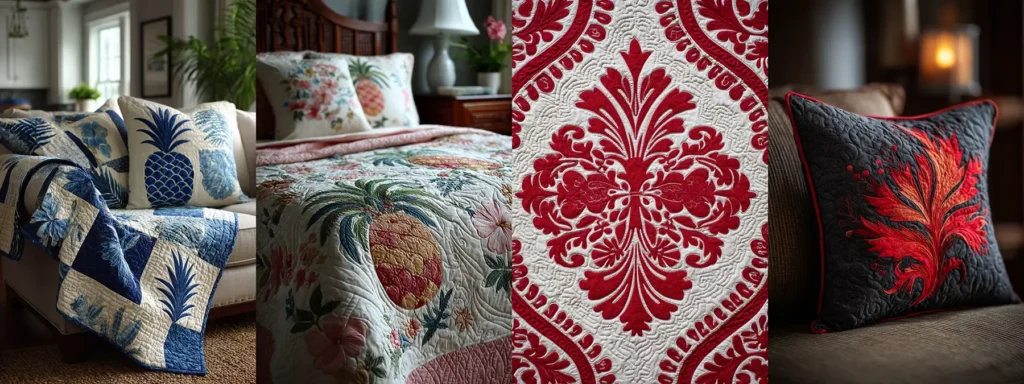
Hawaiian quilts are immediately recognizable. Where most quilt traditions rely on piecing — sewing small fabric shapes together to create a larger design — Hawaiian quilts are built around appliqué: a large-scale motif cut from a single folded piece of fabric and stitched onto a contrasting background. The motifs themselves are drawn from the natural world of the Hawaiian islands: pineapples, breadfruit leaves, palm fronds, ferns, plumeria blossoms, monstera leaves, ocean waves, and the forms of specific plants that grow there.
Hawaiian quilting developed in the nineteenth century, when American missionaries arrived and introduced New England quilting traditions to Hawaiian women, who already had deep knowledge of kapa — a bark cloth textile used for clothing, ceremonial purposes, and everyday life for centuries. The Hawaiian women took the quilting technique and transformed it entirely. The repeating patchwork block was set aside. In its place came the large symmetrical appliqué design — intricate, botanically specific, and built for visual impact at a distance.
Symmetrical appliqué designs. Hawaiian quilt motifs are typically cut from fabric folded into fourths or eighths, much like a paper snowflake, so that the resulting shape has perfect bilateral or radial symmetry when unfolded. This symmetry gives Hawaiian quilts a formal, almost ceremonial presence. The pattern is always clearly centered, well-organized, and intentional.
Tropical motifs: pineapple, palm, orchid, and leaves. The motifs in Hawaiian quilts are drawn from the specific plant life of the islands, not from abstract geometry. A pineapple quilt does not use a geometric abstraction of pineapple form — it uses a stylized but recognizable pineapple shape, with the crown of leaves rendered carefully and the body of the fruit shown with its characteristic diamond-pattern texture. This specificity of reference gives Hawaiian quilts a botanical quality that connects them to a particular place in a way that more abstract designs cannot match.
Echo quilting. One of the defining technical features of Hawaiian quilts is the echo quilting that fills the background. After the appliqué motif is stitched down, the quilter sews concentric lines of running stitch that follow the outline of the motif outward across the background fabric, as ripples expanding from a stone dropped in water. This echo quilting creates a subtly textured surface that makes the background visually interesting and reinforces the centrality of the appliqué motif by continually pointing back to it.
Use as bed covers, runners, pillows, and textile wall art. Hawaiian quilts work in almost every room context. A large quilt in bright red on white, or deep green on cream, transforms a bedroom into a space with genuine visual presence. Smaller Hawaiian quilt pieces — table runners, pillow covers, wall hangings — bring the same motif vocabulary to less prominent spaces. The botanical specificity of the designs makes them work well in rooms that contain other natural elements: houseplants, woven materials, wood, stone, and natural fiber rugs.
How Hawaiian quilts can brighten a neutral room. The traditional Hawaiian quilt palette — two strong, contrasting colors rather than a complex arrangement of many fabrics — is both striking and easy to work with in an interior context. A Hawaiian quilt in deep teal and white, hung on a light gray wall, creates a focal point without requiring any other changes to the room.
Irish Chain and Other Timeless Heritage Quilt Patterns
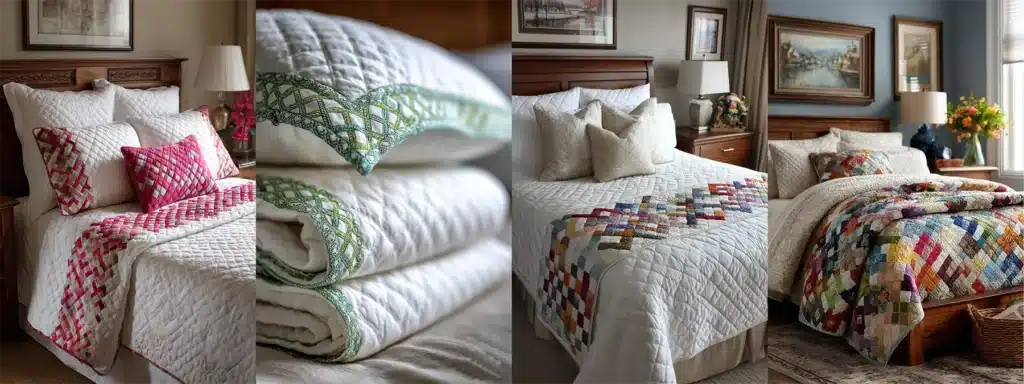
Not all heritage quilts trace their origins to a specific Indigenous or ethnic community. Some patterns have become heritage quilts simply through longevity and transmission — they have been passed from maker to maker for so long, and in so many variations, that they now belong to the broader shared heritage of quilt-making itself. The Irish Chain is the most elegant example of this category.
Repeating squares and chain-like movement. The Irish Chain is built from simple square blocks arranged in a repeating diagonal pattern that creates the visual effect of continuous chains running across the quilt’s surface. The Double Irish Chain — the more common variant — uses alternating light and dark squares in a configuration that creates both the chain itself and the negative space that allows the chain to read clearly. The pattern is geometrically straightforward but visually complex. The eye does not rest on any single block; it follows the chain across the surface.
Why does the pattern feel calm but not static? This is the quiet genius of the Irish Chain: it is orderly enough to feel settled and peaceful, but the diagonal movement of the chain keeps the surface alive. There is always somewhere for the eye to go. This makes it unusually compatible with a wide range of room styles — it works in traditional bedrooms, contemporary spaces, dining rooms for gatherings, and as a wall hanging in hallways or entryways.
How it works in bedrooms, dining rooms, and wall decor. In a bedroom, the Irish Chain quilt serves well as a central covering because it adds visual interest without requiring a particular style response from the rest of the room. It does not insist on a rustic context or a formal context — it adapts. In a dining room, a smaller Irish Chain quilt on a sideboard or wall brings warmth and pattern to a space that might otherwise feel purely functional.
Why it belongs in a heritage roundup. The Irish Chain has been made continuously for at least two hundred years, and probably longer. It appears in American and European quilt traditions, in quilts made by professional quilters and by home sewers, in plain domestic cloth and in carefully selected fabrics. Its longevity is the mark of a pattern that genuinely works — that solves the visual problem it sets out to solve in a way that continues to satisfy across changing tastes and contexts.
Scandinavian Quilt Patterns: Nordic Simplicity and Functional Beauty
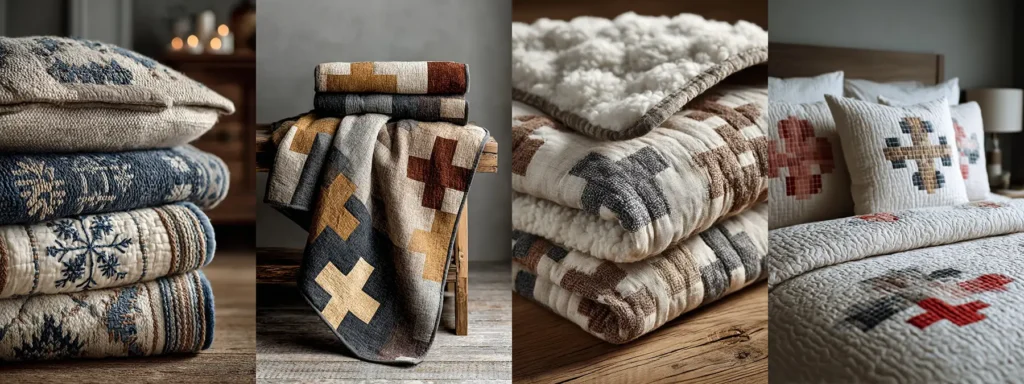
Scandinavian design has shaped the way a large part of the world thinks about home interiors. The concepts that have traveled farthest — restraint, honesty of materials, the embrace of natural light, the relationship between beauty and function — are also, not coincidentally, the concepts that define Scandinavian textile traditions.
Scandinavian quilt traditions express heritage more quietly than some of the more symbolic or ceremonial textiles in this article. They do not carry the layered narrative weight of Nakshi Kantha or the ceremonial significance of the Lakota Star. What they do carry is a different but equally valuable quality: clarity. A Scandinavian quilt knows what it is. It does not try to be more.
Cool neutrals, soft pastels, and negative space. Where many heritage quilt traditions work with strong contrast and complex color relationships, Scandinavian quilt design favors a more limited palette. Whites, creams, soft grays, pale blues, and muted sage greens dominate. These colors do not compete for attention — they create a quiet background against which the quilt’s geometric structure can be seen clearly. The use of negative space — large areas of plain fabric between pattern elements — is intentional. The empty space is part of the design.
Simple geometry. Scandinavian quilt patterns tend toward simple geometric forms: squares, rectangles, triangles, and stripes. The shapes are clean-edged and precisely sewn. There is little of the freehand quality that characterizes boro or Nakshi Kantha, and there is no figurative imagery. The geometry itself is the content.
Natural materials. Linen and organic cotton are the preferred fabrics in Scandinavian quilt traditions. These materials have a slightly matte, slightly rough texture that holds color differently than smooth commercial cotton — the color appears softer, more varied, and more alive. They also feel different in use: linen, in particular, softens with each wash, becoming, over time, a cloth that feels genuinely intimate rather than merely comfortable.
Cozy but uncluttered styling. The Scandinavian concept of hygge — a feeling of warmth, comfort, and conviviality — is sometimes misapplied in interior decoration as an excuse for accumulating objects. The real application is more disciplined: a room that is warm because it is carefully composed, not because it is full. A Scandinavian quilt on a simple bed in a white-walled room, with a candle and a good book, is closer to the actual spirit of the tradition than a room loaded with knitted blankets and decorative pillows.
How Scandinavian quilt patterns connect heritage craft with modern interiors. The aesthetic values of Scandinavian quilt-making — simplicity, natural materials, geometric clarity, restrained color — align almost perfectly with the values of contemporary minimalist interior design. This is why Scandinavian-style quilts have so effectively made their way into modern homes: they do not require any stylistic adjustments. They already speak the language of the contemporary room.
Patchwork and Scrap Quilts: Turning Old Fabric into Living Memory
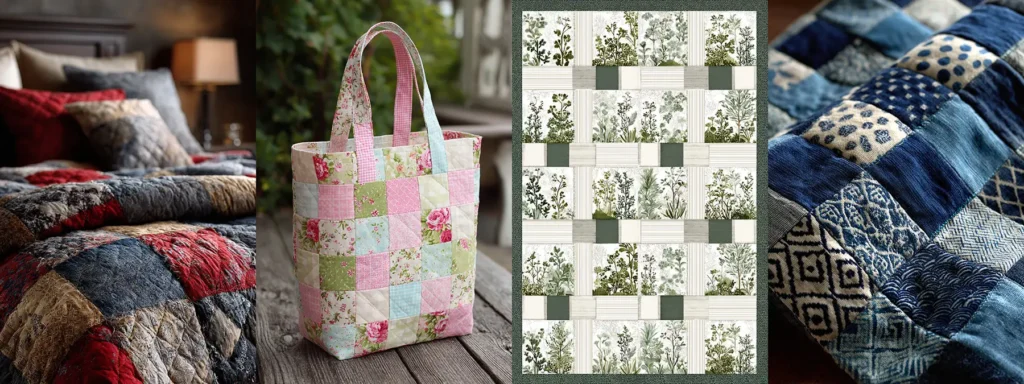
For more Patchwork Quilts and Accessories: Japanese Patchwork Quilt, Nine Patch Quilt Pattern, Modern Farmhouse Quilt Patterns, and Elegant Nakshi Kantha Accessories.
Patchwork is the technical foundation of most quilt traditions around the world. The act of cutting fabric into pieces and sewing them back together into a larger whole is so fundamental to quilting that it is easy to take it for granted. But patchwork in its deepest form — the kind practiced in boro and Kantha and American scrap quilts — is not just a construction method. It is a philosophy.
Why patchwork is central to many heritage quilt traditions. Across cultures that developed quilt-making independently or in parallel, the practice of using fabric scraps rather than new cloth is nearly universal. This is partly economic: fabric was expensive, and waste was not possible. But it is also aesthetic. The combination of fabrics in a scrap quilt creates visual complexity that cannot be planned or purchased — it arises from the particular history of what was available. Two quilts made from the same pattern with different fabric collections will never look the same, because no two households accumulate the same cloth.
Scraps as memory, economy, and beauty. In a scrap quilt, the fabric itself tells a story. The piece of blue gingham that came from a child’s dress, the remnant of a tablecloth from a family celebration, the strip of shirting that belonged to someone now gone — these materials carry memory in a way that new fabric cannot. When a quilt is made from such cloth, it becomes a kind of textile archive. The pattern holds it together visually, but the fabric holds it together emotionally.
Family clothing, worn textiles, and rescued fabric. Many of the most significant heritage quilts in existence were made from clothing — specifically from clothing that had already passed its useful life as a garment. Worn shirts, outgrown dresses, faded curtains, and thinning linens were all candidates for the quilt pile. This recycling of cloth was practical, but it also resulted in quilts that contained a complete cross-section of a family’s material life. Looking at such a quilt closely is like reading a record of what people wore, and by extension, how they lived.
How patchwork creates visual depth and emotional value. A quilt made from many different fabrics has a visual richness that a quilt made from two or three carefully coordinated fabrics cannot replicate. The slight variations in color within a “red” that draws from thirty different red fabrics create a living, breathing surface. The way light catches fabric cut on different grains at different times of day creates constant, subtle variation. This depth is the reward for the complexity of working with many fabrics rather than a few.
How to Style Heritage and Cultural Quilts in Modern Rooms
Heritage quilts are not museum objects. They are made to be used, and using them well in a modern home requires some thought about how to let them be what they are without forcing them into a context that diminishes them.
Use one cultural quilt as the main statement piece. The biggest styling mistake with heritage quilts is using too many of them at once. A Nakshi Kantha on the bed, a Navajo-inspired throw on the chair, a Hawaiian quilt on the wall, and an Irish Chain as a table runner would be a room trying too hard. Choose one significant quilt and build around it. Let it be the most interesting thing in the space.
Pair detailed quilts with simple bedding. A quilt with complex embroidery, strong geometry, or bold color does not need help. Put it on a bed with plain white or cream linen. Use simple pillow covers in a single color drawn from the quilt’s palette. The quilt does the work; everything else steps back.
Use wall hangings carefully. A quilt hung on a wall serves as artwork and should be treated accordingly. Choose the wall with the most natural light, keep the surrounding area clear, and hang the quilt at a height that allows it to be seen without craning. Use a proper quilt sleeve to distribute the weight evenly and prevent distortion.
Layer quilts with linen, wood, rattan, leather, or neutral upholstery. Heritage quilts from most traditions were made in environments that contained natural materials almost exclusively. Placing them in rooms with similar materials — raw wood furniture, linen curtains, rattan baskets, leather-bound books, undyed wool rugs — creates a context that feels coherent without being calculated.
Avoid over-theming the room. A Navajo-inspired quilt does not require every other element in the room to reference the American Southwest. A Japanese boro quilt does not require shoji screens and tatami mats. The quilt brings the reference; the rest of the room can simply be honest and natural. Over-theming flattens a cultural tradition into a costume, which is the opposite of respect.
Let the quilt be the “story” of the space. Good interior design always has a story — an organizing idea or a dominant element that gives the room coherence and character. In a room with a significant heritage quilt, that quilt is the story. Everything else should support it without competing.
Choosing Cultural Quilt Patterns with Respect and Intention
Working with cultural and heritage quilt traditions requires more than aesthetic appreciation. It requires a willingness to understand where a pattern comes from, who made it, and what it means to the people for whom it carries living significance.
Learn the origin before using the motif. Before incorporating a cultural pattern into your own work or home, spend time understanding its origins. This does not mean you need an academic credential — it means you should know enough to speak honestly about the tradition you are drawing from. If you cannot explain the origin of the pattern you are using, you probably need to learn more before using it.
Credit the tradition where appropriate. If you are showing your work publicly — in a blog post, in an online sale, in a conversation with guests — name the tradition you are working with or inspired by. This is both honest and generous. It points attention toward the source rather than allowing the pattern to become decontextualized.
Avoid claiming sacred or ceremonial designs as generic decor. Some patterns within Indigenous and cultural textile traditions are specifically associated with ceremonies, spiritual practices, or sacred occasions. Using these patterns purely as visual decoration, without any awareness of their significance, is a form of disrespect, even if unintentional. When in doubt, ask. When you cannot ask, err on the side of restraint.
Buy from makers when possible. The most direct form of respect for a living cultural textile tradition is to purchase authentic work from the people who make it. This supports the makers economically, helps sustain the tradition, and puts an authentic object in your home rather than an approximation. Lakota Star quilts, authentic Navajo textiles, and Nakshi Kantha pieces made by Bengali artisans can all be found through fair-trade retailers, artisan cooperatives, and direct sales from makers.
Use words like “inspired by” honestly. If you have made or purchased a quilt that draws on a cultural tradition without being an authentic product of that tradition, say so. “Navajo-inspired” is honest. “Navajo” applied to a quilt made by someone outside the Diné community is not.
Appreciate without flattening the culture into a trend. Cultural textile traditions are living, evolving, and deeply meaningful to the communities that practice them. Treating them as interchangeable aesthetic options — choosing a Nakshi Kantha-style one season and a Hawaiian appliqué-style the next, based on whatever is trending — reduces them to surfaces. The alternative is genuine engagement: learning about the tradition, understanding its context, and making choices that reflect that understanding.
Note: When buying cultural quilts online, look for clear maker information, region of origin, artisan cooperative details, or transparent fair-trade sourcing. Vague labels such as “tribal,” “ethnic,” or “boho” without maker credit are usually a sign to look more carefully.
Heritage Quilts as Heirlooms, Gifts, and Everyday Comfort Pieces
The most important thing about a heritage quilt is that it should be used.
There is a tendency, with objects of real beauty and cultural significance, to treat them as too precious for daily life — to fold them carefully and put them away, to take them out only for guests or special occasions. This is understandable, but it is also a form of loss. A quilt that is never used is a quilt that never fully becomes what it was made to be.
Quilts as gifts. In many of the traditions described in this article — Lakota, Bengali, Hawaiian — quilts are specifically made to be given. A Lakota Star quilt given at a graduation or a ceremony carries not just the visual meaning of its design but the meaning of the gift itself: someone spent significant time and skill making something for you, by hand, from cloth. This is a different kind of gift than an object selected from a store. It carries the maker’s attention in a way that nothing manufactured can replicate.
Quilts passed through families. A heritage quilt that has been in a family for two or three generations has accumulated a different kind of meaning than a new quilt, however beautiful. The slight fading, the soft drape of cloth washed many times, the knowledge of whose hands made it and whose beds it has covered — these things add to the quilt rather than subtracting from it. If you are lucky enough to inherit such an object, use it carefully but use it.
Quilts are used daily, not only displayed. The quilts in everyday use are the ones that feel like home. The heritage quilt on the bed that you reach for on a cold morning, the Kantha throw you pull over your legs while reading, the boro-inspired table runner that comes out for every meal — these objects are doing what they were made to do. Their presence in daily life does not compromise their significance. It is the fulfillment of it.
Why handmade irregularities make them more meaningful. No handmade quilt is perfectly regular. The stitches vary in length. The blocks are almost but not exactly equal. The colors shift slightly from one piece of fabric to the next. These variations are not flaws to be corrected. They are evidence of a human hand at work, making careful decisions across hundreds of small moments. The irregularity is what makes a handmade quilt feel different from a machine-made one — not just visually, but in the hand and against the skin.
How cultural quilts can make a home feel personal. A home that contains objects with real histories — made by specific people, within specific traditions, from specific materials — feels different from a home assembled entirely from new goods. The heritage quilt brings irreducible specificity into a room. It cannot be duplicated. It carries something that is genuinely its own.
How to Care for Handmade and Heritage Quilts
A handmade quilt deserves careful handling, particularly if it is old, fragile, or made from materials that may not be colorfast. The following guidance applies broadly, though individual quilts may require specific care based on their materials and condition.
Gentle washing. Most handmade quilts can be washed, but should be washed gently. Use cold water, a gentle or wool-safe detergent, and either a delicate machine cycle or hand washing in a large sink or bathtub. Avoid harsh detergents, bleach, and any product that promises brightening or whitening — these can damage both the fabric and the thread. For quilts with embroidery, check that the thread colors are colorfast before washing by pressing a damp white cloth against the embroidered areas and checking for any color transfer.
Air drying when appropriate. When possible, air-dry quilts rather than using a machine dryer. Lay the quilt flat on a clean surface or on a drying rack, reshaping it while damp so that it dries in its correct dimensions. If you must use a dryer, use a low-heat setting and remove the quilt while it is still slightly damp to finish drying it flat. High heat damages batting, weakens fibers, and can cause the quilt to distort.
Avoid harsh sunlight for display quilts. Sunlight fades fabric. A quilt displayed on a sunny wall will fade faster than one kept out of direct light. If you are displaying a quilt as a wall hanging in a bright room, rotate it periodically — hang a different quilt for part of the year and fold the heritage piece away in cool, dry storage.
Folding and rotating stored quilts. Quilts stored folded will eventually develop permanent creases at the fold lines, and the fabric at the fold points can weaken over time. To slow this process, refold stored quilts along different lines periodically — changing the fold lines distributes the stress. Some conservators recommend rolling quilts around an acid-free tube rather than folding them.
Using quilt sleeves for wall hangings. A quilt hung by a single rod through a sleeve distributes the quilt’s weight along its entire width, which is much less damaging than hanging it from clips or pins at isolated points. Make a quilt sleeve by sewing a strip of fabric into a tube and attaching it to the top back of the quilt. Thread a wooden or metal rod through the sleeve and suspend the rod from hooks on the wall.
Treating older handmade quilts as delicate textiles. Very old quilts — particularly those made before the twentieth century, or those that have been stored in less-than-ideal conditions — should be assessed carefully before any washing or treatment. If a quilt is fragile, has areas of fabric loss, or shows signs of significant deterioration, consider consulting a textile conservator rather than attempting to wash or repair it at home. The goal is always to preserve as much as possible for as long as possible, and sometimes that means doing less rather than more.
Conclusion
Heritage and cultural quilts are among the most honest objects that can live in a home. They do not pretend to be what they are not. They carry the evidence of their making, the mark of their tradition, and the record of their use. They ask nothing of you except that you look carefully, handle them with care, and give them room to be seen.
The traditions described in this article — Lakota Star, Nakshi Kantha, Japanese boro and sashiko, Hawaiian appliqué, Navajo-inspired design, Irish Chain, Scandinavian simplicity, patchwork from scrap — are not interchangeable. Each one comes from a specific place, a specific history, and a specific set of values about what cloth is for and what making means. Learning to see these differences is part of what makes collecting and living with heritage quilts worthwhile.
Use them well. Use them honestly. Let them be what they are.