
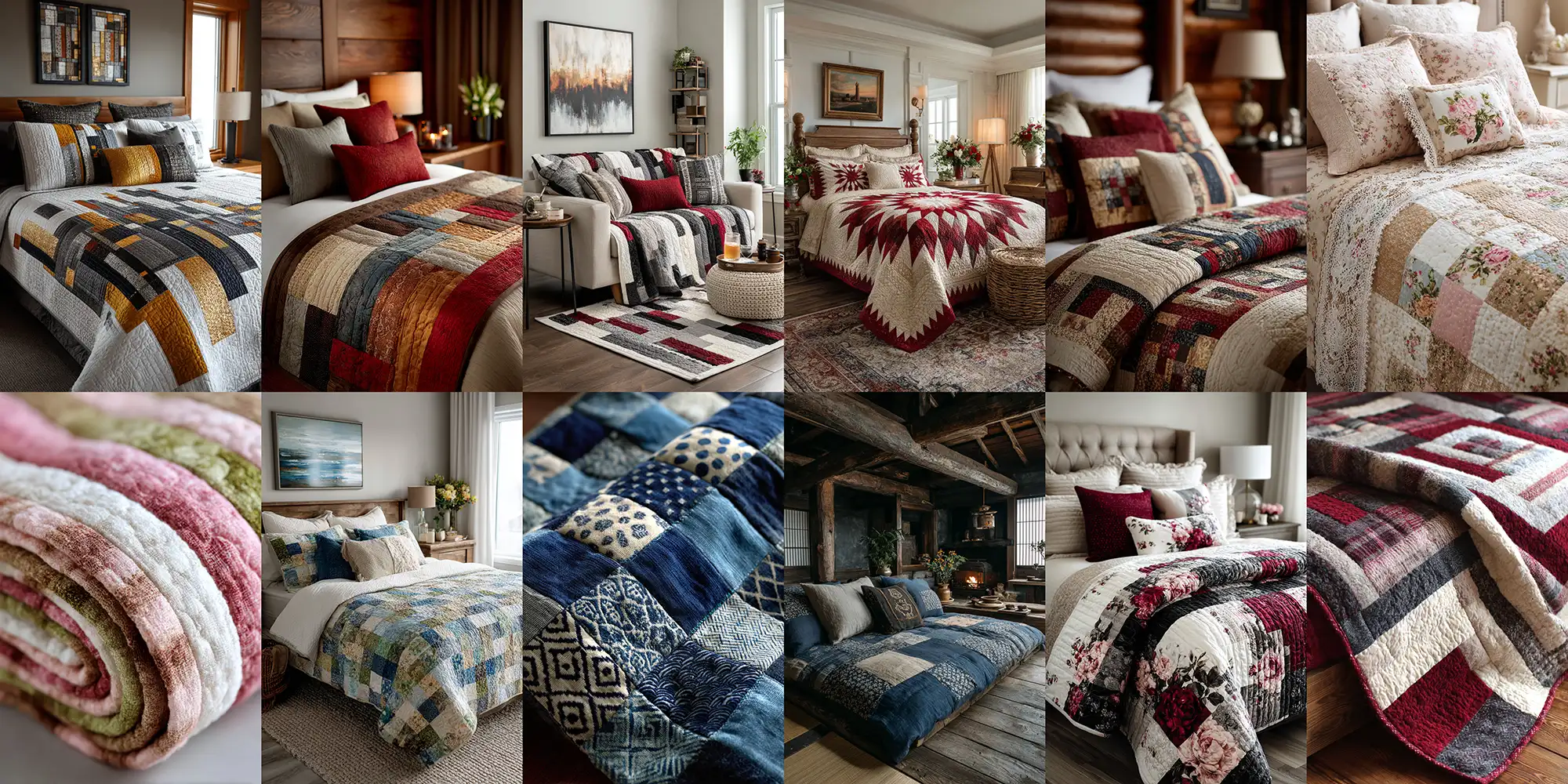
Classic Quilt Patterns: Timeless Blocks for Cozy and Elegant Homes
Some things in a home earn their place not because they are fashionable but because they work. A well-made quilt in a classic pattern is one of those things. It brings warmth to a bedroom, texture to a sofa, and a sense of accumulated care to whatever room it lives in. It does not need to be trendy to feel right. It just needs to be well chosen and honestly made.
This article covers the classic quilt blocks and patterns that have stayed in continuous use for generations — not because quilters lack imagination, but because these designs solve real problems beautifully. The Nine Patch, the Log Cabin, the Star, the Irish Chain, the Churn Dash, the Flying Geese — these patterns have survived because they are, in the most practical sense, very good designs.
Whether you are a quilter choosing your next project, a home decorator looking for the right textile for a room, or someone simply curious about why these patterns persist, this guide is written for you.
Start here: find the classic pattern that fits your home and skill level
- Nine Patch quilts if you want the simplest classic block with maximum versatility
- Log Cabin quilts, if you want a cozy, structured design built around a strong center
- Star quilts if you want a bold focal point for a bed or wall
- Irish Chain quilts, if you want something elegant and quietly active
- Jelly Roll quilts, if you want strip-pieced comfort with coordinated fabrics
- Churn Dash quilts if you want a farmhouse block that works in modern rooms, too
What Makes a Quilt Pattern Classic?
Before diving into specific patterns, it is worth asking why some quilt blocks endure while others fade. The quilt world has produced thousands of block designs over the past two centuries. Most of them have been forgotten. A handful have stayed in constant use. What separates the classics from the rest?
Simple repeated blocks. Classic quilt patterns are built from units that can be repeated across a surface without requiring constant decision-making. Once you understand the Nine Patch block, you can make hundreds of them in slightly different fabric combinations, and the quilt will hold together. The pattern does not ask you to design every section from scratch. This is both practical for the maker and visually satisfying for the viewer — repetition creates rhythm, and rhythm creates rest.
Balanced geometry. The blocks that last are the ones that feel resolved. The Log Cabin’s concentric strips, the Star’s radiating points, the Irish Chain’s diagonal movement — these geometries reach a natural conclusion. They do not feel like a fragment of something larger. They feel complete.
Patterns that work in many color palettes. A block that only works in one set of colors has limited life. A block that reads beautifully in red and cream, in gray and white, in navy and gold, in soft pastels, and in scrappy mixed fabrics is a block that can live across generations and decorating styles. The classic blocks all have this adaptability. The same Nine Patch block that looked right in a Victorian farmhouse looks equally right in a contemporary apartment with white walls and wood floors.
Easy-to-recognize layouts. Classic patterns communicate immediately. A viewer who has never made a quilt still recognizes the Log Cabin, the Star, and the Irish Chain as distinct things. This legibility is part of what makes these designs satisfying to look at — they are organized so that the eye can read them without effort.
Why classic quilt blocks suit both traditional and modern homes. The language of classic quilts — square grids, repeating units, geometric forms, clear light-and-dark contrast — is also the language of contemporary design. A two-color Nine Patch quilt on a modern platform bed does not look out of place. It looks considered. The geometry is timeless enough to work across decorating contexts.
The difference between classic, heritage, farmhouse, and modern quilt patterns. These terms overlap but are not synonyms. Classic quilt patterns are the long-established blocks that form the structural vocabulary of the craft: Nine Patch, Log Cabin, Star, Irish Chain, Flying Geese. Heritage quilts carry cultural or family history — they may use classic blocks, but their significance is rooted in community identity and tradition. Farmhouse quilts use classic blocks and typically favor soft neutrals, plaids, stripes, and comfortable, unpretentious color palettes. Modern quilts take classic block logic and push it further: larger scale, fewer colors, more negative space, more asymmetry. Understanding where these categories meet and diverge helps you make clearer choices for your home.
Nine Patch Quilts: The Simple Block That Never Goes Out of Style
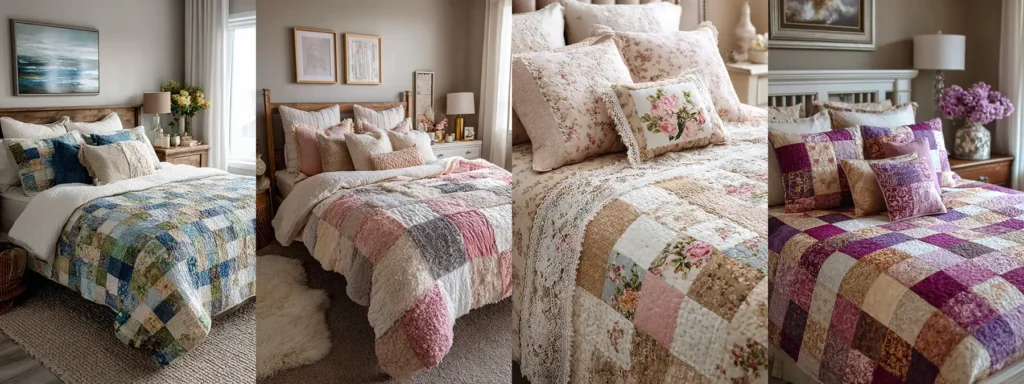
The Nine Patch is the block that most quilters learn first, and the block that most experienced quilters return to throughout their lives. Its structure is exactly what the name promises: nine equal squares arranged in a three-by-three grid. That is the whole of it. And yet the visual possibilities within that simple grid are, in practice, nearly inexhaustible.
Basic grid structure. A Nine Patch block divides a square into nine equal smaller squares. In the most basic version, five squares of one fabric alternate with four squares of a contrasting fabric in a checkerboard arrangement. This two-fabric version is clean, graphic, and immediately readable. It is also just the beginning.
Why is it good for beginners? The Nine Patch involves only one skill: sewing straight seams. There are no triangles, no curves, no complex matching of points. You cut squares, you sew them into rows of three, you sew three rows together. The result is a block that looks intentional and handsome from a distance, and that can be made quickly enough to maintain the satisfaction of visible progress.
Disappearing Nine Patch variations. One of the most interesting things about the Nine Patch is what happens when you cut a completed block apart and rearrange the pieces. The “Disappearing Nine Patch” is a technique in which the finished block is cut into four equal quadrants, each quadrant is rotated, and the resulting arrangement creates a new secondary pattern — pinwheels, hourglasses, or other forms — that was not visible in the original block. This technique produces quilts of apparent complexity from a very simple starting structure.
Soft bedroom quilts and cushion covers. In soft colors — pale blues, warm creams, sage greens, dusty roses — the Nine Patch makes beautifully gentle bedroom quilts. The small scale of the individual squares creates a fine-grained texture that reads as both busy and restful from a distance, like a well-designed fabric. As a cushion cover or pillow sham, a single Nine Patch block in slightly larger squares becomes a small, complete design that needs nothing else around it.
How color placement changes the entire mood. This is the Nine Patch’s real gift to the maker: it is a complete color-study tool. Place a dark fabric in the corner squares, and a light fabric in the center, and the block recedes into a gentle texture. Reverse it, and the center pops forward. Use a high-contrast two-color arrangement, and the quilt reads bold and graphic. Use twenty different scraps in the same value range, and the quilt reads as warm, comfortable, and accumulated — the visual equivalent of a room that has developed over time rather than being decorated in one afternoon.
Log Cabin Quilts: Cozy Blocks Built from the Center Outward
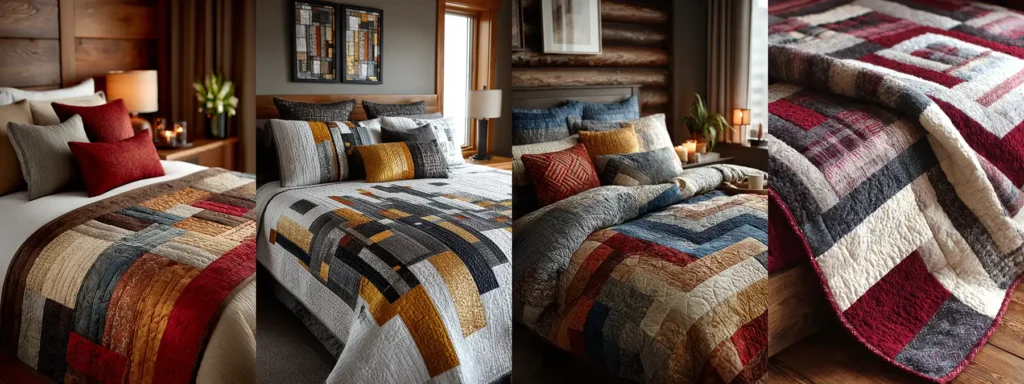
The Log Cabin quilt is built on a single organizing idea: start at the center and work outward. A small square — the hearth, in the traditional symbolism of the pattern — anchors the block. Strips of fabric are added around it in rounds, alternating light fabrics on two sides and darker fabrics on the other two. The result is a block that seems to glow from its center, with light and shadow organized across its surface.
Center square and surrounding strips. The center square of a Log Cabin block is traditionally red, representing the fire at the heart of the home. Around it, strips are added in sequence: one strip on the top, one on the right, one on the bottom, one on the left, then repeating outward. The strips grow slightly longer with each round because the block grows with each addition. By the time a block is finished, it has been built in a clear sequence that is satisfying both to make and to look at.
Light-and-dark fabric placement. The visual character of the Log Cabin derives entirely from the distribution of light and dark fabrics. In the most common arrangement, light fabrics are placed on two adjacent sides of the center and dark fabrics on the other two, dividing the block diagonally. When finished blocks are placed together, this diagonal division creates secondary patterns across the quilt surface that depend entirely on how the blocks are oriented.
Barn Raising layout. The Barn Raising is the most dramatic of the Log Cabin settings. Finished blocks are arranged in a specific orientation so that their light and dark halves form a large diamond pattern at the center of the quilt, with rings of alternating light and dark radiating outward from it. The effect is striking from a distance — the quilt appears to have a completely different structure than its individual blocks would suggest.
Courthouse Steps variation. In the Courthouse Steps variation, strips are added opposite rather than adjacent — one strip on the top, one on the bottom, then one on the left and one on the right. This creates a block with a different internal balance than the standard Log Cabin, and a different set of secondary patterns when the blocks are combined.
Pineapple Log Cabin variation. The Pineapple Log Cabin is a more complex variation in which strips are added at 45-degree angles rather than horizontally and vertically, creating a rotating, pinwheel-like effect within each block. It requires more careful cutting and piecing than the standard Log Cabin, but produces a surface of remarkable visual richness.
Bed covers, pillow covers, runners, and wall hangings. The Log Cabin block scales well to almost any project. A full Barn Raising quilt on a bed is one of the most handsome things you can put in a bedroom. A simplified Log Cabin in two or three fabrics makes a clean, elegant throw. Individual blocks, made larger than normal, work as striking pillow covers. A strip of Log Cabin blocks in a single color family becomes a table runner with a structured, orderly character.
Why Log Cabin quilts feel warm, structured, and homey. The Log Cabin earns its name. There is something genuinely hearth-like about a well-made Log Cabin quilt — it feels organized but not cold, complex but not fussy. The strips suggest shelter, accumulation, and care. In a bedroom with wood furniture and natural textiles, a Log Cabin quilt in warm earth tones becomes one of the most comfortable things in the room.
Star Quilt Patterns: Timeless Geometry for Year-Round Comfort
See also: Christmas Star Quilting Pattern Ideas, and Elegant Star Quilt Pattern Ideas
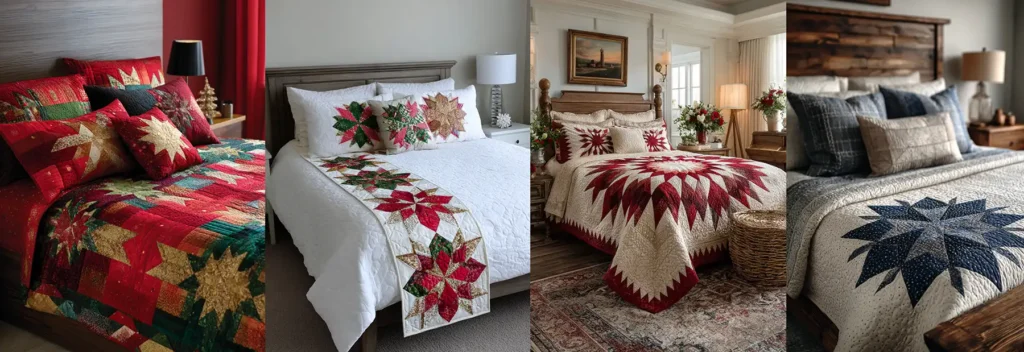
Stars appear in quilt patterns across virtually every quilting tradition in the world. Points radiate outward from a central form, creating a design that is simultaneously contained and expansive. Star quilts work as bold bed focal points, wall-hung artwork, smaller accent pieces on chairs and sofas, and seasonal decorations. They are among the most versatile of the classic blocks.
Ohio Star. The Ohio Star is built from a Nine Patch grid in which the corner squares are plain, the center square is plain, and the four edge squares each contain a set of triangles that create the star’s points. The result is a relatively simple block — it requires cutting triangles accurately, but the geometry is straightforward and has a clean, strong visual impact. Ohio Star quilts in two or three colors have a crispness that works equally well in traditional and contemporary rooms.
Sawtooth Star. The Sawtooth Star uses Flying Geese units to create its points, which gives the star a slightly more dynamic character than the Ohio Star — the points are narrower, the angles more acute, the overall impression more active. Sawtooth Star blocks can be arranged in a grid, alternated with plain squares, or combined into larger star formations.
Evening Star. The Evening Star (sometimes called the LeMoyne Star or Eight-Pointed Star) uses eight diamond shapes sewn together to create a star with eight equal points. This block requires setting-in seams — a slightly more advanced technique — but the result is a star of exceptional elegance. Evening Star quilts in deep jewel tones on a dark background look genuinely dramatic on a bedroom wall.
Star quilts as bed focal points. A large star quilt on a bed works like a well-placed painting in a room: it organizes the visual field around itself and gives the space a clear center. This is particularly true of designs with a single large central star — the eye finds the center immediately, and the rest of the room arranges itself around it.
Star pillows, wall decor, and seasonal quilts. Star blocks in smaller sizes make excellent pillow covers — a single Sawtooth Star in holiday-appropriate fabrics becomes a seasonal accent that can be swapped in and out without rearranging the room. Star quilts hung on walls, particularly in bold two-color arrangements, function as large-scale graphic art.
Why star blocks work in both soft and dramatic color palettes. The star’s geometry is strong enough to carry almost any color approach. In soft pastels, a star quilt reads as gentle and romantic. In high-contrast navy and white, it reads as crisp and modern. In scrappy mixed colors, it reads as warm and hand-gathered. This range of expression within a single block structure is part of what makes star patterns so durably useful.
Irish Chain Quilts: A Graceful Classic with Soft Movement
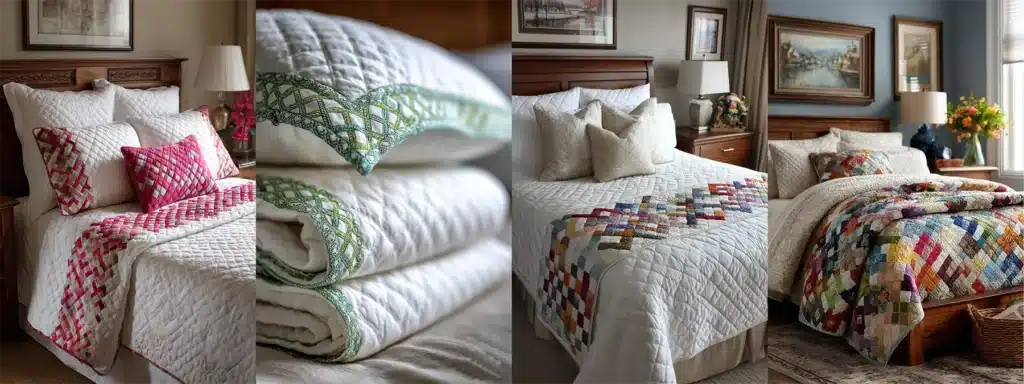
The Irish Chain is an unusual classic: it creates strong visual movement across a quilt’s surface without a single complex block. Unlike the Star, which draws the eye to a central point, or the Log Cabin, which builds concentrically, the Irish Chain sends the eye traveling diagonally across the entire quilt. The result is a design that feels active and peaceful at the same time — never static, never agitated.
Single Irish Chain. The Single Irish Chain is the simplest version: alternating small squares of two fabrics arranged in a grid creates a diagonal chain effect when the blocks are combined. The chain reads clearly even at a distance, giving a quilt made of very small squares a graphic impact that belies the simplicity of the individual pieces.
Double Irish Chain. The Double Irish Chain is the more common and more visually rich version. It uses two different block configurations: one composed entirely of small squares in a specific checkerboard arrangement, and one with a large plain square and small accent squares in the corners. When these two blocks alternate across the quilt, the chain becomes bolder, and the negative space between the chains becomes more prominent. The interplay of the two gives the quilt a layered quality that repays close looking.
Soft neutral bedroom quilts. Irish Chain quilts in cream and white, or in soft blue and natural linen, are among the most beautifully quiet bedroom quilts in the classic repertoire. The pattern has enough movement to prevent the quilt from feeling flat, but not so much complexity that it competes with other bedroom elements. It works well alongside patterned pillows, textured throws, and printed wallpaper precisely because its own pattern is well-behaved.
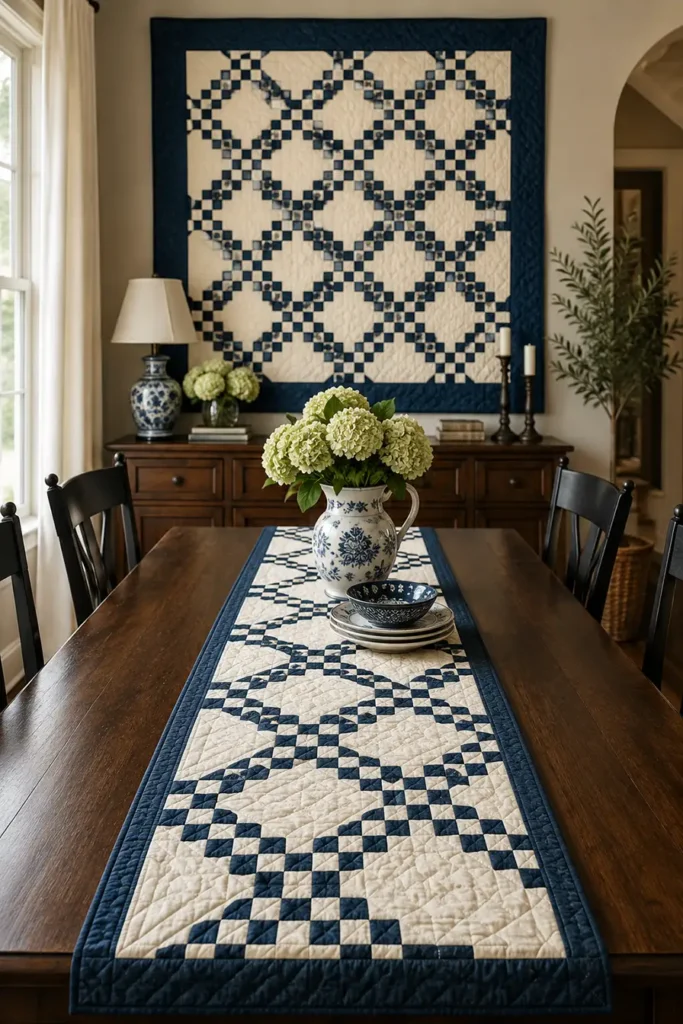
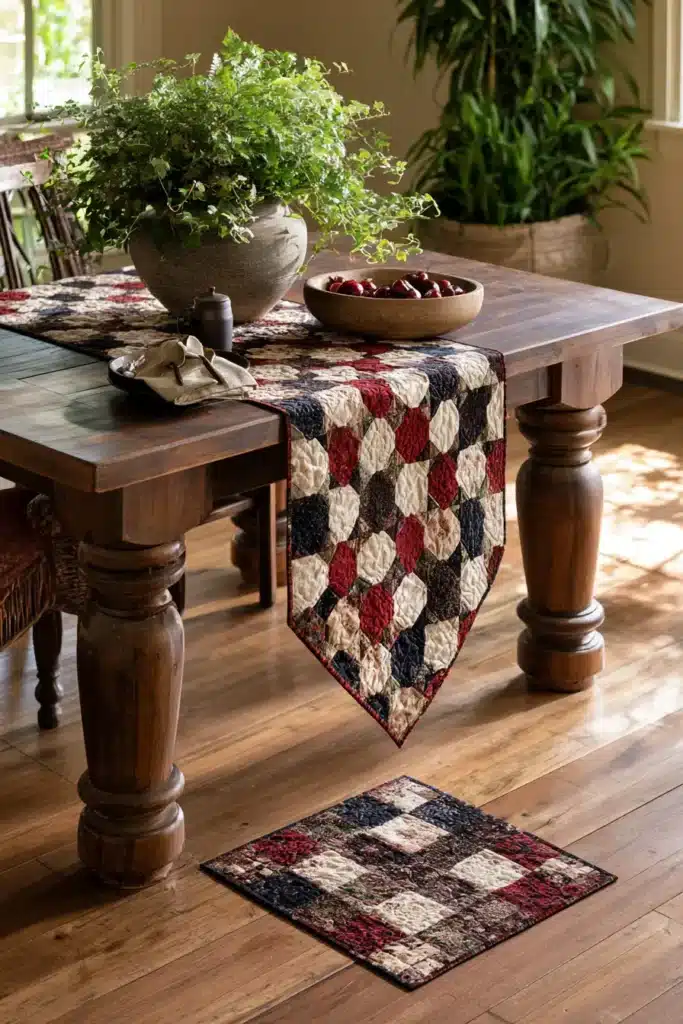
Dining table runners and wall decor. The Irish Chain’s diagonal movement makes it particularly well-suited to table runners, where the chain can run the length of the table, creating a sense of continuity and direction. As a wall hanging, a Double Irish Chain in strong contrast — dark navy and cream, or deep red and white — has a graphic boldness that works in hallways and dining rooms.
Why is the Irish Chain elegant without feeling busy? The elegance of the Irish Chain comes from its discipline. The pattern is made of small squares — nothing could be simpler — but the arrangement of those squares creates the impression of a much more complex structure. This gap between simple components and sophisticated results is part of what gives the Irish Chain its lasting appeal.
Churn Dash, Flying Geese, and Other Beloved Traditional Blocks
Beyond the four major classic patterns, the traditional quilt vocabulary includes several blocks that deserve their own attention — blocks that appear again and again in classic and farmhouse quilts because they bring specific visual qualities that the major patterns do not provide.
Churn Dash: farmhouse charm with clean geometry. The Churn Dash block is built from a Nine Patch grid in which the corner squares contain half-square triangles and the edge squares are rectangular bars. The center square is plain. The result is a block with a slight rotational quality — the triangles suggest motion around the center — that feels both grounded and dynamic. In soft gray and cream, the Churn Dash is the quintessential farmhouse block: familiar, unpretentious, and somehow very comfortable. In black and white with a graphic two-color treatment, the same block looks modern and precise. This flexibility between rustic and contemporary contexts is the Churn Dash’s great virtue.
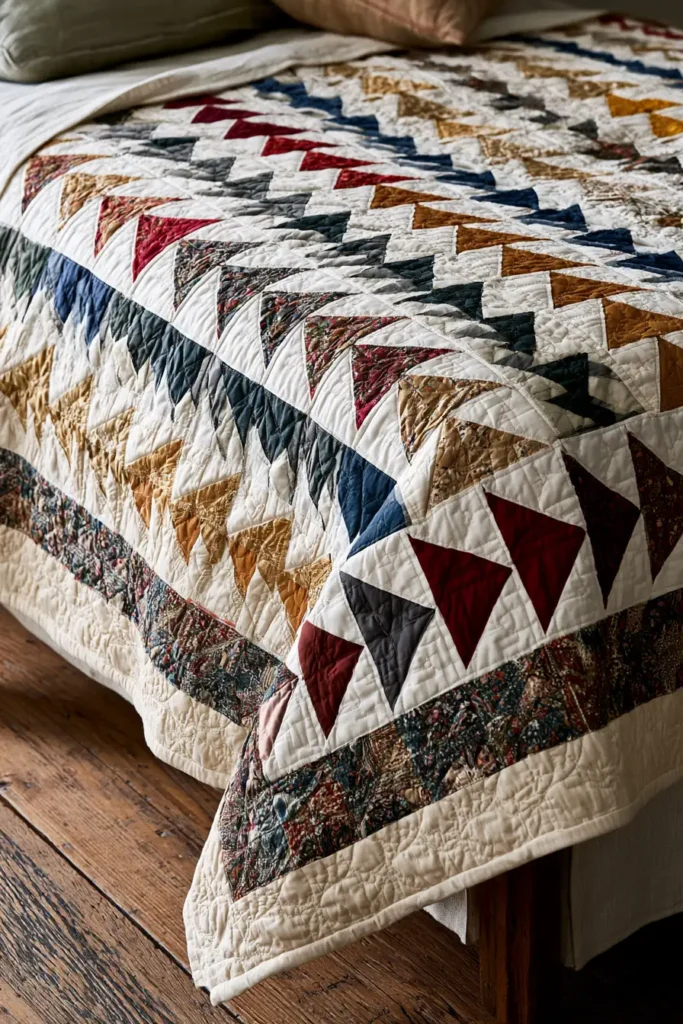
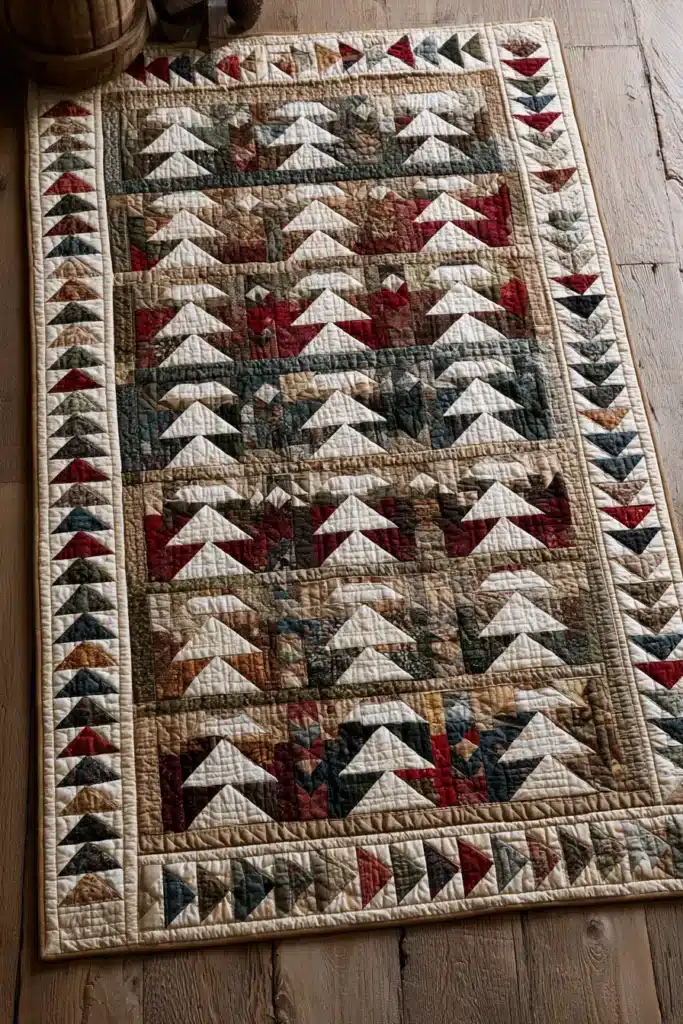
Flying Geese: direction, movement, and classic rows. The Flying Geese unit is one of the most useful elements in the classic quilt vocabulary. Each unit is a rectangle composed of one large triangle pointing in a single direction and two smaller triangles filling the corners. When assembled into rows, Flying Geese units create an unmistakable sense of movement — a visual migration across the surface of the quilt. Rows of Flying Geese are used as borders, sashing, and stand-alone quilt designs. They also form the points of Sawtooth Star blocks. A quilt made entirely of Flying Geese units in two or three colors has a directional energy unlike any other classic block — it feels like it is going somewhere.
Pinwheel blocks. The Pinwheel is made from four half-square triangles arranged so that the diagonal seams all spin in the same direction. The effect is a block that seems almost to rotate. In a high-contrast two-color treatment, a Pinwheel quilt is among the most graphic of the classic designs. In softer colors, it reads as a gentle, playful surface well-suited to children’s rooms and guest rooms.
Bear’s Paw. The Bear’s Paw block is more complex than the Churn Dash or Flying Geese, involving small triangles arranged in clusters at the corners of a large center square. It reads as a classic country or farmhouse block, and works best in earthy tones — brown and cream, rust and gold — where the name’s reference to the natural world feels coherent.
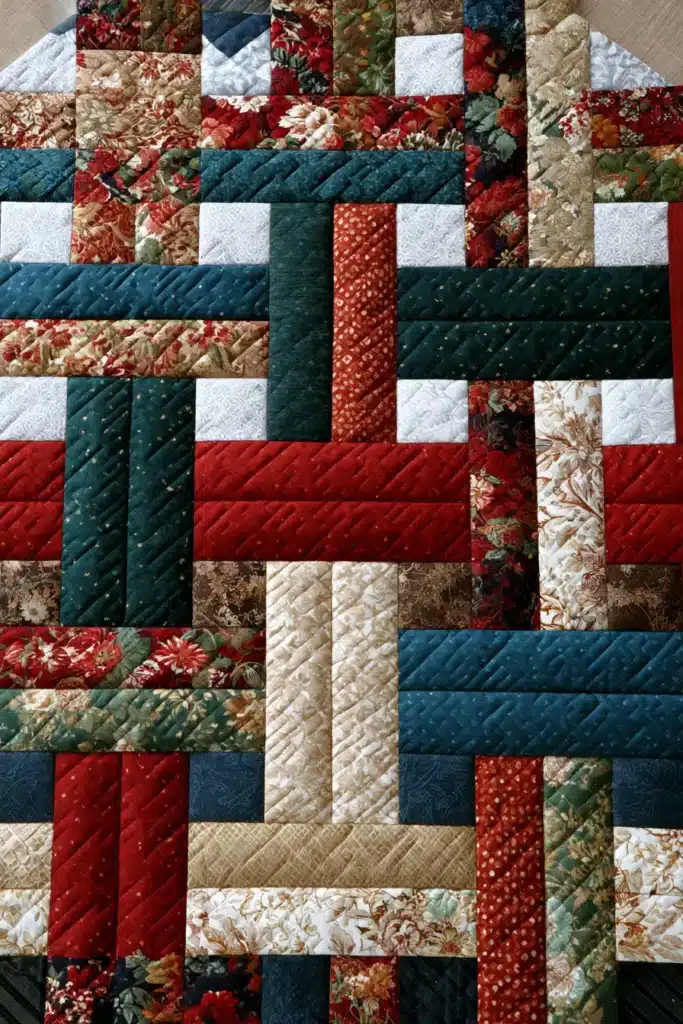
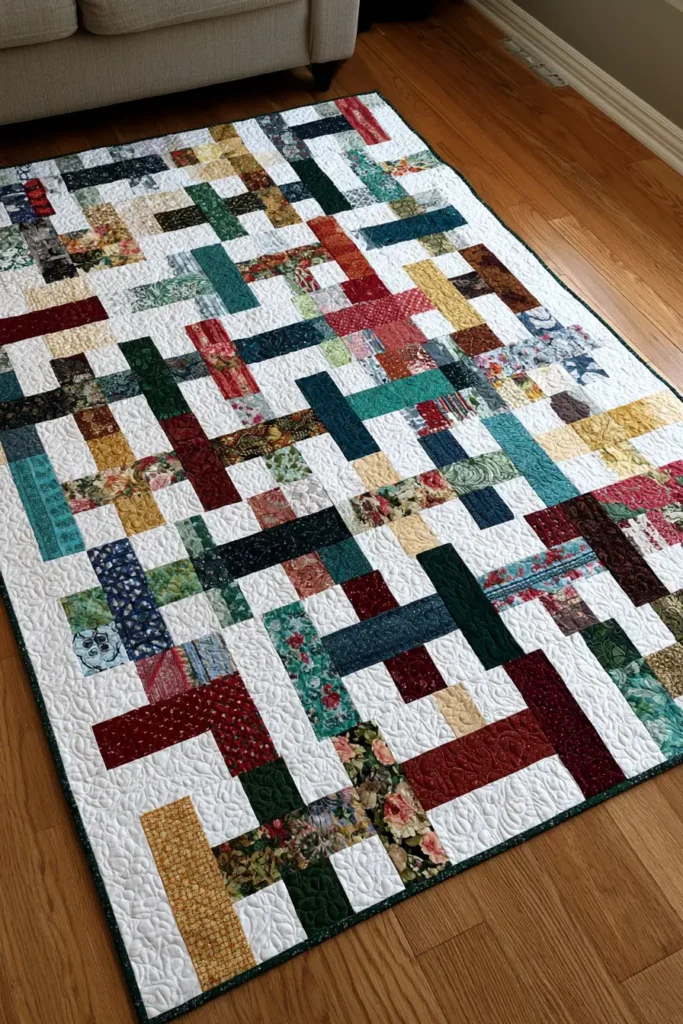
Rail Fence. The Rail Fence is perhaps the simplest block of all: three or four strips of fabric sewn side by side. Blocks are then alternated in horizontal and vertical orientations, creating the impression of a woven pattern. Rail Fence quilts are fast, beginner-friendly, and surprisingly effective. In a coordinated three-fabric combination, a Rail Fence quilt looks planned and orderly. In a scrappy arrangement of many fabrics within the same color family, it looks warm and accumulated.
Jelly Roll, Strip Quilts, and Simple Patchwork Favorites
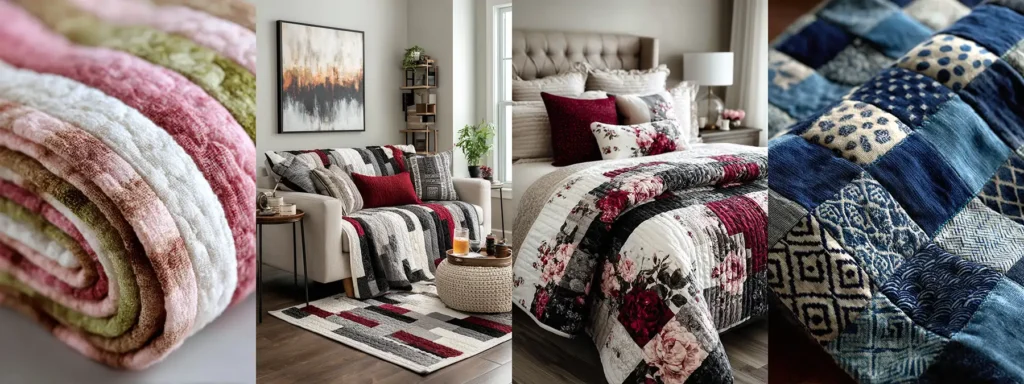
See also: Jelly Roll Quilt Pattern Ideas, Strip Quilts for Farmhouse Bedroom, and Japanese Patchwork Quilt Ideas
Not all classic quilts are built from named blocks. Some of the most enduring and satisfying quilt designs come from simpler organizing principles: strips, squares, and arranging fabric by color and value rather than by geometric structure.
Jelly Roll quilts and strip piecing. A Jelly Roll is a pre-cut bundle of fabric strips, each 2.5 inches wide and approximately 44 inches long, containing one strip from each fabric in a coordinated collection. Jelly Roll quilts are built by sewing these strips together in various arrangements — side by side to create a horizontally striped surface, in blocks that are then rotated, or in spiral and other configurations.
The appeal of the Jelly Roll quilt is partly practical: the cutting is done for you, and the fabrics are already coordinated. But Jelly Roll quilts also have a genuine visual appeal. The strips create horizontal movement and a sense of rhythm that works well on beds and as living room throws.
Rail-style arrangements and woven layouts. When Jelly Roll strips are sewn into three-strip units, and those units are alternated horizontally and vertically, the surface develops a woven or basketweave quality. This arrangement is more structured than a simple striped layout and more interesting up close, where the over-under visual of the woven pattern can be appreciated.
Why Jelly Roll patterns work for coordinated fabrics. One of the challenges in making a classic quilt is fabric selection — choosing a group of fabrics that work together across the entire surface of the quilt without clashing or becoming monotonous. The Jelly Roll solves this problem by offering a pre-selected, professionally coordinated set of fabrics. The maker’s job is to arrange the strips in an order that pleases the eye, which is a much simpler creative task than selecting fabrics from scratch.
Simple square patchwork and checkerboard quilts. At their most elemental, patchwork quilts are made from squares. A checkerboard quilt in two fabrics — alternating dark and light squares across the entire surface — is one of the oldest and most satisfying quilt designs in existence. It has no blocks per se, no directional movement, no complex geometry. It is just alternating squares across a surface. The result is a quilt that feels like a resolution — clean, orderly, complete.
Scrap quilts and memory quilts. Scrap quilts are built from whatever fabric is available, within some organizing principle — often a consistent block structure, sometimes just a consistent color range. The visual richness of a scrap quilt comes from the variations within the structure: the slight differences between fabrics that are all “blue,” or all “floral,” or all “vintage.” Memory quilts take this further by using fabric with specific personal significance — old shirts, worn dresses, children’s outgrown clothing — to create a textile that is also an archive.
How to Use Classic Quilt Patterns in Bedrooms, Living Rooms, and Dining Spaces
Classic quilt patterns are versatile, but they work best when used with some thought given to the specific context they are entering.
In bedrooms. The bedroom is the natural home of the quilt, and classic patterns suit it particularly well. A Log Cabin quilt in a Barn Raising arrangement becomes the organizing element of an entire bedroom — hang it on the wall above the bed, or lay it as the main covering on a simple white linen bed. An Irish Chain quilt in soft neutrals makes a beautifully calm coverlet for a guest room. A Star quilt in bold contrast becomes a room’s focal point without requiring any other strong pattern in the space. Layer classic quilts with simple linen sheets and a neutral throw at the foot of the bed — the quilt does the visual work; everything else supports it.
In living rooms. A quilt draped over the arm of a sofa or folded across the back of a chair is one of the most effective ways to bring textile warmth into a living room without redecorating.
A Log Cabin quilt in warm earth tones, or a Jelly Roll quilt in the room’s existing color palette, adds both pattern and comfort to a seating area. Smaller classic quilts — a Nine Patch in two fabrics, or a Flying Geese in high contrast — work as wall hangings that bring the warmth of textile art into a room without the formality of framed artwork. Patchwork pillow covers in classic blocks pull the quilt’s pattern vocabulary into the seating area without requiring a full quilt-sized textile.
In dining rooms and on tables. The dining room is an underused space for classic quilts. An Irish Chain table runner in cotton — easy to wash, visually clean — transforms a dining table for everyday meals and for gatherings alike. Log Cabin runners in warm autumn fabrics suit seasonal tables. Star placemats in coordinated fabrics bring a small dose of classic pattern to place settings. For a special occasion, a simple patchwork table cover in linen and cream creates a backdrop that makes everything placed on it look considered.
The layering principle. Across all these spaces, the most useful principle is restraint. One classic quilt as the dominant textile in a space, supported by plain materials — natural linen, simple cotton, unfinished wood, white walls — allows the quilt to be fully seen. Multiple competing patterns reduce all of them. The classic quilt is generous: it gives the room its warmth and visual interest. The room’s job is to receive it without argument.
Choosing Colors for Classic Quilt Patterns
The same block in different colors is a different quilt. Color is where the maker’s personality enters the classic pattern, where the quilt becomes personal rather than generic.
Soft neutrals for elegant bedrooms. Cream, warm white, soft gray, pale linen, and dusty sage work beautifully in classic blocks for bedrooms. These palettes create quilts that feel quiet and refined — the pattern reads through the color rather than competing with it. A Nine Patch in five shades of cream and gray, or an Irish Chain in soft white and natural linen, brings texture without loudness.
Red, cream, and navy for traditional homes. The red-and-white and navy-and-cream color stories are among the most enduring in the classic quilt tradition. Both have a crispness and clarity that suits formal and traditional interiors — dining rooms with dark wood furniture, bedrooms with iron bedsteads, sitting rooms with wing chairs and bookshelves. The contrast is high enough that the pattern reads immediately, and the palette is contained enough that the quilt looks composed rather than busy.
Black and white for crisp modern contrast. A classic black-and-white block is a different object from the same block in traditional fabrics. The geometry sharpens, the pattern becomes more graphic, and the quilt reads more like a design object than a traditional textile. Flying Geese in black and white has an almost architectural quality. A Nine Patch in black and white is bold in a way that soft-colored versions never are. These high-contrast versions of classic blocks work particularly well in contemporary rooms where other textiles are plain.
Pastels for nurseries and guest rooms. Soft pinks, pale yellows, mint greens, and sky blues in classic block arrangements make quilts that feel gentle and welcoming without being saccharine. A Log Cabin in soft pastels with a white center reads as a slightly formal baby quilt. A Nine Patch in mixed pastels reads as cheerful without effort. These palettes work best in rooms that are meant to feel easy and comfortable rather than dramatic.
Scrappy colors for cozy handmade charm. A scrappy quilt — one made from many different fabrics in no fixed arrangement — has a warmth that precisely coordinated quilts cannot replicate. The visual complexity of many different fabrics, each slightly different from the others, creates a surface that rewards looking. In a bedroom or living room where other elements are simple and plain, a scrappy classic-block quilt becomes the room’s personality.
Low-contrast versus high-contrast layouts. The same block can be quiet or bold depending on the contrast between the fabrics used. Low contrast — fabrics that are similar in value, differing mainly in texture or subtle color — creates quilts that read as unified and calm. High contrast — dark fabrics against light, saturated colors against neutrals — creates quilts that read as graphic and active. Neither is better. The choice depends on the room and the intended effect.
Classic Quilt Patterns for Beginners
If you are new to quilting and want to start with a classic pattern, the field narrows quickly. Not every classic block is appropriate as a first project — triangles require more precision than squares, and some classic blocks involve techniques that need to be learned in sequence. Here is an honest guide to where to start.
Nine Patch as the easiest starting point. The Nine Patch involves only straight seams and square cutting. If you can cut a square accurately and sew a straight seam, you can make a Nine-Patch block. A full quilt in this pattern is achievable in a weekend with focused effort. Start here.
Rail Fence and strip quilts. Strip quilts — including the Rail Fence and Jelly Roll arrangements — are the other beginner-friendly option. Strips are cut rather than squares, and the construction is even more linear than the Nine Patch. The visual result is less classic in the traditional sense but still handsome, and the construction speed is encouraging for a first project.
Simple patchwork squares. A quilt made entirely of squares in two or more fabrics — a checkerboard, a simple brick arrangement, or a randomly distributed scrap layout — is an excellent first project. It builds cutting and sewing skills without introducing any new techniques. The result is never boring because the fabrics always make it specific.
Jelly Roll strip quilts. Jelly Roll quilts solve the fabric-selection problem for beginners and require only straight seam sewing. The strips are already cut to a consistent width, and the bundle’s coordinated nature means the color choices are set. This allows the beginning quilter to focus entirely on construction.
Log Cabin as the next step. After mastering straight seams and square cutting, the Log Cabin is the natural next project. It introduces strip piecing and the concept of building outward from a center, but it does not require triangles. The construction sequence is very clear — strip, press, rotate, add the next strip — and the result is a block with real visual sophistication.
Star blocks after learning triangles. The Ohio Star is a good introduction to triangle piecing. The half-square triangles used in its construction teach the fundamental skill of accurately making two-triangle squares, which then serve as the foundation for dozens of other blocks. Once you can make a consistent Ohio Star, you can make Pinwheels, Bear’s Paw, Flying Geese, and eventually the more complex star designs.
What to avoid as a first project. Curves (as in the Wedding Ring pattern) require a different set of skills than straight-line piecing and should wait until seaming is confident. Very small pieces — squares smaller than two inches — require greater cutting accuracy than beginners typically have. Complex eight-pointed stars (LeMoyne, Lone Star) involve Y-seams that are genuinely difficult. All of these are excellent projects for the quilter who has completed several straight-line quilts. None of them is an appropriate first project.
How to Make Classic Quilt Patterns Feel Fresh and Modern
Classic quilt blocks are old, but they do not have to look antique. Several straightforward choices can update a classic pattern for a contemporary interior without changing the fundamental block structure.
Larger blocks. Traditional quilts were often made with small blocks — four-inch Nine Patches, six-inch Log Cabins — because small blocks allowed for fine detail and showed off hand-quilting skill. In a contemporary room, larger blocks read as more modern. A twelve-inch Nine Patch, a sixteen-inch Log Cabin, a twenty-inch Ohio Star — these larger versions of classic blocks have a bold, graphic quality that suits rooms with clean lines and minimal ornament.
Fewer colors. A classic block in two colors — and only two — reads as a design decision rather than a tradition. A Nine Patch in white and one strong color, a Log Cabin in two shades of the same hue, a Flying Geese in black and linen — these restrained palettes make the geometry of the block the entire point, which is a contemporary sensibility even when applied to a centuries-old block.
More negative space. Traditional quilt layouts fill every inch of the surface with pattern. Modern quilts often leave substantial areas of plain fabric — a single central star surrounded by a vast expanse of white, a row of Flying Geese at one edge of the quilt with the rest left plain. This use of negative space is borrowed directly from contemporary graphic design and gives classic blocks a different kind of visual weight.
Two-color palettes. As mentioned above, two-color quilts read as precise and intentional. The classic two-color quilt combinations — red and white, blue and white, black and white, navy and cream — all have historical precedent but look freshly modern when made with clean fabric and well-pressed seams.
Simplified Log Cabin layouts. A Log Cabin made from solid fabrics rather than prints has a very different character from the traditional printed-fabric version. In solids, the light-and-dark structure becomes the entire content of the quilt — there is nothing else to look at. This directness is a modern quality, making the Log Cabin feel less like a heritage object and more like a contemporary design piece.
Modern farmhouse styling. The modern farmhouse interior — white walls, shiplap, natural wood, simple hardware — creates a context in which classic quilt blocks feel exactly right without looking old-fashioned. A Churn Dash in gray and cream, a Log Cabin in warm white and natural linen, or an Irish Chain in soft blue and white suits this aesthetic perfectly. The quilts look deliberate in this context rather than inherited.
Frequently Asked Questions
What is the easiest classic quilt pattern for beginners? The Nine Patch is the standard starting point, and for good reason. It involves only straight cuts and straight seams; the block is forgiving of minor inaccuracies, and the visual result is genuinely satisfying. Strip quilts and simple patchwork squares are equally accessible and slightly faster to construct.
What is the most timeless quilt block? Difficult to say definitively, but the Log Cabin and the Nine Patch are the two blocks most consistently in use across the longest period of quilt history. Both appear in quilts made in the nineteenth century and in quilts being made today. If forced to choose one, the Log Cabin — with its strong organizing logic and its range of possible layouts — may edge ahead.
Are Log Cabin quilts good for modern homes? Yes, particularly when made in solid fabrics rather than traditional prints, and when the palette is restrained. A Log Cabin in two or three solid colors — especially in a Barn Raising or Straight Furrows layout — has a graphic boldness that suits contemporary interiors very well.
What colors work best for classic quilt patterns? The answer depends on the room and the effect you want. For elegant bedrooms, soft neutrals — cream, warm white, soft gray, pale linen. For traditional rooms, red and cream or navy and cream. For contemporary rooms, black-and-white or a strong single color against white. For cozy, handmade warmth, scrappy arrangements within a consistent color family.
What classic quilt pattern is best for a bedroom? For a large bed, the Star quilt — particularly in a bold two-color version — makes the most striking statement. For a softer, calmer bedroom, the Irish Chain in neutral tones is hard to improve on. For a cozy, layered look, the Log Cabin works beautifully in warm earth tones or soft pastels.
Can classic quilt patterns be used for pillows, runners, and wall decor? Absolutely. In fact, smaller applications of classic blocks can be more effective than full quilts in rooms where a large textile would overwhelm the space. A single Ohio Star block makes a handsome pillow cover. An Irish Chain in two fabrics makes an excellent table runner. A high-contrast Flying Geese strip makes a bold wall hanging for a hallway or stairwell.
Conclusion
The classic quilt patterns in this article have been used continuously for generations because they are genuinely good designs. They are clearly organized, adapt to different color palettes and rooms, scale up or down without losing their character, and reward both the maker and the viewer with a sense of visual satisfaction that does not wear off over time.
These are the blocks that make a home feel warm, familiar, and beautifully handmade. Not because they are fashionable — they predate fashion in any modern sense — but because they solve the problem of how to make a useful textile that is also beautiful, and they do it in a way that continues to feel right.
Start with the Nine Patch if you are beginning. Return to the Log Cabin when you are ready for more. Hang a Star quilt on the wall when you want the room to have a center. And whenever you need a quilt that will look right in ten years as surely as it looks right today, reach for a classic block. It will not disappoint you.